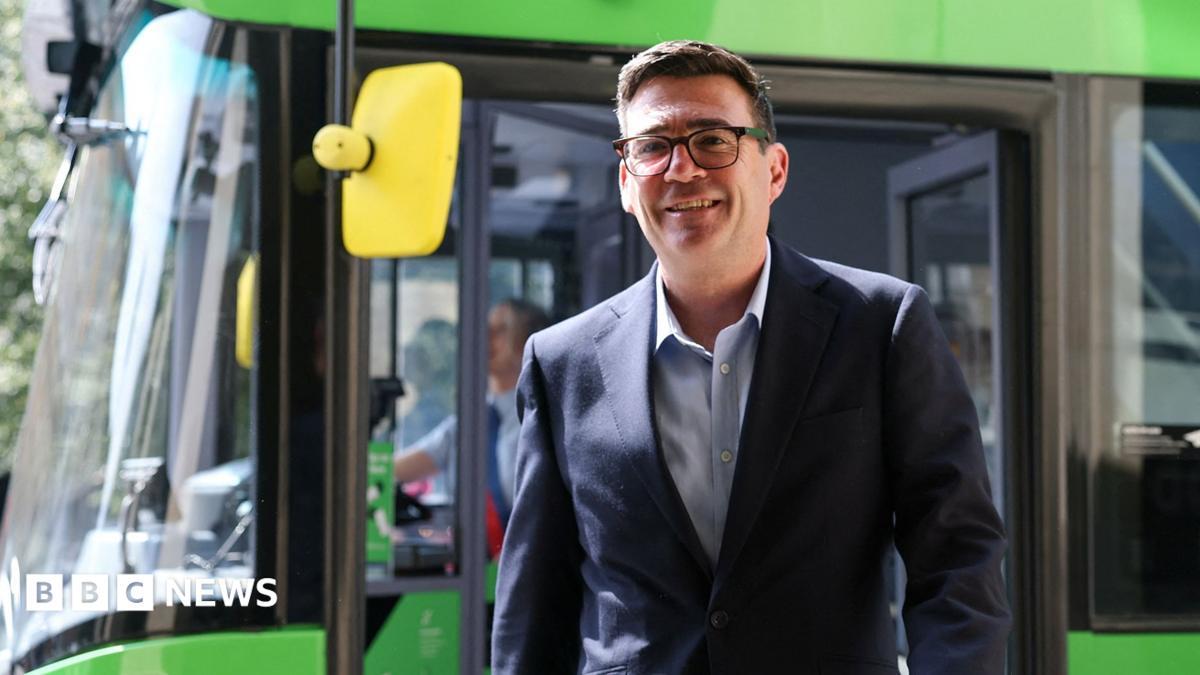
England's £2 single bus fare cap will be paid for by "re-prioritising" government funds, Andy Burnham says
Earlier, the prime minister announced fares would be capped from January and throughout 2027 in all areas outside London – the capital has its own £1.75 limit
There will also be extra funding for Scotland, Wales, and Northern Ireland – though they're not obliged to introduce the same policy
The bus fare cap is expected to cost more than £500m, with funds largely coming from reallocated Department for Energy Security and Net Zero money
On a visit to Bath – where he met the "Bus Aunty" – Burnham also says there is "no commitment" to increasing the tax-free personal allowance
I wish I had waited for the £2 cap, jokes one man who travelled from Land's End to John O'Groats when the cap was £3
Edited by Imogen James and Alex Smith Malu Cursino
Live reporter
In his second full day in office, Prime Minister Andy Burnham announced that a £2 cap on bus fares in England will be reinstated from January and be in effect throughout 2027.
For some, like in Manchester and Liverpool, they are already operating a £2 cap scheme, and while there will be extra funding for the devolved nations, there is no obligation for them to introduce the policy.
While welcoming the policy to support families with the cost of living, opposition politicians criticise the funding, length of the scheme, and say it does not go far enough.
This video can not be played
This phase of government is about 're-prioritising', says PM
The government this morning insisted the scheme is paid for. They said it will cost more than £500m, £400m of which comes from replacing grants for international climate projects with loans.
Burnham later told journalists that the fare is "fully funded" by "re-prioritising" the government's budget.
This drew criticism from ActionAid UK, who warned against diverting money away from these overseas initiatives as it risks "penalising those most impacted by a climate crisis they did not create".
Throughout the day several people shared with the BBC how the change would affect their pockets. While many people voiced relief, a few expressed frustration – more on that in our previous post.
We're now wrapping up our coverage but our transport correspondent, Katy Austin, has the latest on this story.  Tara Mewawalla
Live reporter
Throughout the day we've been hearing your thoughts on Andy Burnham's pledge to cap most single bus fares at £2 in England from January.
Responses have been mixed – Sarah Bodger, who owns a wool shop in Royal Leamington Spa, says the cost of her two-hour bus journey to and from work is "crippling", and the cap will save her over £500 a year.
Whereas Seb Pelisse, who lives in Chertsey in Surrey but works in London, told the BBC it is "a little delusional to think this will help most people". He wants the government to reduce the cost of train fares because his commute is "horrendously expensive".
Similarly, Mark Tait who lives near Durham, says commuting via bus is "not always possible" because he works 13 miles away from home and he would prefer a cut on fuel duty.
However, Maisie in Coventry told BBC's 5 Live the cap will encourage "young people to go outside and make friends… have fun". The policy would have saved her £3 on each morning bus journey to college.
And Susannah in Glastonbury is "delighted" to hear Burnham is going to "apply himself to buses", adding she says she wants him to go even further and be "more ambitious", building a "reliable, frequent, swift" bus system. Peter Gillibrand
BBC Newsbeat
Coffee shop worker Izzy Marsden tells BBC Newsbeat, as a regular bus user, she welcomes prices being capped at £2.
The 19-year-old takes the bus at least six times a week, so she’s set to save £24 each month from January – the price of a single is £3 in Cheltenham.
"A pound can go a long way sometimes," she says.
Izzy hopes the price drop encourages more people to take the bus, but also questions whether it's the right priority for the new government.
"I don't think that focusing specifically on buses is the way forward," she says. “They should be focusing a lot more on living costs, specifically housing".
While the £2 cap for England is due to come into effect in January, there are other schemes that will be in place much sooner for children in the summer holidays.
Under-16s in England will get free bus journeys in August as part of former chancellor Rachel Reeves' scheme to aimed at reducing the cost of activities for families during the break.
A similar scheme began in the West of England last year, which allows under-16s to travel on buses for free in the summer holidays.
The West of England scheme runs from 18 July until Sunday 6 September, and will continue for the next three years.
It is funded by the West of England Mayoral Combined Authority and was introduced in 2025. About 1.4 million free journeys took place in its first trial year.
In London, a scheme will run from 25 July to the end of August, meaning anyone travelling on buses and trams on the weekend can make unlimited journeys for the price of a single fare, at £1.75.
Adam Clarkson
BBC Your Voice
Katerina Bowes and her husband used to take buses everyday for their commutes to work and to take their child to nursery, but as prices increased in Plymouth in 2025 the option became unaffordable for them.
The Plymouth couple ended up learning to drive and purchasing a car to save money.
"It took my husband a long time to learn as it’s very difficult to find an instructor and a test slot, but in May 2026, he passed his test. Now we almost never use buses anymore."
The 29-year-old says that even if bus prices go back down their switch to driving is "irreversible". Bowes says they've "already adopted a new lifestyle" and invested a lot of money on making the move from public transport to having their own car.
"The cap is not likely to help us. It just maybe makes us feel bitter". Jack Grey
Live reporter
James White says it's possible to travel the length of the UK by local busses, but he probably doesn't recommend it
For James White, who travelled the length of the UK by bus in 2025 to raise money for charity, his response to Andy Burnham’s proposed £2 fare cap is: "I wish I’d waited 15 months."
Thanks to the £3 fare cap in place in England at the time, James' seven-day, 46-bus, journey cost him £206 in April of last year.
However, under the new proposed cap, he says it would have cost him £33 less, or £115 cheaper if that cap was extended to Scotland – which had substantially higher fares.
"Anything that encourages public transport use is to be applauded," adds James, from Richmond in south-west London.
James' trip raised about £5,000 for suicide prevention charity Campaign Against Living Miserably
James says the highlight of his week-long journey was the "incredible" Scottish and Cornish scenery and the “limousine”-like 36 bus from Leeds to Ripon, which he calls "unmatched".
"End of the day, it is possible to travel from Land’s End to John O’Groats by bus. Would I recommend it? Not necessarily," he says.
And will he now look to repeat his odyssey to celebrate the even lower fare cap?
"Absolutely not."
Iona Young
BBC Scotland
Scotland could also see a cap of £2 bus fares rolled out across every part of the country – a policy pledged by First Minister John Swinney during the Scottish election campaign earlier this year.
Currently in Scotland free bus travel is available to anyone under 22, those 60 and over, and eligible disabled individuals.
Earlier this year, a pilot £2 cap on bus fares was launched in Shetland from 30 January, shortly followed by the Western Isles and Orkney. The year-long scheme was then rolled out across all of the Highlands and Islands at the end of March.
The year-long trial aims to make bus travel more affordable and encourage greater use of public transport.
Stephen Flynn, the cabinet secretary for economy, tourism and transport, confirmed in June that work is now under way to expand the area included in the pilot.
“Making public transport more affordable is one of the ways this government is determined to support people," he said at the time.
The UK government said this morning the funds allocated for the bus fare cap included money for devolved governments. It's not clear how that money will be spent – the Scottish Parliament is on recess until 30 August.
Adrian Browne
BBC Wales political reporter
Earlier we reported government funds allocated for the bus fare cap included money for devolved governments.
We estimate the Plaid Cymru-led Welsh government could receive up to around £25m in extra funding, although we'll get clarification later on the actual figure.
How that money is spent would be a matter for ministers in Cardiff.
Welsh Labour leader Ken Skates has urged the Welsh government to introduce the same £2 fare cap in Wales, a policy Labour pledged at the Senedd election in May before losing power to Plaid Cymru.
Reform, the largest opposition party in the Welsh Parliament, is also calling for the £2 cap in Wales.
Wales already has a different approach to bus subsidies, with discounted fares focused on younger passengers rather than a universal cap.
Plaid Cymru's election manifesto promised to continue funding £1 single bus fares and £3 day tickets for children and young people aged five to 21, while retaining free bus travel for over-60s.
Bernadette McCague and Rozina Sini
BBC Your Voice
Seb Pelisse says its "delusional" to think the fare cap will help most people
Seb Pelisse lives in Chertsey in Surrey but works in London, and is asking the government to reduce the cost of train fares first because his commute is "horrendously expensive".
Additionally, the 33-year-old says if he needs to get around his area he will use his car for convenience, instead of waiting "for a bus once an hour or every half hour".
"It's a great measure for anyone not driving, a little delusional to think this will help most people," he adds.
Meanwhile, Charlie, 24, lives on the outskirts of Bristol and finds that getting the bus into the city centre is the best way to travel.
"Capping the bus fare may not massively change the cost for each journey but, considering I use it both ways, will probably mean I’ll be more likely to travel to the centre of the weekend," he says.
"It was always going to be the small things that improve quality of life”.
A concern raised by some NGOs following news of the bus fare cap is the diversion of funding away from projects aimed at supporting countries with the impacts of climate change.
As we explained earlier, part of the government funding for the new bus cap will re-direct £400m it planned to give to developing countries to tackle climate change.
ActionAid UK's Joanne O'Neill says the PM's scheme is a "welcome initiative but his funding proposal throws global south countries under the bus, penalising those most impacted by a climate crisis they did not create".
O'Neill goes on to call on the government to "commit to delivering international climate finance through grants, not loans, with funds raised through progressive taxes on polluting companies, and the banks which finance them".
We've been hearing from the new Defence Secretary Wes Streeting today, during his first speech since taking up the post on Monday.
Speaking from Farnborough Airshow, Streeting has called for the modernisation of UK defence.
"Investment is only one side of the coin," he said, adding: "Modernisation without investment, but investment without modernisation is irresponsible."
Warning that "delay and inaction" pose a threat in modern warfare, Streeting also stressed his department would "be a central contributor" to economic growth.
Pressed by reporters later on whether he would commit to raising defence spending to 3% of GDP by 2030, he replied fiscal policy is "a matter for the chancellor".
He added that he and the chancellor both "understand defence" and its "immediate pressures and priorities".
We're now turning our coverage back to bus fares – you can get up to speed on the changes in our earlier post.
PC Harper's mother said it feels like an “insult” that two of her son’s killers may be eligible for early release
Away from the single bus fare cap, Prime Minister Andy Burnham says he will "review" the policy which means two people jailed over the death of a police officer could be released early from prison.
PC Andrew Harper, 28, was killed in 2019 when he was dragged by a car down a country road as three teenagers fled the scene of a quad bike theft in Berkshire.
Jessie Cole and Albert Bowers, who were passengers in the vehicle and both 17 at the time, were sentenced to 13 years in custody for manslaughter but might be eligible for early release under the new Sentencing Act. The car's driver, Henry Long, was jailed for 16 years for manslaughter and would not be eligible for early release.
From September, thousands of offenders in England and Wales will be eligible to be released earlier under the act.
Speaking to reporters in Bath this morning, Burnham said: “All I can say is I will review the whole of this policy.
“But I want to assure myself that everything has been looked at before this policy proceeds, and I can give that assurance that every single part of this I will look into with the Justice Secretary."
Nick Timothy MP, shadow justice secretary, said the scheme has been "catastrophic" and said Labour needs to back the Tory bill "to exclude rapists, paedophiles, and other serious criminals".  Joe Coughlan
Live reporter
Andy Burnham has said his scheme to cap most bus fares in England at £2 from January next year will be paid for by "re-prioritising" government funds.
The government announced the policy this morning, funded by more than £500m, and said it will last throughout 2027. It won't apply in London, where there's a cap of £1.75, and matches caps in place already in Manchester and Liverpool.
Accused of "bringing back" a similar Conservative policy introduced by Boris Johnson in 2023, the prime minister said it was "actually my policy originally" and that all of his schemes so far are "fully funded".
This includes today's announcement on bus caps, the cut to VAT on electricity bills for six months from October and his pledge to end rough sleeping – measures which Chancellor John Healey said show how the government will "advance working people across the country".
Opposition parties have criticised the funding and scale of the bus scheme overall, with shadow chancellor Mel Stride saying it's not clear where the funding is coming from.
We've also been hearing from you about what effect the cap may have – Susannah in Glastonbury is "delighted" by the initiative but calls on Burnham to be "more ambitious".
As a reminder, you can get in touch with us to tell us how the cap affects you.
In the next few posts, we'll be going over some other political news from today away from the bus cap, stick with us.
Bernadette McCague
BBC Your Voice
Sarah Bodger, who owns a wool shop in Royal Leamington Spa, says her travel journey to work involves a two hour bus journey each way, costing almost £58 per week.
“The bus fare cap will help keep a lot," she says. "I own a very small shop and the cost of bus travel is crippling."
She says it costs her over £3,000 a year to get to work, adding "the cap will save me over £500 a year". Georgina Rannard
Climate and science reporter
One way the government will pay for this new bus cap is by re-directing £400m it planned to give to developing countries to tackle climate change – projects like building wind farms or protecting rainforests.
Instead of giving this money as grants, it will now been given as loans, according to the government.
Developing nations often criticise loans. The repayments can be larger than the original loan, worsening countries’ already staggering debt. And it is likely to make delivering these climate projects less effective.
But what about the UK’s responsibilities to tackle climate change at home?
Transport is the biggest single climate polluter in Britain, and progress in reducing those emissions has stalled.
In 2025, 31% of net greenhouse gas emissions in the UK were from domestic transport, mostly from driving petrol and diesel vehicles, according to provisional government figures.
Last year emissions actually went up 2%, due to more driving, making it the only sector to see an increase.
By Tom Edgington
The government says its £2 bus fare cap policy will cost more than £500m which ministers insist will be paid for by re-prioritising existing budgets rather than increasing overall spending or borrowing.
The funding breaks down as follows:
Most of the money will come from replacing international climate grants with loans and because the Treasury expects the loans to be repaid, replacing the grants reduces the cost to the public finances.
However, Max Warner from think tank the Institute for Fiscal Studies says there are still uncertainties.
“It's not clear how much we would expect to be paid back nor what the interest rates will be. Both matter for how much the government will ultimately save from this switch to loans,” he says.
He adds it is also unclear whether reducing spending on overseas climate projects could require the government to increase spending elsewhere to still meet its overseas aid target, potentially reducing the overall savings.
Transport Secretary Heidi Alexander told Sky News earlier that the details for replacing overseas climate grants with loans “needs to be worked through”.
During Prime Minister Andy Burnham's visit to Bath today, he was photographed with a certain TikTok star you might recognise.
Bemi Orojuogun has amassed almost half a million followers with her quirky adoration of London's bus network.
Nicknamed 'Bus Aunty', her videos show Orojuogun staring into the camera as busses whizz close by, set to a catchy song.
"It was just a normal day," she told the BBC last year. "I took a quick video, posted it on TikTok, didn't think much about it, until my daughter called and said, "Mummy, you're going viral!" I was like, what?"
One of her videos has more than 50 million views, winning Video of the Year at the TikTok UK & Ireland Awards in 2025.
She's also collaborated with the Mayor of London, TfL, Ikea, and Burberry.
Bemi, who works as a mental health nurse, says she hopes her videos also spotlight the hard work of bus drivers.
This video can not be played
Watch: Meet TikTok’s ‘Bus Aunty’ who celebrates London’s buses
As we've been reporting, Prime Minister Andy Burnham's government began his second full day in power by announcing a £2 bus fare cap for everyone in England from January.
Here's how opposition leaders and other political parties have reacted: Kaleigh Watterson
BBC Cheshire political reporter
Steve Rotheram, the mayor of the Liverpool City Region, says the bus fare cap will mean the city can keep its current cap for longer.
Bus fares are currently capped at £2 in the Liverpool City Region, and last week the area’s combined authority said the £2 fare would “remain in place for now”.
“We will continue that much longer now than we were able to do, because I was wrestling on having to put them up at one stage myself, because we haven’t got an infinite pot,” he told BBC Radio Merseyside's Hot Seat.
Rotheram – who is friends with Burnham – said that the change would help with the cost of living.
He also said he knew Andy Burnham was going to introduce a £2 fare cap before this morning’s announcement.
When asked if he knew beforehand, he said he did as he had spoken to Burnham about his plans when he became PM.
By Phil Leake
Local bus use in England increased the last time a £2 fare cap was in place, but remained below pre-pandemic levels, according to data from the Department for Transport.
The £2 cap was first introduced by the Conservative government in January 2023 and applied to single fares in England outside London. Keir Starmer's Labour government increased the cap to £3 in January 2025.
Passengers made just under 1.9 billion local bus journeys in England outside London in the year to March 2025 – up from 1.6 billion in the year to March 2023.
However, that was lower than the two billion journeys recorded in the year to March 2020, before the Covid pandemic.
A government-commissioned evaluation of the scheme's first 10 months found the £2 cap increased bus use by around 5% compared with the previous year.
Overall bus use rose by 13% over the same period, which the report attributed to a wider post-pandemic recovery and the impact of other local transport investments.
This Flourish post cannot be displayed in your browser. Please enable Javascript or try a different browser.
This Flourish post cannot be displayed in your browser. Please enable Javascript or try a different browser.
Copyright © 2026 BBC. The BBC is not responsible for the content of external sites. Read about our approach to external linking.
About the Author