Two crew have died after two firefighting helicopters collided in Greece
A British pilot and a Greek crew member survived the crash, and have been taken to hospital for treatment
Greek PM, Kyriakos Mitsotakis has shared condolences and his "deepest sorrow" following the incident
The two people killed were a Danish pilot and a Greek fire service liaison officer
The collision happened in Psatha, a coastal area west of Athens, on Sunday
Greece is one of several European countries suffering wildfires – high winds are likely to be behind the fires' "rapid growth" says our weather presenter
Earlier on Sunday, Mitsotakis had said that the country is facing extreme weather conditions and warned of "extremely difficult" days ahead
Edited by Jamie Whitehead
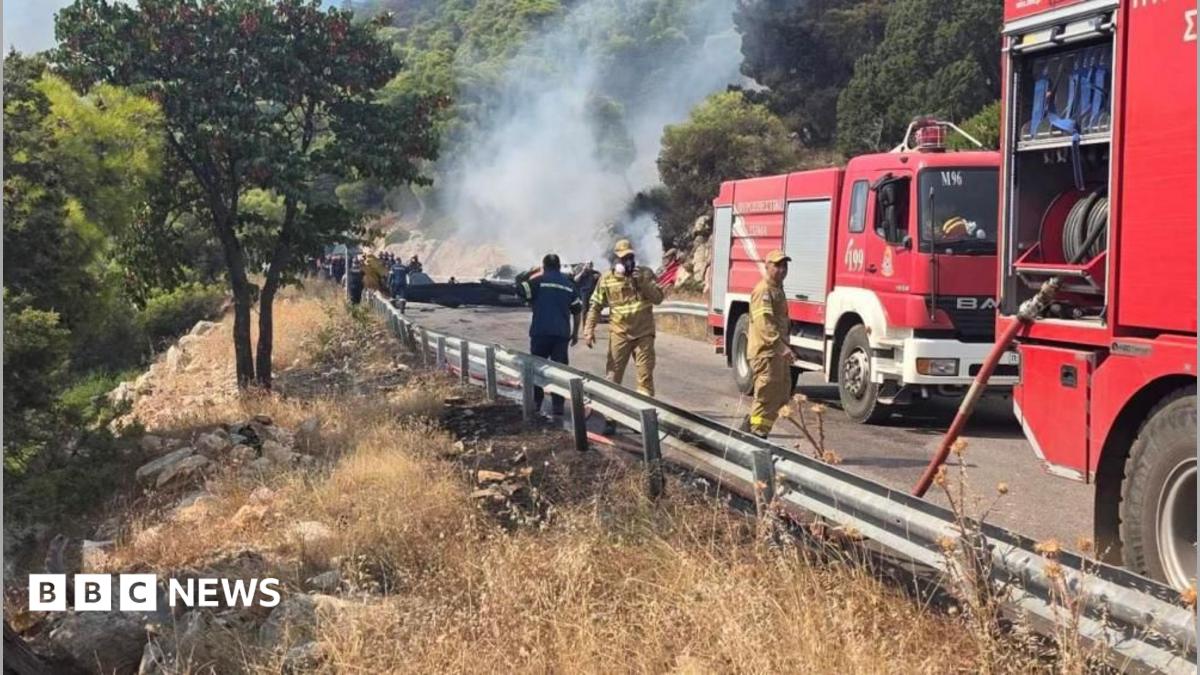
Images show firefighters working near the helicopter crash site in Attica earlier today.
The charred remains of one helicopter can be seen lying next to the road with smoke rising.
As we've been reporting, two helicopters – each with two crew – collided earlier today while fighting the fires. Two of the crew have died, while the two others are in hospital.
Greece’s chief fire officer Vasilios Vathrakoyannis has delivered a general update on the fires this evening.
He started by expressing his "sincere condolences" to the families of the two crew members who died when two firefighting helicopters collided.
Vathrakoyannis says forces are operating for a third day to tackle the large fire in the Attica-Boeotia area. Conditions have been "extremely difficult" with strong winds meaning aircraft were unable to operate at times.
Conditions improved shortly before noon, with an order given for eight aircraft and 20 helicopters to operate periodically, he says.
The cause of this helicopter crash remains unclear, and it is not known whether weather conditions contributed.
Fires have also affected other parts of the country, including areas such as Paros, Crete and Kefalonia.
Across Greece, 220 agro-forest fires have broken out since Monday 27 July, Vathrakoyannis says. Stav Danaos
BBC Weather
Unlike much of western and southwestern Europe, Greece has experienced a relatively average summer so far, with no significant or prolonged heatwaves and temperatures that are typical for a Greek summer.
Despite the absence of extreme temperatures, the current wildfires have been fuelled by a combination of dry vegetation and more especially, strong winds.
The most significant factor in the current fires' rapid growth has been the Meltemi – the dry, gusty northerly winds that commonly affect Greece during July and August.
In some of the affected areas, gusts have reached 80 – 100 km/h, (49-62mph) fanning flames, carrying burning embers far ahead of the main fire front and igniting new spot fires.
These powerful winds can also cause fires to change direction with little warning, making evacuations more challenging and limiting the ability of firefighters, particularly aircraft, to safely and effectively contain the blazes.
In contrast to Greece, much of western and southwestern Europe – including Spain, Portugal, France and parts of Italy – has experienced repeated episodes of extreme heat this summer, with temperatures exceeding 40°C, leaving vegetation exceptionally dry and highly susceptible to wildfire.
Looking ahead through the rest of this week, Greece is expected to remain hot but largely free of extreme heat, with the greatest wildfire threat continuing to come from persistent Meltemi winds interacting with dry vegetation.
Across southern Europe more broadly, above-average temperatures and predominantly dry conditions are forecast to persist, maintaining an elevated risk of fires to spread once ignited. Katie Williams
Live reporter
Two crew have died after two helicopters collided earlier today while fighting wildfires west of Athens.
Greece's Prime Minister Kyriakos Mitsotakis announced the deaths in a social media post a short while ago, describing the deceased as a Greek coordinator and a Danish pilot.
Two other crew were also involved in the collision but have survived – a British pilot and a Greek fire service liaison officer, according to authorities.
Mitsotakis has expressed his "deepest sorrow" over the incident.
The helicopters were fighting fires in the wider area of area of Psatha, Attica, when they collided. Two crew were onboard each one, the fire service said.
Fires have been burning across large parts of Greece this summer, with Greek meteorologist Theodore Giannaros telling the BBC earlier that more than 100,000 hectares of land have been burned.
Wildfires have been raging across large parts of Greece.
Dark red dots on the map show fires active in the last 24 hours, and are heavily concentrated around Psatha, west of Athens, where the largest cluster is visible.
Smaller active fire clusters also appear on the map near Patras on the Gulf of Corinth and on the island of Kefalonia.
Earlier this week, hundreds were evacuated in central Greece from a coastal town hemmed in by one of the many wildfires raging across the country. Around 500 people, mostly tourists, were left stranded after the fire broke out near Agios Vasileios in Viotia, local media reported.
Other affected areas have included Crete, Paros, Andros and Kalymnos.
In a statement this morning, Greek PM Kyriakos Mitsotakis said "extreme weather conditions and winds" had contributed to an "extremely difficult" situation.
This has meant it has not always been possible to carry out water drops due to "extreme turbulence", he said.
The two helicopters that crashed were working to tackle wildfires in Psatha, but blazes are affecting areas across Greece, including Kefalonia and Patras.
A local resident (left) tries to extinguish fire that has broken out at his house in the Megara region, west of Athens
He battles flames close to entering his home
Firefighters drive a fire truck as they attempt to extinguish a wildfire in the Veniza area, west of Athens
An excavator is used in the same area to try and tackle the flames
Footage captured of the two helicopters shows the moment before the pair collided, in a crash that caused the death of two crew.
As we've reported, a British pilot and Greek fire service liaison officer survived the collision.
Flames and smoke plumes following the crash have also been filmed in the footage below.
This video can not be played
Moment before helicopters collide while tackling Greece wildfires Nikos Papanikolaou
BBC News
A British pilot has survived after two firefighting helicopters collided while tackling a wildfire near Psatha, west of Athens, Greek authorities say.
The British pilot and a Greek fire service liaison officer from the second helicopter were rescued and taken to the 251 Air Force General Hospital in Athens for treatment.
The two people killed were a Danish pilot and a Greek fire service liaison officer.
According to the Greek Fire Service, the two leased Bell helicopters collided while taking part in efforts to tackle a large wildfire burning on the Attica-Boeotia border.
Four people were onboard the two aircraft in total – two Greek nationals and two foreign nationals. Two were rescued alive, while the other two were recovered unconscious and were pronounced dead.
We can now bring you more of Greek Prime Minister Kyriakos Mitsotakis' statement on the helicopter crash which caused the death of two people.
He expresses his "deepest sorrow" for the "tragic accident" in a post on X.
Mitsotakis said the loss of a Greek coordinator and Danish pilot while they were operating in the "major fire" at Porto Germeno "fills us all with grief", adding that he sends condolences to their families.
Two people have died in the crash between two helicopters in Greece, the country's prime minister has confirmed.
The fire service said earlier that the helicopters involved were fighting wildfires west of Athens, in the wider area of Psatha, Attica.
We'll bring you more from the prime minister in the next post.
Residents and tourists were evacuated from several villages in Crete earlier this week
Fires have burned across multiple areas of Greece already this summer, prompting thousands to be evacuated.
One of those areas is the island of Crete, where a fire broke out on Wednesday and spread rapidly, destroying homes and agricultural land.
Flames fanned by strong winds led to around 8,000 people being evacuated from their homes overnight – they were later allowed to return.
Two firefighters died on the island on Wednesday when they became trapped while tackling a fire near Krya Vrysi in the Rethymno region.
Wildfires in France and Spain forced mass evacuations last month, but situation in both countries now largely appears to have been brought under control.
In the Gironde region in France, the fire at one point came within kilometres of Bordeaux, but the region's prefect Sophie Brocas has since described the situation as "stable".
"The fire has been secured since yesterday morning," she said in a social media post on Saturday, though cautioned it was not yet extinguished.
A separate blaze flared up again in the Var region on Friday, but was described as being contained over most of its perimeter in an update today.
In Spain, the government lifted the state of emergency over the fires on Thursday.
A woman looks on as smoke rises from a wildfire in Madrid last month
A firefighter, pictured on 29 July, works to contain a major blaze in France's Gironde region
A firefighting helicopter drops water on the blaze in Var on Saturday
Meteorologist Theodore Giannaros tells the BBC News channel that the crews dealing with the fire in which the two helicopters crashed are "working under very, very difficult conditions".
"Since last Wednesday, my country is experiencing very bad fire weather," he says, adding that the fire has already burned more than 100,000 hectares of land in Greece.
"So conditions are very difficult, and both crews on the ground and through the air experience all this difficulty in containing this large event."
He also says climate change "sets the stage for larger and more intense wildfires due to the increased heatwaves, more dry vegetation and drought", but in the end, fire "also comes to human activity, either negligence or arson".
According to the fire service, the helicopters collided in the wider area of Psatha, Attica, a coastal area west of Athens.
Firefighters have been battling wildfires in the region, along with several other parts of the country.
A firefighter works to extinguish a wildfire near Formariz, Spain, on Wednesday
Greece is one of several European nations suffering devastating wildfires. A succession of heatwaves and little rain created favourable conditions for them in other parts of Europe.
Since mid-July wildfires have torn through France, Spain, and Portugal, forcing hundreds of thousands of people to evacuate their homes.
Officials in the Spanish capital Madrid have said the fires are the worst the region has ever experienced.
More than 200,000 hectares of land has burnt across the country in 2026, roughly five times above the average by this point in the year, EU data shows.
A wildfire that broke out in the Gironde region of France was last week described by French President Emmanuel Macron as "completely unprecedented".
The UK has also been battling wildfires, with a blaze that devastated heathland in Suffolk declared stable on Saturday.
You can get in touch in the following ways:
Please read our terms & conditions and privacy policy
In some cases, a selection of your comments and questions may be published, along with your name and location as provided, unless you request otherwise. Your contact details will never be published.
Workers use olive branches to extinguish flames during in the Megara valley
Volunteers try to extinguish a fire burning at a yard of a house in the settlement of Zachouli, in Attica
Firefighters battle an inferno near the village Agia Paraskevi
Earlier on Sunday, Greece's Prime Minister Kyriakos Mitsotakis said that the country is facing "extreme weather conditions" and warned of "extremely difficult" days ahead amid the ongoing wildfires.
He says winds have reached 100 kilometres (60 miles) an hour, which means "the dozens of aircraft we have at our disposal cannot operate safely".
"There are moments when nature and the intensity of weather phenomena surpass any human planning and any operational capability," he writes on Facebook.
Mitsotakis has also paid tribute to three firefighters who died tackling the wildfires across the country earlier in the week and praised continued efforts of fire crews, volunteers and military personnel.
Thousands of people have been evacuated as wildfires rage in multiple areas of Greece, including parts of the mainland and tourist destinations.
On the island of Crete, fires have burned thousands of hectares of land and prompted the temporary evacuation of 8,000 people.
About 500 people, mostly tourists, were also evacuated in central Greece on Friday.
Fires have also broken out on the islands of Paros, Andros and Kalymnos.
The collision occurred during firefighting efforts in Greece – here's what we do and don't know.
What we know
What we don't know
Copyright © 2026 BBC. The BBC is not responsible for the content of external sites. Read about our approach to external linking.
About the Author