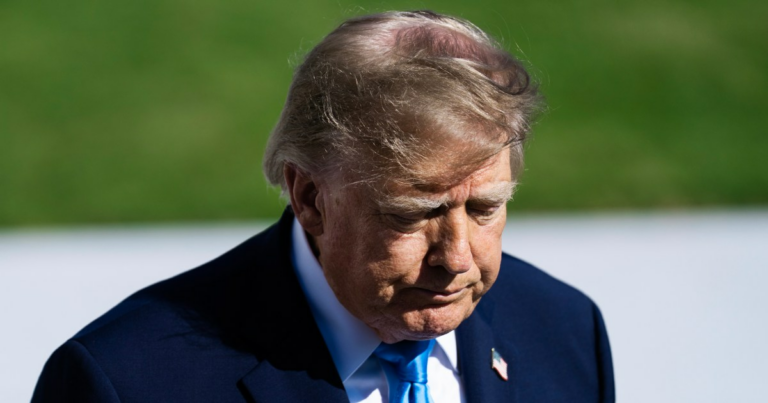
President Donald Trump is in Maryland to announce a $6.6 billion investment in a new submarine parts factory.
The super PACs aligned with House Republican and Democratic leadership are slashing ad spending reservations in Nebraska’s 2nd District, one of the hardest districts for Republicans to defend this fall.
Republicans had been hopeful that City Councilman Brinker Harding could have a chance to defeat Democratic activist Denise Powell in a seat that Republican Rep. Don Bacon has held over the years. But Bacon’s retirement gave Republicans a tall task in a seat former Vice President Kamala Harris won by almost 5 points in 2024, and both House Majority PAC and Congressional Leadership Fund have cut more than $1 million in spending there in the last day.
A top Trump administration official has told the Justice Department to adopt President Donald Trump’s rebranding of artificial intelligence, or AI, as “super intelligence,” or “SI,” four people familiar with the matter tell NBC News.
In a memo titled Super Intelligence sent to Justice Department employees Tuesday, acting Deputy Attorney General Trent McCotter referenced Trump’s Sept. 29 executive order that said the term “Super Intelligence” more appropriately captured “the promise, potential, and rapidly advancing capabilities” of AI technologies.
Read the full story here.
The FBI’s internal review of a hack of its jobs portal last month has so far determined that a “security failure” by a contractor managing the site caused the breach.
“To date, our review has determined that the incident occurred as the result of a security failure of a platform managed by a third-party organization — after a contractor failed to implement a security patch explicitly issued to secure the platform,” Cyber Division Assistant Director Brett Leatherman said in a statement Tuesday.
Read the full story here.
Maryland Governor Wes Moore is not attending President Trump’s announcement of a new ship manufacturing facility in Baltimore this afternoon, a project the administration pledges would create thousands of jobs and lead to billions in annual economic output.
According to a source familiar, Moore, a Democrat, was blocked from speaking at the announcement.
His spokesperson tells NBC News: “Governor Moore has always said he will work with anyone when it comes to delivering for Marylanders but bow to no one when it comes to standing up for them. The Governor is proud to welcome Anduril to Baltimore County and the thousands of permanent jobs this investment is bringing to our state.”
A White House official claims Moore “was not slated to speak” at the event but was invited to attend.
They added: “President Trump is willing to work with anyone to revitalize our manufacturing sector, which is why the White House graciously invited Governor Moore to attend today’s event as a guest. It’s unfortunate that the Governor is now making a multi-billion dollar announcement about himself by throwing a tantrum over a federal initiative that will bring sorely needed jobs back to his state thanks to President Trump.”
In downtown San Antonio’s historic Market Square, Arturo Flores paces in front of his shop’s handmade horse saddles and leather belts, waiting for customers who aren’t coming.
“The people is not coming. You see, the market is empty,” said Flores, whose first language is Spanish. “Another time, at this time, is a lot of people over here. Yeah, but now it’s empty.”
Much of Flores’ business comes from migrant workers, who filled area flea markets and spent money there. The traffic at those markets has dried up to the point where Flores can no longer afford his booth.
The timing of his drop in business correlates directly with the Trump administration’s mass deportation program. Many migrant workers, even those with proper paperwork, fear being caught up in Immigration and Customs Enforcement raids. The result, Texans said in interviews, is fewer people available to work and spend money in a border state like this one.
Read the full story here.
In their televised debate, Republican Rep. Tom Barrett and Democratic nominee William Lawrence both called for AI regulations to combat cybercrime, but they outlined different approaches.
During the debate, Barrett and Lawrence were asked how they would choose to crack down on such crimes.
Barrett said the government and law enforcement must impose harsher punishments for cybercriminals.
“We need robust protections at the FBI, at the Department of Justice, to go after cybercriminals who are preying on Americans,” Barret said. “These are all things that are very serious. It’s why I support robust law enforcement efforts.”
Lawrence called for pausing AI advancements, saying the technology is “a hacker’s dream, making it easier to scam all of us or hack into secure systems.”
“What we need to do is have a process to ensure that AI is deployed safely,” he continued. “So my Stop Tech Overreach Plan would put a pause on advanced AI development because the whistleblowers in Silicon Valley, they’re raising the alarm.”
Lawrence also called for an international treaty to regulate the technology “so that we can ensure that we treat this like other global threats, like nuclear weapons.”
While Barrett said he agreed with Lawrence’s point that “we need robust protections for artificial intelligence,” he echoed Trump’s often-stated reason to keep AI development going at a fast pace in order to maintain global leadership on the technology.
“If we simply stand down, our foreign adversaries — the Chinese, Russians, and others who are perpetrating all of these cyberattacks against the United States — will only go grow stronger in that effort, with no ability for us to defend ourselves.”
Barrett recently also called for an international agreement on AI, sending a letter to Secretary of State Marco Rubio and U.S. Ambassador to the United Nations Mike Waltz asking they work with other nations to put guardrails on the technology.
A former Olympic canoeist was wrongly charged with causing felony damage to President Donald Trump’s renovations of the Lincoln Memorial Reflecting Pool and lived through a “nightmare” because of “the incompetence and wrongdoing” of Justice Department and Interior Department employees, his attorneys said in a letter Tuesday.
David “Davey” Hearn is demanding investigations into the case by watchdogs at both departments, a request that came days after a judge barred U.S. Attorney for the District of Columbia Jeanine Pirro from ever bringing Reflecting Pool-related charges against Hearn.
Read the full story here.
The Trump administration pushed the FBI to investigate Los Angeles protesters in violation of their constitutional rights and the bureau’s policies, a former FBI supervisor alleges in a new whistleblower complaint.
Jill Fields, a former supervisory intelligence analyst in the FBI’s Los Angeles Field Office, made a formal whistleblower complaint to Senate Judiciary Committee leaders over the federal response to anti-ICE protest activity around federal buildings, as well as in a residential area, early last year.
Read the full story here.
In a debate between Michigan 7th district congressional candidates this morning, Rep. Tom Barrett, a Republican, touted a bipartisan data center bill he cosponsored.
Barrett joined Reps. Jamie Raskin, D-Md., and Greg Landsman, D-Ohio, on the bill to make sure “data center plans are negotiated in public, not behind closed doors,” the news release said.
“It is my position and my firm position that local residents have to have the ultimate decision about whether or not to have a data center built in their community,” Barrett said, pointing to his legislative efforts.
Meanwhile, his opponent, Democrat William Lawrence, has been a staunch critic of data centers.
“As residents across the political spectrum — Democrats, Independents, and Republicans — have been fighting back and saying, ‘No, we don’t want this in our communities,’ he stuck his finger up into the wind and he saw which way it was blowing,” Lawrence said of his opponent. “He did a complete 180 on this issue.” Lawrence referred to the House Republicans’ passage of incentives for businesses, including major tech companies, in the GOP’s sweeping tax cut and spending bill that Trump signed last year.
Data centers and artificial intelligence have emerged as a key mobilizing issue ahead of the midterm elections.
Separately, Lawrence slammed the war in Iran and argued that Barrett has not “offered any meaningful opposition” to it.
“We can’t afford for this war to continue, and I will fight to bring it to an end,” he said later.
Barrett pointed to his vote on a non-binding resolution directing Trump to end the war if he did not get congressional approval for it.
“This was not a vote of convenience for me, this was one of conviction,” Barrett said, pointing to his time in the Army.
“I saw friends that came home struggling after the effects of war,” he added. “I’m the only one on this stage who’s actually been to war to see the the devastating effects that that causes. I take that responsibility very seriously.”
California officials denounced Trump for saying at a campaign rally in Nebraska on Monday that Iran could “take out” Los Angeles or San Diego, calling his remarks “deranged” and “irresponsible.”
California Governor Gavin Newsom in Los Angeles in 2025. Eric Thayer / Los Angeles Times via Getty
In an apparent reference to the effect of the Iran war on U.S. prices, Trump said, “Remember, with the war, it’s just artificial. It’s a little bit high. It’s a small price to pay for keeping the world safe, keeping our country safe.”
“They can take out a city. Let them take out Los Angeles, let them take out San Diego,” Trump said, drawing cheers from the crowd.
Read the full story here.
Several general election debates are being held tonight, including in the toss-up Senate race in Maine between Republican incumbent Susan Collins and Democrat Troy Jackson, and the governor’s races in Michigan, Georgia, and Iowa.
In the governor’s races, Democrat Jocelyn Benson and Republican John James are squaring off in Michigan, Democrat Keisha Lance Bottoms and Republican Rick Jackson in Georgia, and Democrat Rob Sand and Republican Zach Lahn in Iowa.
Trump will will announce at a shipyard in Baltimore County, Maryland, today that the Navy and the defense company Anduril Industries will invest $6.6 billion for a new facility to build submarine parts, White House spokesperson Anna Kelly said.
Baltimore County was selected because of its access to the water and proximity to other shipbuilding facilities on the east coast, an industry official said, who added the factory would not start production for a couple of years.
Kelly said the plant would create more than 13,000 direct and indirect jobs and lead to $2 billion in annual economic output.
The president has made a series of trips in recent days to make economic announcements or campaign for Republican candidates as the midterm elections approach. Within the past week, he has traveled to Texas, Alabama, Ohio and Nebraska, and tomorrow, he will head back to Texas.
The top Republican super PAC involved in Senate races is planning to spend $5 million in South Carolina, a source familiar with the spending confirmed to NBC News on Tuesday.
The injection of funds from the Senate Leadership Fund, a group aligned with Senate Majority Leader John Thune, R-S.D., is the latest sign that the race between GOP Sen. Darline Graham and Democratic pediatrician Annie Andrews is competitive. The outlay was first reported by Axios.
Sen. Darline Graham following her primary win on Aug. 25. Megan Varner / Getty
Read the full story here.
In a major reversal, Trump said yesterday that he and his super PAC will now pay for campaign-style ads that promote his administration, instead of using federal funds.
Trump made the announcement on Truth Social after intense criticism from lawmakers on both sides of the aisle, some of whom questioned the legality of using taxpayer dollars for pro-Trump ads.
Read the full story here.
Abdul El-Sayed, the Democratic Senate nominee in Michigan, told donors at a closed-door fundraiser in New York City last night that his race could play a significant role in the trajectory of the 2028 presidential cycle, an attendee told NBC News.
El-Sayed, this person said, drew the connection between his race and the presidential contest because of Michigan’s status as an early primary state in the Democratic nominating calendar, as well as its being a presidential battleground. Should El-Sayed win, he said, it would show that candidates who hail from the party’s left flank have viability in a key battleground, this person said.
El-Sayed’s campaign did not immediately respond to a request for comment.
El-Sayed is locked in a tight race with Republican former Rep. Mike Rogers that could determine control of the Senate.
Rep. Alexandria Ocasio-Cortez, D-N.Y., also spoke at the fundraiser, outlining the stakes of the race for the left, this person said, adding that El-Sayed offered her effusive praise.
Others in attendance included Donavan McKinney, Claire Valdez and Chris Rabb, state legislators in Michigan, New York and Pennsylvania, respectively, who knocked off center-left Democrats in competitive House primaries this year, the attendee said, adding that former New York Mayor Bill de Blasio also attended the fundraiser.
The Sunflower State has emerged as perhaps the unlikeliest Senate battleground this year, with Republican Sen. Roger Marshall locked in a surprisingly tight contest with Democrat Adam Hamilton. Kansas hasn’t elected a Democrat to the Senate since 1932, and it has sided with every GOP presidential nominee since 1968.
And yet, a New York Times/Siena poll over the weekend gives Marshall, who has faced scrutiny over his residency status, a scant edge of 1 percentage point, 47% to 46%. The national implications of a Hamilton win would be enormous, dramatically increasing the likelihood of Democrats’ regaining control of the Senate. (Remember, the party needs a net gain of four seats to win the majority, which means it has to successfully defend every seat Democrats currently possess and flip four more.)
Read the full story here.
Local officials from around the country are reporting a spike in political polarization within their communities in the months leading up to the midterm elections, with the high cost of living a top driver, a new survey shared first with NBC News has found.
The results of the more than 1,200-person survey, conducted over the summer by the nonprofit research firm CivicPulse, show that 41% of local officials reported “substantial negative effects” of polarization, about a 10-point spike from the organization’s three previous surveys. The reported levels of polarization differed depending on the size of the community, with 49% of local officials in towns with more than 50,000 residents reporting more, compared to 39% of local officials in smaller communities.
Read the full story here.
Republicans are swamping House and Senate races with an unprecedented flood of late ad spending as the party tests whether hundreds of millions of dollars can buy it some reprieve from the eroding political environment that’s threatening longtime Republican states and districts.
Since the start of September, Republicans have made more than $700 million worth of new advertising bookings in congressional races alone, according to an NBC News analysis of data from AdImpact, a political ad-tracking firm. That’s new money on top of what had already been committed to those races in ad reservations made over the summer.
By comparison, Democrats booked more than $430 million in new ad reservations across those races last month.
Read the full story here.
NBC News
About the Author