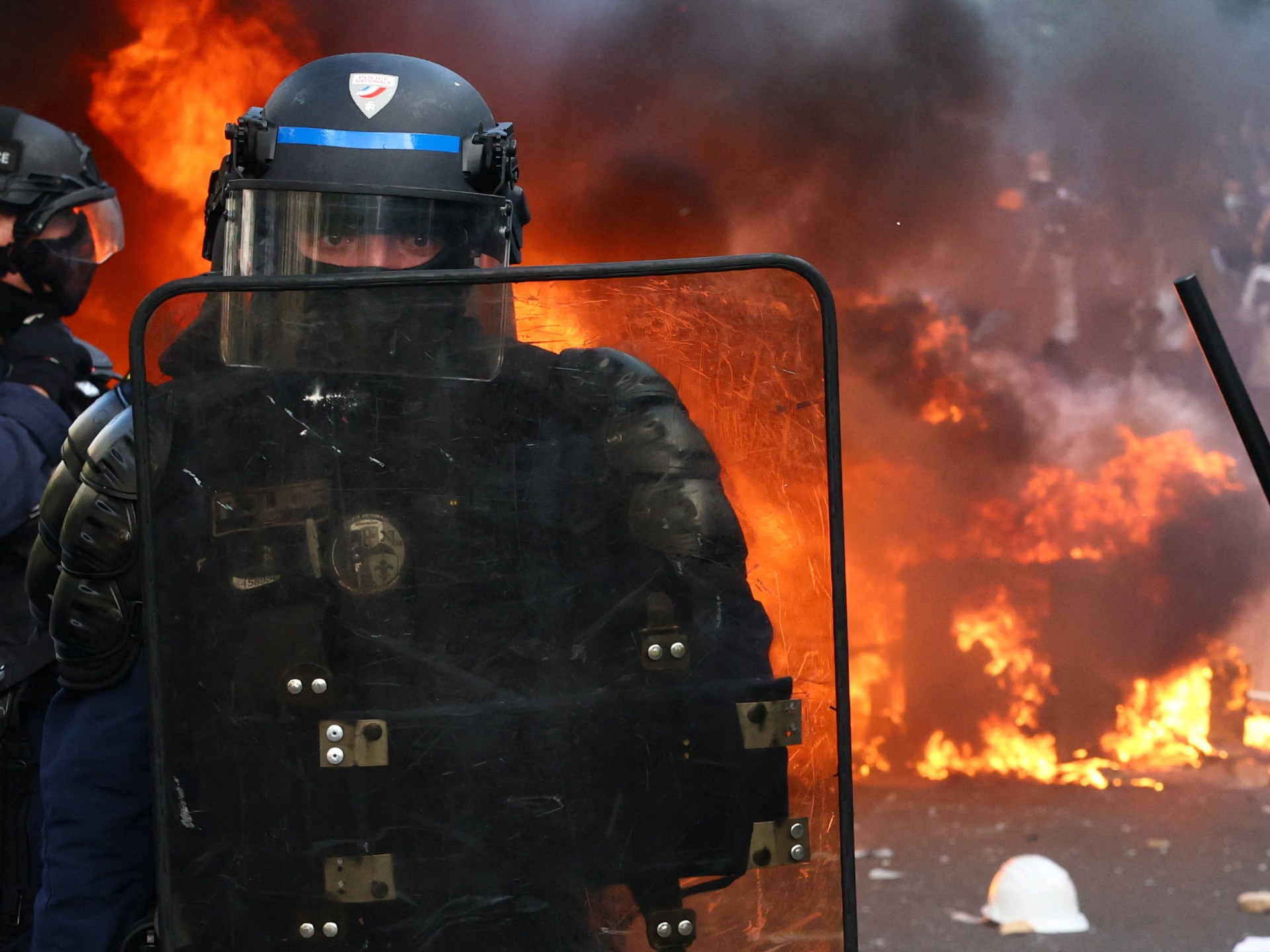
School blockades and clashes intensify in France as frustration mounts over government inaction on educational needs.
Save
Share
Prime Minister Sebastien Lecornu has suspended high school classes across France for the rest of the week as protests demanding education reforms continue to sweep the country.
Police fired tear gas at protesters blockading high schools on Tuesday as hundreds of thousands rallied in a number of cities calling for improvements to the education system, including replacing absent teachers, making lunch breaks longer and changing the length of the school day.
Authorities put the number of protesters nationwide at about a quarter of a million, but organisers estimated the number of students and activists at closer to half a million. The High School Students Union said nearly 2,000 high schools were blockaded or closed for the day.
Reporting from a march in the capital, Paris, Al Jazeera’s Natacha Butler said a growing number of groups had joined the demonstrations.
“We’re seeing people from various unions – like the farmers’ union, energy workers, teachers’ unions – who’ve also said they’re going to come out in support of the students,” said Butler.
“Parents and teachers said they want to be here not just to support their children but to protect them as they are worried about troublemakers who may infiltrate the protests and excessive police force,” added Butler.
In the cities of Marseille, Nantes and Lyon, demonstrators took to the streets holding aloft signs which read “they don’t really care about us” and “survive or study”.
In Strasbourg, Lyon and Rennes, the protests turned violent at times, with police firing tear gas and protesters lighting fires in the streets and hurling projectiles.
“When the answer is violence, it means democracy is no longer working,” said Hugo Vetzel, a recent high school graduate in Strasbourg preparing to attend university. “There is such a gap between the elites and us.”
The protests started two weeks ago in Paris’s poorest suburbs, lighting a blaze that has spread across the country. The government said the movement has turned into urban violence, and riot police were deployed to some rallies.
“Burning down a high school does not improve the state of high school buildings,” said Lecornu, as he announced the cancellation of classes.
The prime minister added the moved was aimed at empowering headteachers, teachers and pupils to pursue “internal democracy” to address concerns over school conditions.
He also ordered ministers to address the students’ demands by the end of October, saying that the government will look into repairing old campuses.
There are doubts, however, how quickly the government can respond.
“France is riddled with debt; France has a real budget crisis. Where would that money come from to put budget into public services?” said Al Jazeera’s Butler said.
France’s Ministry of Interior said that it has arrested 6,100 people since the beginning of the protests, the majority of them under the age of 18. The Ministry of Justice announced that more than 1,800 will be prosecuted, including 1,483 minors.
During the protests, at least 215 teenagers have been wounded along with 715 police officers, according to Lecornu.
On Monday, a 15-year-old’s hand was blown off during clashes between high school students and the police in the northern city of Lens. The government said that approximately 200 to 250 protesters had thrown objects at the police.
French newspaper La Voix du Nord said the teenager lost his hand and part of his arm after he picked up a police grenade during the protest.
Meanwhile, US President Donald Trump has waded into the protests in France, blaming runaway immigration and Muslims, without providing any evidence.
In a post on his social media platform Truth Social, Trump claimed that “what’s happening in France is nothing less than out of control mass migration. This isn’t about schools, this is about Islam wanting to take over a once great Country!”
In August, the Republican president described Democratic candidates in the upcoming midterm US elections as “jihadists”, in an apparent reference to Muslim Democratic contender Abdul El-Sayed after he secured his party’s nomination for the Michigan primary elections last week.
Advocates say such pronouncements fuel a proliferating wave of Islamophobic discourse among Republican lawmakers and elected officials in a bid to appeal to right-wing voters ahead of November’s polls.
Follow Al Jazeera English:
About the Author