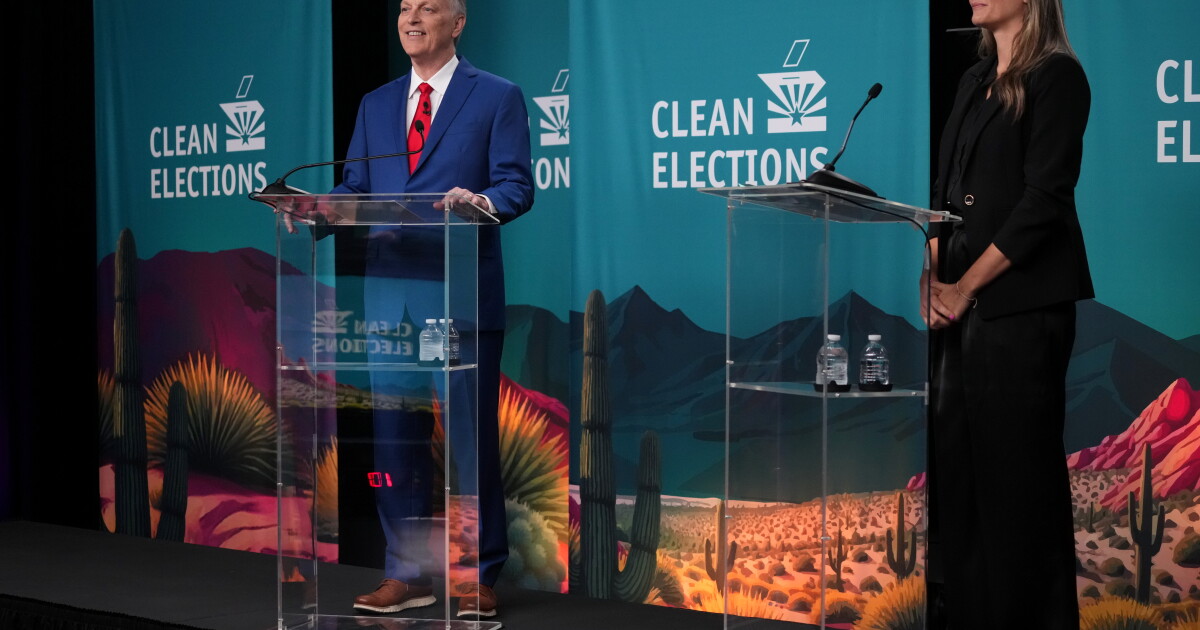
SCOTTSDALE, AZ — Gov. Katie Hobbs may have skipped the gubernatorial debate, but the Republican nominee, U.S. Rep. Andy Biggs, spent the hour under fire from No Labels Party nominee Teri Hourihan.
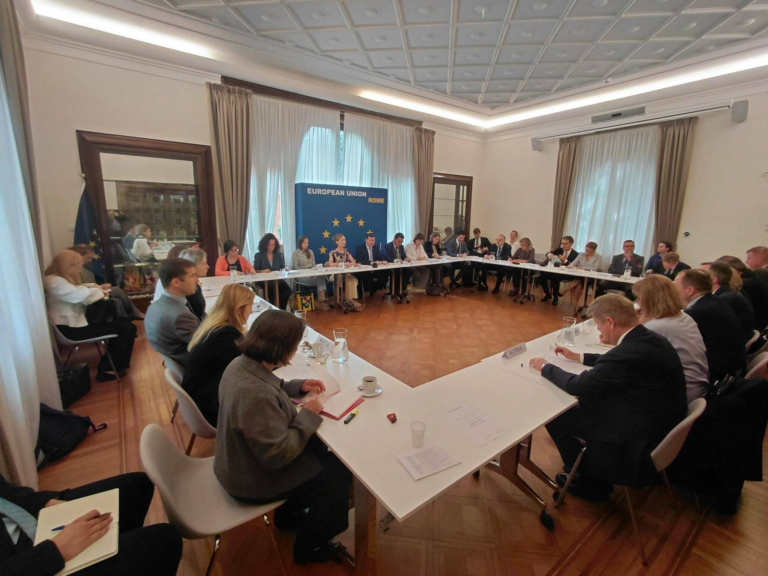
Biggs and Hourihan faced off at the Clean Elections Commission-sponsored debate Tuesday night in Scottsdale, clashing over water, Medicaid, state spending and Biggs’ legislative record.
“I will tell you that you’re the person that I would least trust to protect our border,” Hourihan said. “Seeing how in 2013 – HB 2648 – you failed women and children who were likely being abused, right, by not decertifying the Colorado City marshals.”
Do you have a concern in your community or a news tip? We want to hear from you!
Connect with us: share@abc15.com
Facebook | Instagram | YouTube
House Bill 2648 passed the Arizona House but died in the Senate during Biggs’ tenure as Senate president. The bill, which was sponsored by a Republican lawmaker, would have allowed a takeover of the police department in Colorado City, where leaders of a polygamous community took child brides.
Hourihan said Biggs allowed the bill to die and essentially allowed potentially hundreds of children to be married to adult men.
“So I do not for one minute think that you’ll stop child trafficking at all,” she said. “In fact, I think he’s a risk to it.”
Biggs called her remarks “an outrageous lie,” saying Warren Jeffs, the leader of the Fundamentalist Church of Jesus Christ of Latter-Day Saints, was serving a life sentence in Texas when the bill was introduced.
“Listening to her tonight, I am just baffled that somebody with such little knowledge of either the legislative process or even water policy in this state would stand here and have the temerity to berate me and assault my character,” Biggs said.
More than three years after HB 2648 died, the U.S. Department of Justice recommended the Colorado City Marshal’s Office be disbanded, saying it operated as an extension of the FLDS. Prosecutors said Jeffs was still directing the FLDS’ activities from prison. A judge in 2017 ordered court supervision of Colorado City and its sister city, Hildale, Utah, for 10 years.
While Hourihan repeatedly sent volleys to Biggs, she said she blames both Hobbs and Biggs for Arizona’s problems.
“People are suffering, and our elected officials, who we put in office, Andy Biggs included, Katie Hobbs included, are not listening to Arizona,” she said.
Hourihan, a mental health provider, has said she decided to run for office because of her frustration with how the Hobbs administration handled massive Medicaid fraud that preyed on Native Americans and cost taxpayers about $2.8 billion.
“Healthcare providers are struggling today. They’re going out of business,” she said. “We’re talking about companies that have been around for decades, where they’re being terminated, excluded, suspended without due notice, no proper notice.”
But she also faulted Biggs over his support for the Trump administration.
Biggs focused his attacks on the absent governor.
“Our opponent, my opponent, the one I consider my opponent, is Katie Hobbs,” he said. “She’s not here to debate.”
Biggs called her decision to skip the debate “disqualifying.”
“I think it doesn’t provide Arizonans with the information they need to make an informed decision, except to vote for Biggs-Kerr,” he said.
Hobbs told reporters Monday she is instead focused on meeting voters.
“I believe face-to-face interactions with Arizonans are more effective than a stage that is designed for nothing but political soundbites and theater,” she said.
Hobbs, who didn’t debate Republican Kari Lake four years ago, is the first major candidate since the 1950s to skip an Arizona gubernatorial debate.
“I realize that you want to ignore me and pretend I don’t exist, but I do,” Hourihan told Biggs. “I very much do.”
She told voters to look at how he treated her on the debate stage.
“That’s what he thinks of constituents. He doesn’t want to answer to us. He doesn’t want to talk to us. He doesn’t want to answer the hard questions. And when we’re right in front of his face, he pretends as though we’re not.”
Hourihan criticized Biggs’ plan to phase out Arizona’s state income tax, which he says could be paid for in part by slashing fraud and abuse in Medicaid.
“If you have $3 billion a year in fraud just in the Medicaid program alone, in which we spend about $23 billion a year, guess what? You can actually start tackling that problem as well,” Biggs said. “And then you’re going to have plenty, because the number is somewhere around $5.8 billion to $6.1 billion.”
But Arizona wouldn’t be able to take that money and spend it elsewhere, Hourihan argued, saying it would stay in the Medicaid program.
“You don’t get to put it into your pocket,” she said. “You do not get to put it into the general fund. That’s not how that works.”
In response, Biggs said Arizona would see some of those dollars.
“While not all of that will come back to the state because some of it will go to the feds, some of it will come to the state, and that will help us,” he said.
The two also clashed on water policy, with Biggs arguing that the problem is simply water management.
“We have plenty of water,” he said.
He has sponsored a bill in Congress for Colorado River infrastructure and to develop new sources of water for the river system.
“The bill I introduced in Congress is designed to actually save the entire Colorado River Basin,” he said.
The Colorado River has been depleted by decades of drought and overuse.
“But what people forget, and when they talk about it and they start panicking, they forget that Arizona has massive and copious amounts of underground water storage,” Biggs said.
Treating and distributing that brackish water would support up to 15 million people for 250 years, he said.
“What we have to do is, we have to actually have some pumps to get some of that water out,” Biggs said.
But Hourihan said Arizona needs stricter water conservation. Like her running mate did in the lieutenant governor’s debate, she pointed to efforts in Nevada, a neighboring Lower Basin state.
“It’s not just a management problem,” Hourihan told reporters after the debate. “It’s a water crisis. Lake Mead, Lake Powell are decreasing 22%, 26%, and we need to do something quickly.”
Want more news in your community? Add ABC15 as a preferred source on Google below:
Latest from ABC15:
Kamilah Williams
Garrett Archer
Zander Adams
About the Author