Taiwan Insight
The online magazine of the Taiwan Research Hub
Written by Simona A. Grano
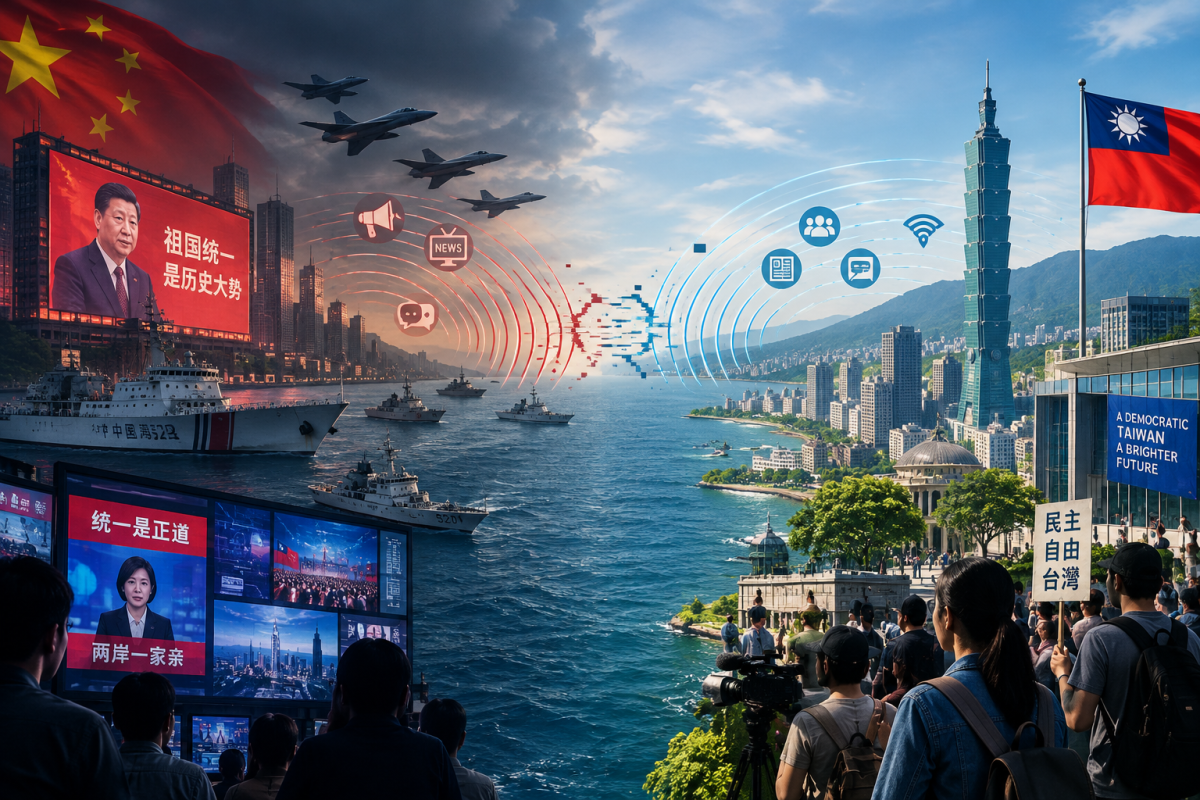
Image credit: Generated by AI.
In 2023, I published an article, Letters to Taiwanese Compatriots: the PRC’s unification ideology and Taiwanese response in cross-strait communication (告臺灣同胞書), examining one of the longest-running instruments of the People’s Republic of China’s (PRC) communication toward Taiwan. First issued in 1950 and subsequently revived at several critical moments in cross-Strait history, these statements offer a useful window into how Beijing has sought to shape how Taiwan is understood, both by audiences on the island and by the international community.
What emerges from this history is a multifaceted but consistent Chinese strategy through which Beijing has repeatedly adapted its language and instruments to changing circumstances. Appeals to shared culture and ethnicity, promises of economic benefits, calls for peaceful unification and, when necessary, military threats have appeared in different combinations over the decades, showing that communication has never been separate from coercion. It has been one element of a much broader strategy aimed at shaping Taiwan’s choices and constraining its international space throughout the decades.
Yet the relationship has changed considerably since the final period examined in my article, which was around 2020/2021. The question today is no longer simply how Beijing communicates with Taiwan, but how communication has become embedded in a much broader campaign of political, economic, legal, informational and military pressure.
The transformation is particularly visible since 2016, when Tsai Ing-wen and the Democratic Progressive Party (DPP) returned to power after 8 years in opposition. Beijing increasingly moved away from the combination of economic incentives and political engagement that characterised the period under Ma Ying-jeou (2008–2016), opting instead to suspend all official cross-Strait communication and intensify military activity around Taiwan. At the international level, the Chinese Communist Party has likewise sought to impose increasing costs on governments and international organisations to force them to limit their relations with Taipei.
The election of Lai Ching-te in 2024 has further sharpened this dynamic. Beijing has portrayed Lai and the DPP as splittists “clamouring for Taiwan independence”. It has repeatedly framed Taiwan’s democratic government as the source of instability in cross-strait relations, constantly reiterating its refrain that Taiwan is an ‘inalienable part of China’. Taipei, meanwhile, has increasingly described China’s actions as part of a broader campaign to alter the status quo through coercive measures spanning multiple domains, including disinformation and cognitive warfare, military pressure, economic coercion and legal warfare.
This is an important change in the nature of cross-Strait relations. Beijing is not relying on one instrument—or even primarily on military force. Instead, different forms of pressure increasingly overlap. Military exercises take place alongside coast guard operations, cyber and information activities, economic measures, diplomatic pressure and legal claims. The objective is not necessarily to trigger a war but instead to gradually change the environment in which Taiwan operates, making certain actions more costly, normalising Chinese military and maritime presence around the island, and narrowing Taiwan’s room for manoeuvre.
This is what is often described as grey-zone coercion: the use of instruments below the threshold of open armed conflict to pursue strategic objectives. The concept has become increasingly important in understanding China’s approach to Taiwan. Between 2020 and 2025, Chinese maritime and air activity around Taiwan also increased substantially. A 2026 CSIS analysis found that the daily average of distinct China Coast Guard vessels entering Taiwan’s near waters rose by more than 500 per cent over the period, while other indicators showed significant increases in Chinese air activity as well.
The significance of these developments is not just in their frequency, but also in their cumulative effect. A military aircraft crossing the median line, a coast guard vessel entering waters around Taiwan, a cyberattack, a disinformation campaign, or a new legal measure may seem controllable in isolation, but taken together they contribute to a progressively altered security environment.
The language used by Beijing has evolved alongside these practices. The rhetoric of “compatriots” has not disappeared. On the contrary, it remains central to the Chinese Communist Party’s narrative. Beijing continues to describe people in Taiwan as Chinese compatriots and presents unification as a historical inevitability. In March 2026, for instance, China’s Taiwan Affairs Office again called on the DPP government to recognise the “1992 Consensus” as a precondition for resuming dialogue, while describing people on both sides of the Strait as members of the same national community.
But the persuasive appeal of this narrative appears increasingly disconnected from political realities in Taiwan. Taiwan has undergone a profound process of democratisation and identity transformation since the authoritarian era. For a growing number of Taiwanese, the central political question is no longer whether Taiwan should eventually become part of a Chinese nation, but how to preserve the democratic and de facto sovereign system in which they live. Recent surveys show that most people in Taiwan reject unification with China and support maintaining the status quo indefinitely (33.9%), while 61% oppose unification.
This creates a deep asymmetry between Beijing’s narrative and Taiwan’s political reality. Beijing continues to frame the Taiwan question primarily as one of national unification, while Taiwan’s political system, by contrast, increasingly treats the future of the island as something to be determined by its own population.
President Lai has repeatedly emphasised precisely this point. In May 2026, on the second anniversary of his inauguration, he reiterated that Taiwan’s future should be determined by its 23 million people and that maintaining peace and stability across the Taiwan Strait remains a strategic priority. At the same time, he argued that peace cannot depend solely on goodwill and that Taiwan must strengthen its own defence capabilities.
This epitomises the apparent paradox at the heart of current cross-strait relations: both sides continue to invoke peace, yet they increasingly mean very different things by it. For Beijing, peace is conditioned on acceptance of its “one China” framework and ultimately on unification, while the PRC has increasingly used coercive political, economic, military, and informational measures to pressure Taiwan toward that outcome. For Taiwan, by contrast, peace means preserving a democratic and self-governing status quo, protecting the freedoms and way of life of its 23 million people, and ensuring that Taiwan’s future is not determined through coercion or political conditions imposed by Beijing.
The result is a relationship in which communication has become simultaneously more important and less effective. Beijing continues to invest heavily in shaping Taiwanese perceptions through propaganda, political messaging, and other forms of influence. Yet, these efforts increasingly confront a lived political reality that bears little resemblance to the one assumed by the PRC’s unification narrative. For a population accustomed to democratic self-government and political freedoms, Beijing’s portrayal of unification as the inevitable route to peace and stability is increasingly difficult to reconcile with the political system and constraints that unification would entail.
The evolution of the Letters to Taiwanese Compatriots therefore tells us something important about the present. The language of persuasion has not disappeared; rather, it now operates alongside a much broader repertoire of coercive tools so that the challenge for Taiwan is no longer simply to respond to Beijing’s narratives but more to navigate an environment in which narratives, military pressure, economic leverage, legal claims and grey-zone tactics increasingly reinforce one another.
The future of cross-Strait relations becomes therefore particularly uncertain since the question is not simply whether Beijing will use force against Taiwan but whether the gradual accumulation of pressure below the threshold of war can itself change the status quo through routinisation and normalisation.
In this sense, the Strait is already experiencing a form of conflict—one that does not look like the wars of the past, but in which the boundaries between communication, coercion and confrontation are becoming increasingly difficult to separate.
Simona Grano is Head of the Research Area China-Taiwan Relations at the University of Zurich and Senior Lecturer in Chinese Studies and Director of the Taiwan Studies Project (since 2017) at this same institution. Since 2024, she has also been a Senior Fellow on Taiwan at the Center for China Analysis, CCA, Asia Society Policy Institute (ASPI) in New York, and was previously a TOY Fellow in 2023- 2024 at the Asia Society Switzerland. Her research focuses on Cross-Strait relations, Switzerland–China and Switzerland–Taiwan relations, as well as small and middle powers’ role in the context of US–China competition. She has published on these topics in an edited volume by Palgrave (2023), a recent CEIAS (Central European Institute of Asian Studies) publication on Switzerland–Taiwan relations, and an edited volume by Palgrave (2025). She regularly contributes to media discussions on these topics.
This article was published as part of the special issue on IJTS Research Article Competition Winners.
Enter your email address to follow this blog and receive notifications of new posts by email.
The Taiwan Research Hub is a research centre based at the University of Nottingham focusing on all aspects of contemporary Taiwan. The Taiwan Research Hub does not privilege political positions and the views published on Taiwan Insight are those of the author and not the institute.
If you are interested in writing for Taiwan Insight, please contact:
Dr Chun-Yi Lee
Taiwan Research Hub Director and Taiwan Insight Editor in Chief
Taiwan Studies Programme
School of Politics and International Relations
University of Nottingham
University Park
Nottingham
NG7 2RD
Chun-yi.Lee@nottingham.ac.uk
Team members:
Adrian Chiu
Taiwan Insight Editor
Mandy Felton
Taiwan Insight Manager
Mark Murphy
Taiwan Insight Editor
Shi Yeu Nga
Taiwan Insight Editor
Chee-Hann Wu
Taiwan Insight Editor


https://www.facebook.com/UoNTaiwanResearchHub
Subscribe now to keep reading and get access to the full archive.
Continue reading
About the Author