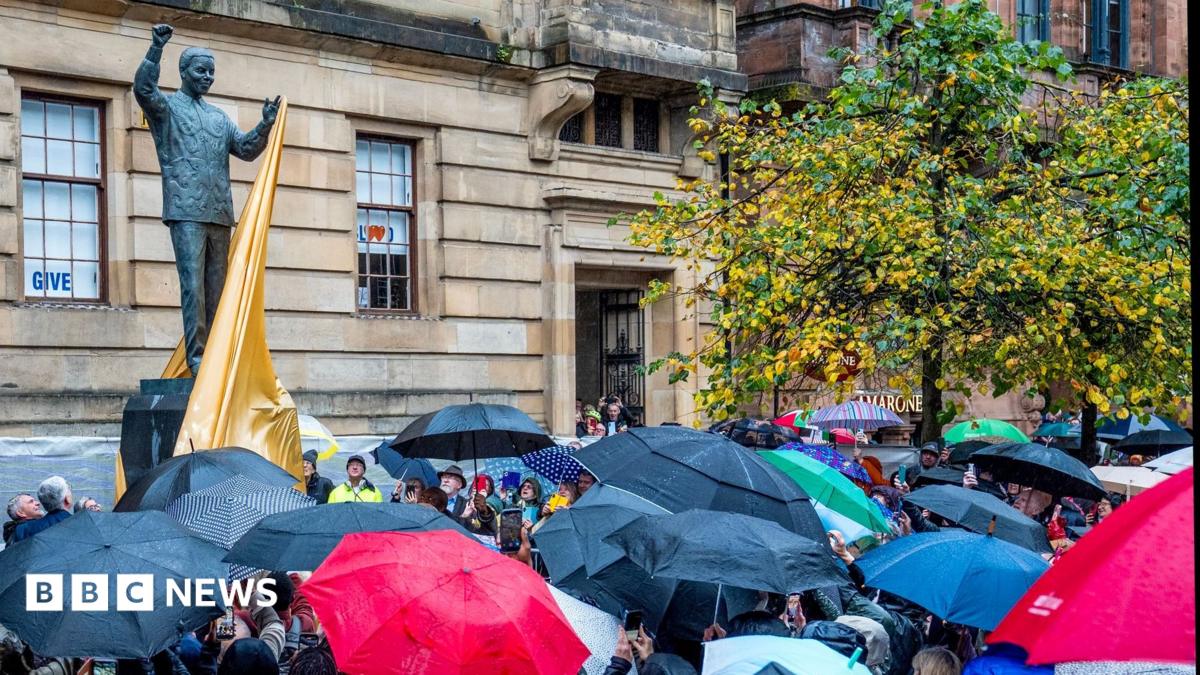
The statue celebrates Nelson Mandela's links to Glasgow
A new statue of Nelson Mandela has been unveiled in Glasgow, celebrating the former South African President's links to the city.
The statue from sculptor Alan B Herriot will stand in the city's Nelson Mandela Place, having been chosen from a shortlist last year.
Glasgow was the first city in the world to award its freedom to Mandela in 1981, at a time when he was still in prison in South Africa.
The leader of the country's anti-apartheid struggle later visited Glasgow in 1993 – three years after he was released from jail.
Brian Filling, the chair of the Nelson Mandela Scottish Memorial Foundation, said the unveiling was "another great day in Glasgow's proud history of association with a struggle thousands of miles away."
Filling campaigned from the 1960s onward against apartheid – the system in South Africa which allowed the white minority to oppress the majority black inhabitants.
He added: "The statue will stand as a testament and recognition of the people of Glasgow, Scotland and Britain's solidarity with the South African people in their long and just struggle and it will provide a focus for ongoing education around the continuing struggle against racism and for justice and equality."
A large crowd turned out in the city centre for the unveiling of the statue
Dr Michael Kelly was Glasgow's Lord Provost from 1980 to 1984 and was heavily involved in the decision to give Mandela the freedom of the city in 1981.
He told the BBC's Radio Scotland Breakfast programme: "This is a lasting reminder of Mandela, and of his tremendous struggle – 23 years of hard labour simply for wanting a vote – and also of the contribution of the people of Glasgow to the worldwide campaign [to free Mandela]."
In attendance for the statue being revealed was Marah Louw, the South African singer who sang in George Square when Mandela visited the city in 1993.
Nelson Mandela danced with Marah Louw when he visited Glasgow in 1993
The visit saw him speak to a crowd of about 10,000 people in George Square and formally receive the honour of the freedom of the city.
The visit came three years after he was released from jail in 1990, following over 27 years imprisoned having been convicted of charges that included conspiring to commit acts of sabotage and guerrilla warfare for the purpose of violent revolution.
The trial was condemned by the United Nations Security Council and nations around the world.
In later life he became the president of South Africa and died, aged 95, in December 2013.
Throughout the 1960s and 1970s, many in Britain were happy to deal with the apartheid regime in South Africa.
In 1979 the then Lord Provost of Glasgow, David Hodge, hosted lunch with the South African ambassador in the city – a decision that sparked furious protests at the City Chambers.
Dr Kelly was among those in the Labour party who wanted to make amends for this, resulting in the decision to give Mandela the freedom of the city. It resulted in both praise and criticism for the council at the time.
Dr Kelly recalled: "There was a very mixed reaction, the press was very hostile to it and the Glaswegians wondered why we were interfering in foreign affairs.
"There was a campaign of education from 1981 to inform Glaswegians about Mandela, about his struggle and about the ghastly system of apartheid."
Soon other cities had followed Glasgow's lead.
Within a year Kelly launched a declaration for the release of Mandela that gained support from 2,500 mayors from 56 countries around the world.
The declaration got the backing of the United Nations in New York and Dr Kelly, on behalf of the city of Glasgow, was invited to speak first in support of the petition.
A jubilant Nelson Mandela visited Glasgow in 1993
Glasgow's support for Mandela did not end there, nor was it limited to petitions and protests.
In 1986, the name of St George's Place in the city centre was changed to Nelson Mandela Place.
The name change was because the South African consulate-general was based on the fifth floor of the Stock Exchange building there – meaning it had to be based at an address which bore the name of the country's most famous political prisoner.
Dr Kelly said: "It really irritated the South African government, and that was part of the point. It also created worldwide publicity."
International pressure, in the form of sanctions against the South African regime, eventually led to Mandela's release from prison at the age of 71, on 11 February 1990.
More stories from Glasgow & West Scotland
More stories from Scotland
Three years later he was able to visit Glasgow in person, where he spoke at the City Chambers.
At the time he said: "While we were physically denied our freedom in the country of our birth, a city 6,000 miles away, and as renowned as Glasgow, refused to accept the legitimacy of the apartheid system, and declared us to be free."
While Mandela was in Glasgow, Dr Kelly asked him if he had been aware of the campaigns in the outside world demanding his freedom.
"He said to me that the South African authorities tried to to keep all news from him, to make them think the world had abandoned them.
"But they had a grapevine, and these kinds of information did come through. He said 'we did know, and it heartened us to carry on with our struggle.'
"I found that deeply satisfying, and the people of Glasgow should know that."
Winning design for Nelson Mandela statue in Glasgow revealed
Charity celebrating Mandela's legacy marks decade of work
Designs unveiled for Nelson Mandela statue in Glasgow
All day bus service between North Ayrshire and Glasgow approved for trial run
Councillor warns A816 repairs must not become Argyll’s ‘new Rest and Be Thankful’
Wet leaves on Glasgow cycle lanes could pose danger to cyclists, councillor warns
A-listed Glasgow church hall could be demolished for 49 flats
Bereaved West Dunbartonshire families reminded of available financial support
Location and practicality are top of this Port Glasgow flat's selling points
Watch our pick of standout clips from across the BBC
US unveils sanctions on ICC in move court condemns as 'assault on rule of law'
Polanski vows to stay as Green leader as he faces criticism after by-election defeat
King pays Andrew's £1.5m repair bill on Royal Lodge
Autism, ADHD and mental health review: What you need to know
Olivia Colman on viral Wicker memes: 'This has never happened to me before'
Will El Niño and the polar vortex bring snow to the UK this winter?
Weekly quiz: How long did it take for Glastonbury tickets to sell out?
I've been with my boyfriend for two years and don't know his salary
Russian strikes and approaching winter force some in Kyiv to pack bags and flee
'You're made to feel like a criminal' – cancer survivor screamed at for stoma at airport
Could Christa Pike face execution again and by what method?
US Politics Unspun: Cut through the noise with Anthony Zurcher's newsletter
Brad Pitt stars as a tank commander on a dangerous mission in WWII
How rats were trained to clear landmines
First look: The hotly-anticipated second series is coming soon
How does The Odyssey unfold?
US unveils sanctions on ICC in move court condemns as 'assault on rule of law'
JD Vance casts doubt on firing squad execution and says he will not watch it
Bank cashier outed by holiday photos after stealing £13k is ordered to pay back money
Commentator Katie Zacharia picked as new White House press secretary
King pays Andrew's £1.5m repair bill on Royal Lodge
Prize-winning image which sparked backlash was AI-generated, Nikon rules
Lib Dem MP quits frontbench job over Ed Davey's leadership
Anthropic bans users from being 'cruel' to its AI systems
Widdecombe suspect had 'particular hostility to Reform', court told
US immigration officials defend ICE agents who shot man in same car as child
Copyright © 2026 BBC. The BBC is not responsible for the content of external sites. Read about our approach to external linking.
About the Author