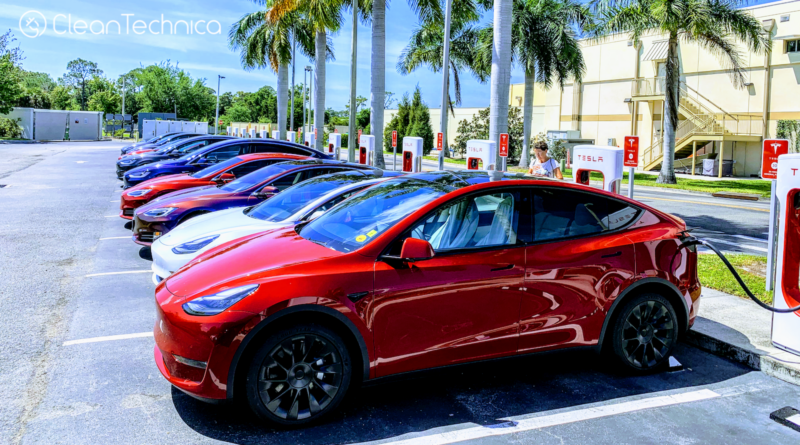
Every Tesla Model 3 and Model Y built in the US on or after October 1, 2026, is capable of vehicle to home (V2H) operation, according to Not A Tesla App. In fact, some cars built as long ago as April may have the upgrade available, as some cars were fitted with the necessary hardware as soon as it became available, even in limited numbers. To see if your car has the technology enabled:
Go to Settings > Software on your car’s touchscreen.
Select Additional Vehicle Info.
If you see Powershare Support: Enabled, you’re good to go.
If your car does not have the Powershare feature, it is not something that can be added by a software update because it requires new power electronics. For the latest self driving capability, owners can choose to have their Tesla Service Center upgrade their computer from HW3 to HW4 specs. Tesla has not said anything yet about whether a hardware update will be available to upgrade cars built prior to October 1 to permit V2H operation.
On its website, Tesla says the Powershare system was originally developed for use with the Cybertruck. “The Powershare Home Backup Bundle allows you to use the energy stored in your [Cybertruck’s] battery to power your home during power outages. It Includes a Universal Wall Connector and Powershare Gateway for a complete home backup system. Both products are required for Powershare functionality unless your home already has a Powerwall residential storage battery.” Professional installation is required and is not included.
Model 3 and Model Y owners will need a Powerwall 3 residential storage battery together with a Wall Connector or Universal Wall Connector, but no separate Powershare Gateway. Only the Cybertruck is capable of V2H operation without a Tesla Powerwall, but requires a Powershare Gateway be installed as part of the system. According to Solar Power World, Powerwall 2 and Powerwall+ support is coming soon.
The Powershare system can deliver a maximum of 11.5 kW of clean, quiet, maintenance free backup power to a home. Based on an estimated daily usage of 30 kWh, the battery in a Model 3 or Model Y can power a residence for about two days, if it is charged to 90 percent of more at the start.
On the Tesla website, the company says, “To install, you must own your own home, be able to park your vehicle on your property within 20 feet of your installation location and have an electrical panel rating of <225A. Check with Tesla Certified Installer for compatibility with existing non-Tesla home battery systems.” That language applies to the Cybertruck but should be applicable to the Model 3 and Model Y as well.
“With Powershare Home Backup, choosing a Tesla is no longer just a decision to buy an EV. It’s a decision to invest in home energy resilience,” said Colby Hastings, Tesla’s senior director of residential energy. “Our vehicles and Powerwall are even better when used together — each increases the value of the other.”
There are over 100,000 people without power in Alabama, Florida, and Georgia at this moment. It is fashionable among those who depend on anti-social media for their information to guffaw about stupid EV drivers who can’t charge their cars if the electricity goes out.
Those geniuses apparently have never stopped to realize that gas pumps also stop working if there is no electricity. There is no gasoline car ever made that can power a home for a couple of days during a grid outage. Residential backup generators can cost as much as $15,000 installed, which is about one third the cost of a new Tesla.
There’s more that the battery in an electric car can do than just keep the lights on in a home for a day or two. When connected to the grid, it can earn money for the vehicle owner by helping to stabilize the electrical grid and by soaking up excess renewable energy that would otherwise go to waste. The European Union has just concluded a four year study of vehicle to grid technologies.
“Beyond hardware and software, EV4EU provided key insights on user engagement, putting citizens at the centre of V2X management strategies,” project coordinator Hugo Morais said in the study’s final report. One of the project’s many successes was the “design and successful testing of a fully functional bidirectional charging station prototype using standard combined charging system technology.”
Another part of the success story was building open source tools for charging point operators that handle communications based on smart/bidirectional charging standards. Finally, EV4EU explored a solution whereby a virtual power plant manages EV flexibility by optimizing different resources and tapping into available energy markets. “This approach can increase revenue while delivering direct benefits to users,” said Morais.
The EV4EU program successfully tested a number of flexibility solutions and management strategies in four EU countries. In Portugal, the team integrated bidirectional charging points at residences and public buildings, achieving an average cost reduction of 14 percent in household charging and an increase of nearly 22 percent in renewable energy integration.
In Slovenia, the team integrated virtual power plants and local market platforms across office and school buildings. Flexible capacity in charging and discharging demonstrated the added value of V2X over standard smart charging. In Athens, the study focused on public charging environments and the impact of EVs on the grid. It validated the importance of dynamic pricing and flexible capacity contracts.
In Denmark, the program focused on managing parking lot charging clusters, particularly where local renewable generation was available. Using the distributed control algorithms created for the study, it reduced three phase power imbalances, maximized local renewable utilization, and reduced costs and fossil fuel use.
In addition to technical feasibility, EV4EU also studied various business models, regulatory frameworks, and the needs of vehicle users. Based on its four years of study, it concluded that bidirectional charging can only function as a flexibility option if the mobility requirements of drivers and battery ageing are taken into account. Appropriate control algorithms can optimize charging and discharging to reduce stress on the battery.
The results show that V2X extends beyond individual vehicle and charging technologies — coordinated communication, suitable market models, and incentives for participants are required. The project provides tested technical approaches and practical insights for this purpose. “The next step is to implement such solutions on a larger scale and under the respective national grid and market conditions,” according to Electrive.
Previously, Tesla shied away from V2H or V2G technology for fear of shortening the life of the batteries in its cars. But now, the evidence shows that battery degradation is not the problem it was once thought to be. In fact, batteries today are outlasting the cars they power.
It is intriguing to imagine that in a few years, tens of thousands of electric cars may be networked together to soak up excess renewable energy and form virtual power plants for communities. The EV revolution is about more than just driving on electrons. It opens whole new ecosystems that never existed previously. The future’s so bright, we gotta wear shades!
CleanTechnica’s Comment Policy
Steve writes about the interface between technology and sustainability from his home in Florida or anywhere else The Force may lead him. He is proud to be “woke” and believes weak leaders push others down while strong leaders lift others up. You can follow him on Substack at https://stevehanley.substack.com/ but not on Fakebook or any social media platforms controlled by narcissistic yahoos.
Steve Hanley has 6792 posts and counting. See all posts by Steve Hanley
About the Author