SageSure has made a strategic investment in Pillar Capital Management, a Bermuda-based insurance-linked securities (ILS) fund manager with more than $4 billion in institutional assets under management.
Financial terms were not disclosed.
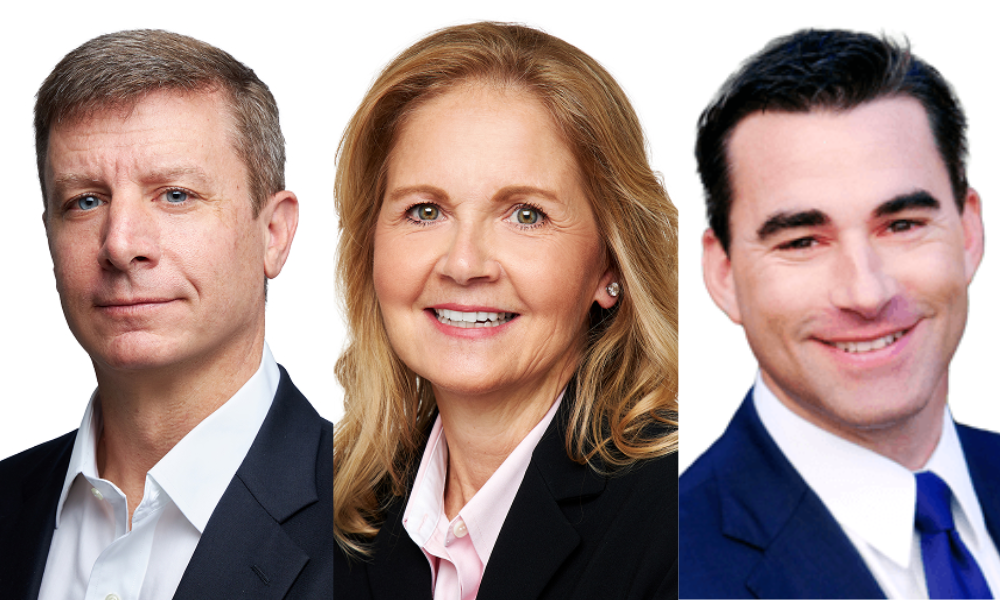
Pillar will continue to operate as an independent business, with its Bermuda team and investment strategy unchanged. Longtime CEO and chief investment officer Stephen Velotti (pictured, left) and chief operating officer Tara Railton (pictured, center) will remain in charge, and Pillar’s management will keep a substantial ownership stake. SageSure will provide Pillar with its risk-level insights, analytics and technology.
SageSure said the deal adds Pillar’s reinsurance underwriting and its relationships with institutional investors to its platform. It said this would broaden its capabilities across the property catastrophe value chain and connect its underwriting with a wider range of capital sources.
“For nearly two decades, Pillar has built a world-class platform and deep relationships with global institutional investors through a relentless focus on strong technical underwriting and prudent risk management,” said Terrence McLean (pictured, right), SageSure’s president and CEO.
Velotti said Pillar’s strategy, team and service to investors would stay the same. He added that the partnership would improve its ability to access, evaluate and manage catastrophe risk.
SageSure funded the investment by expanding its existing debt facility with Ares Management.
The deal adds to a period of rapid expansion for SageSure. The Jersey City-based MGU operates in 16 states, covers more than 970,000 policyholders and manages more than $3.2 billion of in-force premium, according to the company. In January it completed its acquisition of Florida’s Olympus MGA, adding around 130,000 policies and $700 million in gross written premium. That deal was also funded by expanding the Ares facility.
SageSure already sponsors catastrophe bonds for its programs. Owning part of an ILS manager takes it a step further, giving it a stake in a business that allocates institutional capital to reinsurance risk directly.
For agents placing homeowners cover in hurricane-exposed and other catastrophe-prone states, the main question for MGUs like SageSure is whether capacity is stable from one year to the next. MGUs depend on carrier partners, and those carriers in turn depend on reinsurance. A sharp shift in reinsurance appetite after a major event can quickly reduce what an MGU can write.
By linking its underwriting data with an ILS manager’s investor relationships, SageSure is aiming to make the capital behind its programs more reliable. If that works, agents should see more consistent appetite and pricing through the cycle, especially after a large loss year.
The deal also reflects a wider trend. Large catastrophe MGUs are moving beyond underwriting, building or buying the means to raise their own risk capital rather than relying entirely on carriers and traditional reinsurers.
For independent agents, that creates stronger, better-capitalized programs, but it also concentrates more of the coastal market in fewer, larger platforms.
We’ll keep you up-to-date with the latest breaking news, cutting edge opinion, and expert analysis affecting both your business and the industry as whole.
Our daily newsletter is FREE and keeps you up – to – date with the world of Insurance. Please complete the form below and click on subscribe for daily newsletters from IB US.
About the Author