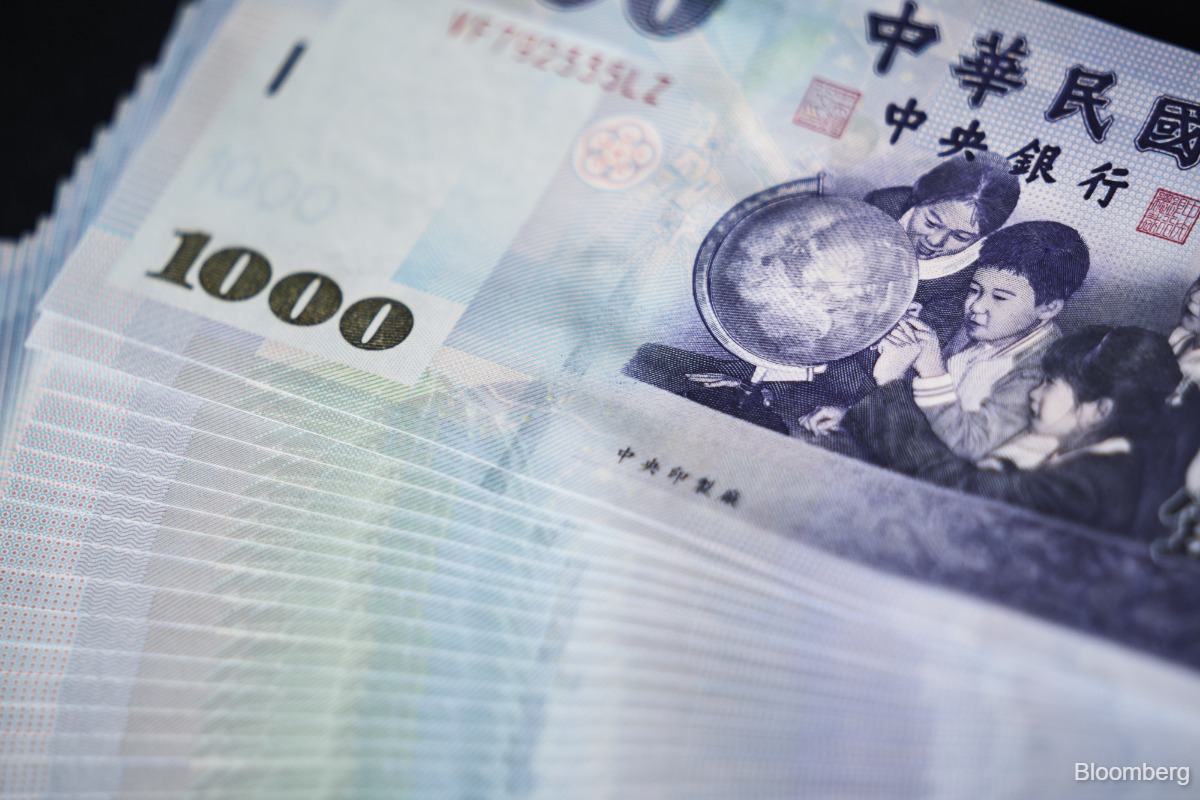
(Oct 15): The Taiwan dollar and South Korean won fell the most among Asian currencies as an overnight slump in Wall Street semiconductor shares spilled into regional markets, dampening demand for artificial intelligence supply-chain plays.
Taiwan’s currency fell as much as 0.8% while the island’s shares lost more than 3% in their sharpest drop since July. South Korea’s won declined as much as 1% with local shares down more than 8% and set for the lowest close since April. The risk-off sentiment spilled into Southeast Asia, putting pressure on currencies including the Philippine peso and Indonesian rupiah.
Despite a broader currency selloff, the steep losses in North Asia underscore how deeply those export-reliant economies remain tethered to global technology sentiment. A US gauge of semiconductor stocks erased US$1.6 trillion (RM6.53 trillion) in market value during a six-day losing streak on concerns over high interest rates, lofty valuations, and massive AI spending. The tech-led anxiety also spread across the region, knocking MSCI Inc’s Asia Pacific equities gauge down about 3%.
“The Korean won and Taiwan dollar, both proxies for the global tech cycle, have come under pressure amid the sharp selloff in technology stocks,” said Christopher Wong, a strategist at Oversea-Chinese Banking Corp.
“Hotter US inflation overnight added to risk aversion, though the pullback in Treasury yields and oil prices may provide some offset,” he added.
The Taiwan dollar’s early-morning slump was primarily driven by foreign capital outflows and exporter dollar hoarding, according to traders. State-owned banks stepped in to sell greenbacks to provide market liquidity, said the traders who asked not to be named as they are not allowed to speak publicly.
Foreign investors dumped NT$165.3 billion (RM20.8 billion) of Taiwanese local equities on Tuesday, the third-biggest ever one-day outflow in data going back to 2000. Foreign outflows had extended to a sixth straight session on Wednesday.
In South Korea, foreign funds have dumped US$1.8 billion worth of Kospi equities on Thursday morning alone, pushing total monthly outflows past US$10 billion in October.
“The stocks selloff is fuelling the global risk aversion, which is spreading to some Asian currencies,” said Philip McNicholas, Asia sovereign strategist at Robeco in Singapore.
“Those which are particularly vulnerable — currencies exposed to tech, obviously, as well as those which are exposed to risk sentiment like the rupiah and peso — are impacted the most,” he said.
Weak market sentiment reverberated well beyond North Asia on Thursday. The Philippine peso weakened past 63 per dollar for the first time. The Indonesian rupiah pared losses after the nation’s central bank intervened to steady the currency. The Reserve Bank of India sold dollars to support the rupee.
Uploaded by Evelyn Chan
Copyright © 1999-2026 The Edge Communications Sdn. Bhd. 199301012242 (266980-X). All rights reserved
About the Author