China's economic growth picked up in the three months to the end of September, rebounding from a three-year low as the artificial intelligence (AI) boom helped boost exports.
The world's second largest economy grew by 4.5% in the third quarter, up from 4.3% in the previous period but below the 5% expansion recorded from January to March, according to official Chinese data.
The latest figure is at the bottom end of Beijing's annual growth target of 4.5%-5%, which analysts have said gives policymakers room to address the country's economic challenges.
Exports have helped offset weak spending at home, but global trade tensions and uncertainty over AI investments are clouding its outlook.
China's National Bureau of Statistics said on Monday that the economy "sustained steady development against pressure" and showed "momentum with new growth drivers and improving structure".
With exports climbing, China's trade surplus – the amount of goods and services it sells abroad compared to what it buys from other countries – is on track to overtake the record $1.2tn (£900bn) seen last year.
But property investment fell by more than 20% in the first nine months from the same period last year, official data also showed.
Oxford Economics researcher Sheana Yue said manufacturing and high-tech exports have boosted China's growth, despite weak investment and domestic spending.
China's economy has struggling to shake off a long-running property slump, after years of overbuilding and excessive borrowing by private developers.
There are still no signs that this trend will end soon, Yue said.
Trade uncertainties and geopolitical issues have also made Chinese consumers more "pessimistic" and unwilling to spend, she added.
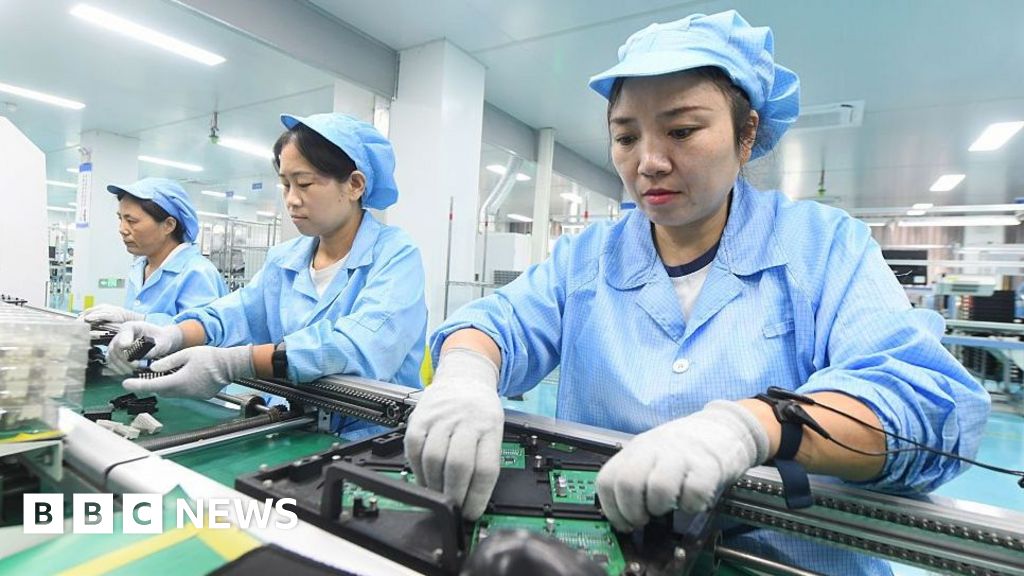
The technology industry has been a key driver of China's growth in recent quarters.
Global demand for computer chips and other components used to build AI data centres has helped to ease pressure on Beijing and cushion the impact of sluggish domestic consumption.
Chinese businesses have leaned heavily on exports as a prolonged property slump, weak wage growth and high youth unemployment have weighed on consumer spending at home.
In September, Beijing unveiled a raft of support measures, including lower interest rates for some businesses and subsidies for property buyers, in an effort to boost the economy.
But Beijing is facing a backlash from Western economies – including the US and European Union – as manufacturers struggle to compete with large amounts of cheap Chinese goods.
There are also concerns over the billions of dollars being spent on AI infrastructure and whether the companies making those investments can deliver on their promises of generating huge profits.
Trading standards officers say AI is "super-charging" existing scams through clones and fake websites.
Tech firm Nscale says it is still committed to building the site in Essex.
Travelling footie fans and a bungled ram raid. Try your hand at our North East and Cumbria quiz.
She and five staff members were found to have used the inedible paint in meals to make them look more appealing.
Experts warn photos uploaded to AI may be stored, reused or expose children's data.
Copyright 2026 BBC. All rights reserved. The BBC is not responsible for the content of external sites. Read about our approach to external linking.
About the Author