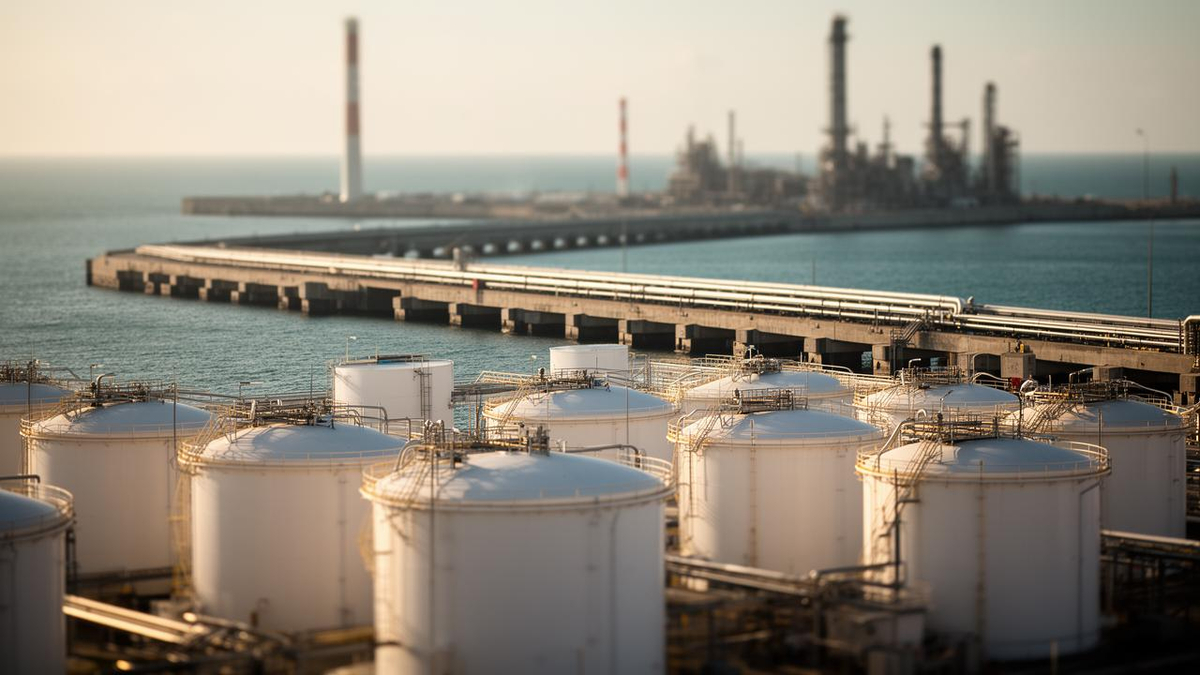
Global diesel markets are tightening to a point where Washington is buying from an adversary and Europe is hunting for replacement barrels, yet South Korean refiners — among the world’s largest fuel exporters — say they are barred from cashing in on the run-up.
The trigger is a supply shock that has been building for months. According to the International Energy Agency, worldwide diesel exports fell by 700,000 barrels a day last month compared with a year earlier. The agency has warned that the shortfall could persist into mid-2027, and its member countries have agreed to release more than 20 million barrels of diesel into the market as quickly as possible.
The causes are stacked on top of one another. Shipping through the Strait of Hormuz has been disrupted by the Iran conflict, crippling export routes out of the Middle East, while Ukrainian air strikes have idled close to half of Russia’s refining capacity. China has added to the strain by restricting exports of refined products to protect domestic prices.
The price signal is stark. The average U.S. pump price for diesel stood at $6.31 a gallon on Oct. 15, just below the all-time high of $6.53, and diesel in the United States has climbed roughly 70% since the Iran war began. Upstream, Brent crude for December delivery settled at $109.86 a barrel on Friday after gaining $5.14, or nearly 5%, over the week.
With U.S. midterm elections approaching, the Trump administration has moved aggressively. President Donald Trump reached an arrangement with Russian President Vladimir Putin under which sanctions on Moscow would be temporarily waived in exchange for diesel supply: an initial 300,000 tonnes, or about 2.25 million barrels, followed by roughly 3.75 million barrels in November and about 7.5 million more later. Trump has also criticized Ukraine’s renewed strikes on Russian refineries, calling them “a disgrace” and “an action that does not help the world at all.”
The inflation backdrop explains the urgency. U.S. producer prices in September posted their largest increase in four and a half years, retail sales beat expectations, truck freight costs jumped 19% year on year and farm input and feed costs rose 15.6%.
For South Korea, the arbitrage opportunity is unusually large. The country’s four refiners devote about 27.6% of petroleum output to diesel, and roughly 58.8% of that diesel was exported last year. With refining capacity well beyond domestic needs, the industry could supply home demand and still ship substantial volumes abroad.
What stands in the way is domestic policy. To hold down consumer prices, the government maintains a ceiling on petroleum product prices and caps monthly exports of gasoline, diesel and kerosene at 100% of the same month a year earlier, while requiring that volumes kept at home stay at least 90% of the prior-year level. Diesel exports from January through July totaled 110.57 million barrels, down 3.4% from the same period a year earlier.
A refining industry official said the risk of a domestic diesel shortage remains relatively low even if global supplies run dry, underscoring the gap between what the country could sell abroad and what it is permitted to.
The restriction is drawing attention beyond Korea’s borders. Analysts at the Korea National Oil Corporation’s petroleum information center argued that with Russian and Middle Eastern supply shrinking and China absent from the market, the list of large refiners able to deliver incremental barrels to Asia at short notice narrows to Korea, India and Singapore. On that reading, Seoul’s export cap is no longer purely a domestic fuel policy but a matter of international energy security — one that could invite growing pressure from trading partners.
The wider market shows how far buyers will go. India, Turkiye and Brunei refineries shipped oil products worth €1 billion (approximately $1.1 billion) to countries that sanction Russia in September, up 43% from August, according to the Centre for Research on Energy and Clean Air. Reliance Industries’ Jamnagar refinery in Gujarat accounted for six of seven cargoes unloaded at EU ports, including a 104,000-tonne diesel cargo still en route to Rotterdam, even though the bloc banned imports of products refined from Russian crude in January 2026.
Note: Figures cover refineries in India, Turkiye and Brunei; the research group estimates €295 million (approximately $330.1 million) of the total was refined from Russian crude.
New Delhi’s own Russian crude intake fell 13% in September, the second straight monthly decline and the lowest since April, as tighter supply and competition from Chinese buyers added to Western pressure. India still spent €4.1 billion (approximately $4.6 billion) on Russian fossil fuels during the month, with crude accounting for 88% of the total.
Analysts remain cautious on crude. Ajit Mishra of Religare Broking told PTI that further escalation could push Brent toward $115 to $120 a barrel, while Navneet Damani of Motilal Oswal Financial Services noted that prices barely reacted to bearish news, a sign that physical shortages are outweighing policy relief.
For Korean refiners, the calculus is straightforward but frustrating: cracking margins are near records, the barrels are available and the buyers are close by, yet the export ceiling keeps the upside on the table. Any relaxation of the cap would put Seoul at the center of a global diesel reallocation — and turn a domestic price-control measure into a question its trading partners want answered.
The news and data on this website are for reference only and do not constitute investment advice or an offer to buy or sell. Information is sourced from exchanges and public sources, and may be delayed, interrupted, or updated. While we strive for accuracy, we do not guarantee timeliness, correctness, or completeness. Content may include external links for which we are not responsible. By using this site, you agree that we and our partners are not liable for any losses. Investment carries full responsibility; please carefully assess risks and consult professionals. If there are errors in the content, please contact us for correction.
About the Author