Executive Summary:
At an EU–Uzbekistan conference in Tashkent on September 30, officials signaled that the Trans-Caspian Transport Corridor is shifting from political commitments to implementation, backed by growing European bank financing in Uzbekistan.
In Kazakhstan, German logistics firm Rhenus Group and local partners agreed to advance a planned container terminal at Aktau, and Rhenus plans 14 terminals along the Trans-Caspian International Transport Route, where cargo volumes rose 58 percent year on year.
The European Union proposed a connectivity partnership with Azerbaijan and announced up to 200 million euros ($225 million) in South Caucasus grants, with possible projects including the Nakhchivan railway and Port of Baku.
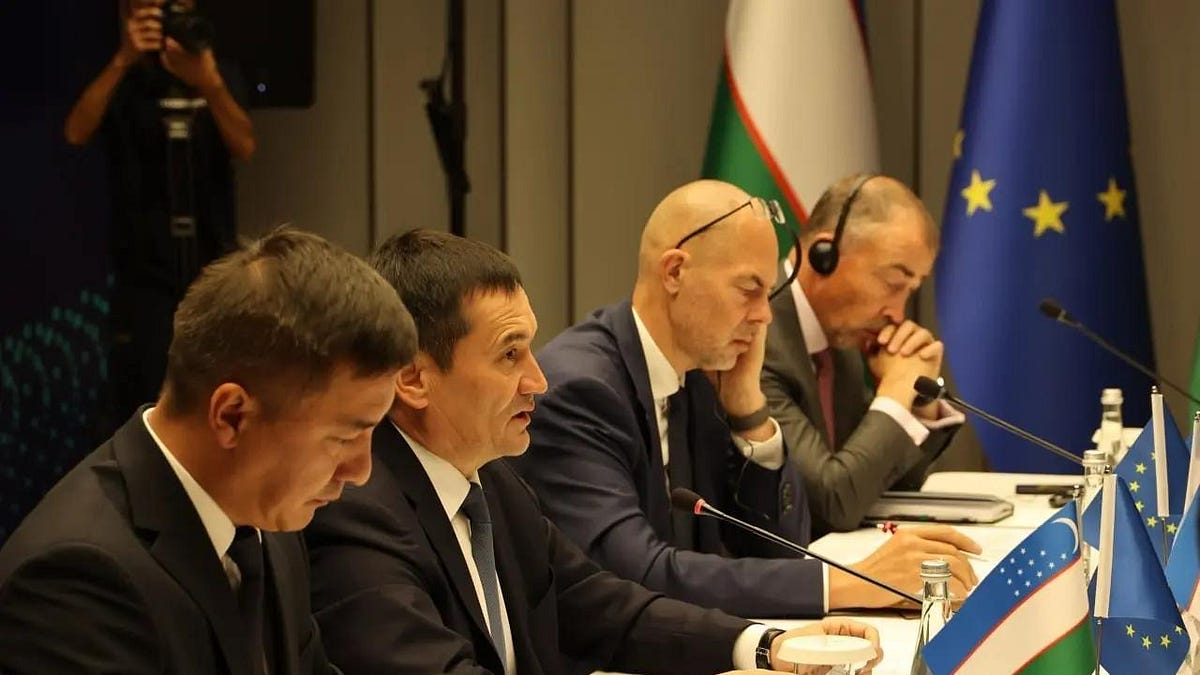
On September 30, the European Union and Uzbekistan convened the Second National Conference on the Trans-Caspian Transport Corridor in Tashkent, bringing together government officials, international financial institutions, development partners, and the private sector. The European Union uses this name for its connectivity agenda along the Trans-Caspian International Transport Route (TITR), also known as the Middle Corridor. The meeting underscored the corridor’s shift from political commitments toward implementation, with a focus on converting shared priorities into investable projects. European Commission Director for Asia and the Pacific Pēteris Ustubs noted the corridor is “moving from ambition to implementation,” with growing emphasis on “concrete projects” and “real investment on the ground” (European External Action Service, September 30).
Discussions covered railway and road infrastructure, logistics centers, border-crossing procedures, digital transport documents, and greater private-sector participation. The conference was held within the EU-funded Trans-Caspian Transport Corridor Coordination Platform, which operates under Global Gateway, the European Union’s global infrastructure investment strategy. The platform brings together the five Central Asian states, the European Union, international financial institutions, and other partners (European External Action Service, September 30).
The conference took place amid growing European financial support for Uzbekistan’s transport sector. In June, the European Bank for Reconstruction and Development (EBDR) approved a loan of up to 38.4 million euros ($43.1 million) for the digital transformation of Uzbekistan Railways. The project will introduce modern traffic-management systems, including dispatching, scheduling, and operational control, while strengthening cybersecurity. Uzbekistan Railways operates a 6,950-kilometer (4,318-mile) network and handles up to 40 percent of the country’s freight, making its modernization relevant to cargo flows toward the Caspian (EBDR, June 17).
European financial engagement with Uzbekistan could expand further. In June, the European Investment Bank opened its Central Asian regional representation in Tashkent and announced that its regional project pipeline was approaching 3 billion euros ($3.37 billion). Potential operations under consideration in Uzbekistan total around 1 billion euros ($1.12 billion) and include transport, energy, climate, digital connectivity, and critical raw materials, with the Trans-Caspian Transport Corridor among the priorities (European External Action Service; European Investment Bank, June 18)
Uzbekistan is also exploring additional links to Azerbaijan across the Caspian. During the September 30 conference, Uztemiryolkonteyner, the state-controlled container freight subsidiary of Uzbekistan Railways, proposed regular feeder services between Turkmenbashi, Turkmenistan, and Baku, Azerbaijan, to expand multimodal transport between Uzbekistan and Europe. “The organization of regular feeder services between Turkmenbashi and Baku will create additional opportunities to accelerate cargo delivery, expand multimodal transportation and strengthen Uzbekistan’s connectivity with European markets,” the company said at the conference (Trend News Agency, September 30).
Kazakhstan is advancing larger-scale infrastructure projects along the Caspian section of TITR. On September 30, German logistics company Rhenus Group, Kazakhstan’s national railway company Kazakhstan Temir Zholy, and the Port of Aktau agreed to move forward with a new trimodal container terminal in Aktau. The planned facility would cover at least 30 hectares (74 acres), integrate rail, road, and maritime transport, and provide at least 150,000 twenty-foot equivalent units (TEU) of additional annual handling capacity. Rhenus links the project to TITR and the European Union’s Global Gateway initiative. Rhenus Group Chief Executive Officer Tobias Bartz said the challenge is “to bring individual infrastructure projects together step by step into an efficient network,” with Kazakhstan playing a key role in connecting the People’s Republic of China, Central Asia, the Caspian region, and Europe (Rhenus Logistics, September 30).
Rhenus’ plans extend beyond Aktau. Bartz said the company intends to develop 14 terminals along sections of TITR across Uzbekistan, Kazakhstan, Azerbaijan, and Türkiye. “After that, they will be connected to our company’s networks in Europe. Rhenus has 23 container terminals and 70 port facilities there. This project will connect the logistics networks of Central Asia and Europe into a single network,” he said (Azernews, October 1).
Traffic volumes are also rising. About 44,000 TEU were transported via TITR in the first eight months of 2026, up 58 percent year on year, Kazakhstan Temir Zholy Deputy Chairman Yerlan Koyshibayev said at the Azerbaijan International Investment Forum in Baku on September 25. He highlighted the corridor’s role in strengthening transport and logistics links between “Central Asia, the Caucasus, and European markets” (Trend News Agency, September 26).
The European Union is deepening its connectivity engagement with Azerbaijan. During her May visit to Baku, EU High Representative for Foreign Affairs and Security Policy Kaja Kallas said there was “clear scope to deepen our cooperation, particularly on trade, transport and digital,” adding that stronger connectivity between “the EU, the South Caucasus, and Central Asia” was a shared strategic interest (European External Action Service, May 5).
That approach became more concrete in July. European Commission President Ursula von der Leyen proposed an EU–Azerbaijan Connectivity Partnership and a High-Level Connectivity Dialogue covering transport, energy, and digital connectivity. Under Global Gateway, she announced up to 200 million euros ($225 million) in grants for South Caucasus connectivity projects, with the potential to mobilize up to 2 billion euros ($2.25 billion) in public and private investment. Possible projects include the railway connection through Nakhchivan and the “development of the Port of Baku” (European Commission, July 1).
The Nakhchivan railway had already entered the preparatory stage in January, when the European Union, Azerbaijan, and the EBRD agreed to launch a feasibility study. The European Union describes the railway as part of the broader Trans-Caspian Transport Corridor linking Europe and Central Asia (European Commission, January 29). Von der Leyen also announced plans for a Regional Connectivity Investment Conference in Baku, bringing together Europe, the South Caucasus, and Central Asia.
The TITR is moving from political ambition toward a more integrated transport system. European-backed modernization in Uzbekistan, German-led logistics investment in Kazakhstan, and the European Union’s expanding connectivity agenda with Azerbaijan are strengthening the Central Asia–Caspian–South Caucasus link. The next stage will be to deepen coordination and connect these projects into an increasingly seamless corridor between Central Asia and Europe.
This article was originally published in Eurasia Daily Monitor.
Thanks for reading! Subscribe today and never miss the latest from Jamestown analysts.
No posts
About the Author