Read The Diplomat, Know The Asia-Pacific
Regardless of the Sino-Vatican agreement, the practical, multifaceted ties between Taiwan and the Holy See have deepened over the past year.
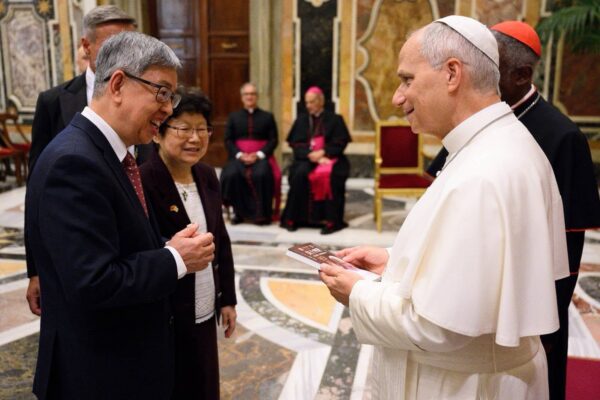
Chen Chien-Jen, former vice president of Taiwan and current president of Academia Sinica, meets with Pope Leo XIV while attending the Pontifical Academy of Sciences (PAS) meeting in the Vatican, Sep. 27, 2026.
Pope Leo XIV succeeded Pope Francis in May 2025, becoming the 267th Pontiff of the global Catholic Church. According to academic and media analyses, Pope Leo XIV’s diplomatic strategy continues Pope Francis’ approach of “engagement” and “openness,” placing a particular emphasis on “peace” and the “de-escalation of potential armed conflicts.”
For Taiwan, the most closely watched diplomatic development during Pope Francis’ tenure was the 2018 provisional agreement on appointing bishops, signed between the Holy See and the People’s Republic of China (PRC). This agreement led the Chinese government to formally recognize the Pope as the Catholic Church’s supreme religious leader, facilitating the joint appointment of multiple bishops by Beijing and the Vatican under its framework. Since taking office, Pope Leo XIV has not altered the Sino-Vatican agreement; instead, he has accelerated the bishop-appointment process, ushering in a “rejuvenated” roster of Chinese bishops.
The Holy See remains the Republic of China (Taiwan)’s sole diplomatic ally in Europe. Since 2000, public discourse has frequently debated whether the Holy See might sever formal diplomatic ties with Taipei in favor of establishing relations with Beijing. Pope Leo XIV’s continuation of his predecessor’s approach to China implies a further deepening of Sino-Vatican relations. However, from Taiwan’s perspective, society should not underestimate its own standing. In fact, since Pope Leo XIV assumed the papacy, the Pontiff has received numerous Taiwanese organizations and individuals.
Furthermore, Pope Leo XIV has not shied away from being photographed alongside the Taiwan national flag. These gestures show that the Chicago-born Pope is friendly toward Taiwan, understands Taiwan’s significance to the global community, and recognizes the distinct differences between Taiwan and the PRC.
When discussing Taiwan-Vatican relations, the analytical lens must not be restricted solely to the continuation of the Sino-Vatican agreement or ongoing negotiations. Instead, one must examine whether the practical, multifaceted ties between Taiwan and the Holy See have correspondingly deepened. From Taipei’s perspective, the answer is a resounding yes.
From September 23 to 26, 2026, Chen Chien-Jen, former vice president of Taiwan and current president of Academia Sinica, attended the Pontifical Academy of Sciences (PAS) meeting and its biennial plenary session at the Vatican. Chen presided over the seventh session, titled “Medicine, Neuroscience, and Human Well-being.” Following the meeting, Chen and the PAS issued a joint statement titled “The Future of Science in a Changing World,” serving as an action plan for the international scientific community. Through the Holy See’s global platform, Taiwan once again showcased its scientific prowess to the world.
Shortly after, from October 7 to 15, Bishop John Lee Keh-mien, president of the Chinese Regional Bishops’ Conference in Taiwan, along with Professor Chou Te-yu and Consultor Yeh Chia-yen – members of the Holy See’s Dicastery for the Laity, Family and Life – attended a major conference at the Vatican. Hosted by Pope Leo XIV, the event marked the 10th anniversary of Pope Francis’ apostolic exhortation, Amoris Laetitia. The grand-scale conference welcomed 187 invited guests, including 111 presidents of episcopal conferences from around the globe. Taiwan was not only present, but Taiwanese scholars attended in their official capacities as members of the Vatican’s Dicastery, underscoring Taiwan’s deep engagement with the Holy See.
Furthermore, on October 19, Pope Leo XIV appointed new members to the Holy See’s International Theological Commission. Sister Hu Shu-qin, an associate professor at the Fu Jen Faculty of Theology of St. Robert Bellarmine, was appointed as a new member of the Commission for the 2026-2031 term. Sister Hu is the first ethnic Chinese theologian to be appointed to the Commission since Archbishop Savio Hon Tai-Fai, S.D.B., who served from 2004 to 2014. Her long-standing dedication to theological education and academic research in Taiwan has deepened Taiwan’s participation in global Catholic theology, further demonstrating the Vatican’s high regard for theological development in Taiwan.
Immediately following, from October 22 to 24, the Vatican’s Dicastery for Evangelization hosted the “The Church of the Sheaves” international conference in Rome. Under the theme “A Church for All: Synodal in Method, Missionary in Spirit, Credible in Love,” the event gathered over a hundred scholars worldwide. Grounded in the spirit and method of synodality, the conference emphasized mutual listening and sharing, signaling a shift in the Catholic Church’s approach to evangelization from the traditional model of missionaries transmitting and teaching, to local churches sharing and receiving each other’s gifts to enrich one another.
Professor Tan Liang-chen, an assistant professor and well-known public Catholic theologian at the Fu Jen Faculty of Theology of St. Robert Bellarmine, was selected to attend the Rome conference. He brought Taiwan’s voice – and the voice of the Taiwanese Catholic Church – to the West and the Vatican, sharing it with the universal Church.
The relationship between Taiwan and the Holy See is concretely built upon these small yet monumental steps. Taiwan’s Ministry of Foreign Affairs has been advancing an “Integrated Diplomacy” strategy, using “Values,” “Alliances,” and “Trade” to expand Taiwan’s friendships – a deeper diplomatic approach increasingly evident in Europe. The good that Taiwan can bring to the world extends beyond high-tech industries like semiconductors and AI; it also includes the vibrant space for religious faith nurtured within Taiwan’s free society.
The stable, deepening relationship between Taiwan and the Holy See is the fruitful result of joint efforts by Taiwanese civil society, the local Catholic Church, and the government. These rich fruits stem from the relentless educational and research dedication of the Fu Jen Faculty of Theology of St. Robert Bellarmine and Fu Jen Catholic University. More importantly, they rely on tireless diplomats on the front lines in Rome and on Ketagalan Boulevard in Taipei. Even when the road ahead is fraught with challenges, they keep working diligently, paving bridges for the present and the future, which is why Taiwan-Vatican ties remain so steadfast.
In the face of shifting Sino-Vatican dynamics, Taiwan has no reason to worry; in the eyes of the Holy See, Taiwan remains an undeniably “precious” presence.
Subscribe today and join thousands of diplomats, analysts, policy professionals and business readers who rely on The Diplomat for expert Asia-Pacific coverage.
Get unlimited access to in-depth analysis you won’t find anywhere else, from South China Sea tensions to ASEAN diplomacy to India-Pakistan relations. More than 5,000 articles a year.
Already have an account? .
Pope Leo XIV succeeded Pope Francis in May 2025, becoming the 267th Pontiff of the global Catholic Church. According to academic and media analyses, Pope Leo XIV’s diplomatic strategy continues Pope Francis’ approach of “engagement” and “openness,” placing a particular emphasis on “peace” and the “de-escalation of potential armed conflicts.”
For Taiwan, the most closely watched diplomatic development during Pope Francis’ tenure was the 2018 provisional agreement on appointing bishops, signed between the Holy See and the People’s Republic of China (PRC). This agreement led the Chinese government to formally recognize the Pope as the Catholic Church’s supreme religious leader, facilitating the joint appointment of multiple bishops by Beijing and the Vatican under its framework. Since taking office, Pope Leo XIV has not altered the Sino-Vatican agreement; instead, he has accelerated the bishop-appointment process, ushering in a “rejuvenated” roster of Chinese bishops.
The Holy See remains the Republic of China (Taiwan)’s sole diplomatic ally in Europe. Since 2000, public discourse has frequently debated whether the Holy See might sever formal diplomatic ties with Taipei in favor of establishing relations with Beijing. Pope Leo XIV’s continuation of his predecessor’s approach to China implies a further deepening of Sino-Vatican relations. However, from Taiwan’s perspective, society should not underestimate its own standing. In fact, since Pope Leo XIV assumed the papacy, the Pontiff has received numerous Taiwanese organizations and individuals.
Furthermore, Pope Leo XIV has not shied away from being photographed alongside the Taiwan national flag. These gestures show that the Chicago-born Pope is friendly toward Taiwan, understands Taiwan’s significance to the global community, and recognizes the distinct differences between Taiwan and the PRC.
When discussing Taiwan-Vatican relations, the analytical lens must not be restricted solely to the continuation of the Sino-Vatican agreement or ongoing negotiations. Instead, one must examine whether the practical, multifaceted ties between Taiwan and the Holy See have correspondingly deepened. From Taipei’s perspective, the answer is a resounding yes.
From September 23 to 26, 2026, Chen Chien-Jen, former vice president of Taiwan and current president of Academia Sinica, attended the Pontifical Academy of Sciences (PAS) meeting and its biennial plenary session at the Vatican. Chen presided over the seventh session, titled “Medicine, Neuroscience, and Human Well-being.” Following the meeting, Chen and the PAS issued a joint statement titled “The Future of Science in a Changing World,” serving as an action plan for the international scientific community. Through the Holy See’s global platform, Taiwan once again showcased its scientific prowess to the world.
Shortly after, from October 7 to 15, Bishop John Lee Keh-mien, president of the Chinese Regional Bishops’ Conference in Taiwan, along with Professor Chou Te-yu and Consultor Yeh Chia-yen – members of the Holy See’s Dicastery for the Laity, Family and Life – attended a major conference at the Vatican. Hosted by Pope Leo XIV, the event marked the 10th anniversary of Pope Francis’ apostolic exhortation, Amoris Laetitia. The grand-scale conference welcomed 187 invited guests, including 111 presidents of episcopal conferences from around the globe. Taiwan was not only present, but Taiwanese scholars attended in their official capacities as members of the Vatican’s Dicastery, underscoring Taiwan’s deep engagement with the Holy See.
Furthermore, on October 19, Pope Leo XIV appointed new members to the Holy See’s International Theological Commission. Sister Hu Shu-qin, an associate professor at the Fu Jen Faculty of Theology of St. Robert Bellarmine, was appointed as a new member of the Commission for the 2026-2031 term. Sister Hu is the first ethnic Chinese theologian to be appointed to the Commission since Archbishop Savio Hon Tai-Fai, S.D.B., who served from 2004 to 2014. Her long-standing dedication to theological education and academic research in Taiwan has deepened Taiwan’s participation in global Catholic theology, further demonstrating the Vatican’s high regard for theological development in Taiwan.
Immediately following, from October 22 to 24, the Vatican’s Dicastery for Evangelization hosted the “The Church of the Sheaves” international conference in Rome. Under the theme “A Church for All: Synodal in Method, Missionary in Spirit, Credible in Love,” the event gathered over a hundred scholars worldwide. Grounded in the spirit and method of synodality, the conference emphasized mutual listening and sharing, signaling a shift in the Catholic Church’s approach to evangelization from the traditional model of missionaries transmitting and teaching, to local churches sharing and receiving each other’s gifts to enrich one another.
Professor Tan Liang-chen, an assistant professor and well-known public Catholic theologian at the Fu Jen Faculty of Theology of St. Robert Bellarmine, was selected to attend the Rome conference. He brought Taiwan’s voice – and the voice of the Taiwanese Catholic Church – to the West and the Vatican, sharing it with the universal Church.
The relationship between Taiwan and the Holy See is concretely built upon these small yet monumental steps. Taiwan’s Ministry of Foreign Affairs has been advancing an “Integrated Diplomacy” strategy, using “Values,” “Alliances,” and “Trade” to expand Taiwan’s friendships – a deeper diplomatic approach increasingly evident in Europe. The good that Taiwan can bring to the world extends beyond high-tech industries like semiconductors and AI; it also includes the vibrant space for religious faith nurtured within Taiwan’s free society.
The stable, deepening relationship between Taiwan and the Holy See is the fruitful result of joint efforts by Taiwanese civil society, the local Catholic Church, and the government. These rich fruits stem from the relentless educational and research dedication of the Fu Jen Faculty of Theology of St. Robert Bellarmine and Fu Jen Catholic University. More importantly, they rely on tireless diplomats on the front lines in Rome and on Ketagalan Boulevard in Taipei. Even when the road ahead is fraught with challenges, they keep working diligently, paving bridges for the present and the future, which is why Taiwan-Vatican ties remain so steadfast.
In the face of shifting Sino-Vatican dynamics, Taiwan has no reason to worry; in the eyes of the Holy See, Taiwan remains an undeniably “precious” presence.
Thomas Ching Wei Tu is a Ph.D. Candidate at National Chengchi University, Taiwan, specializing in comparative politics, religion, and politics. Tu has authored works such as “Neo-Interpretation of the Sino-Vatican Agreement: Provision Simulation Based on the Concordat Model” and “Diplomacy and Divided Nations: The Holy See’s Approach to China and Taiwan.”
Get briefed on the story of the week, and developing stories to watch across the Asia-Pacific.
About the Author