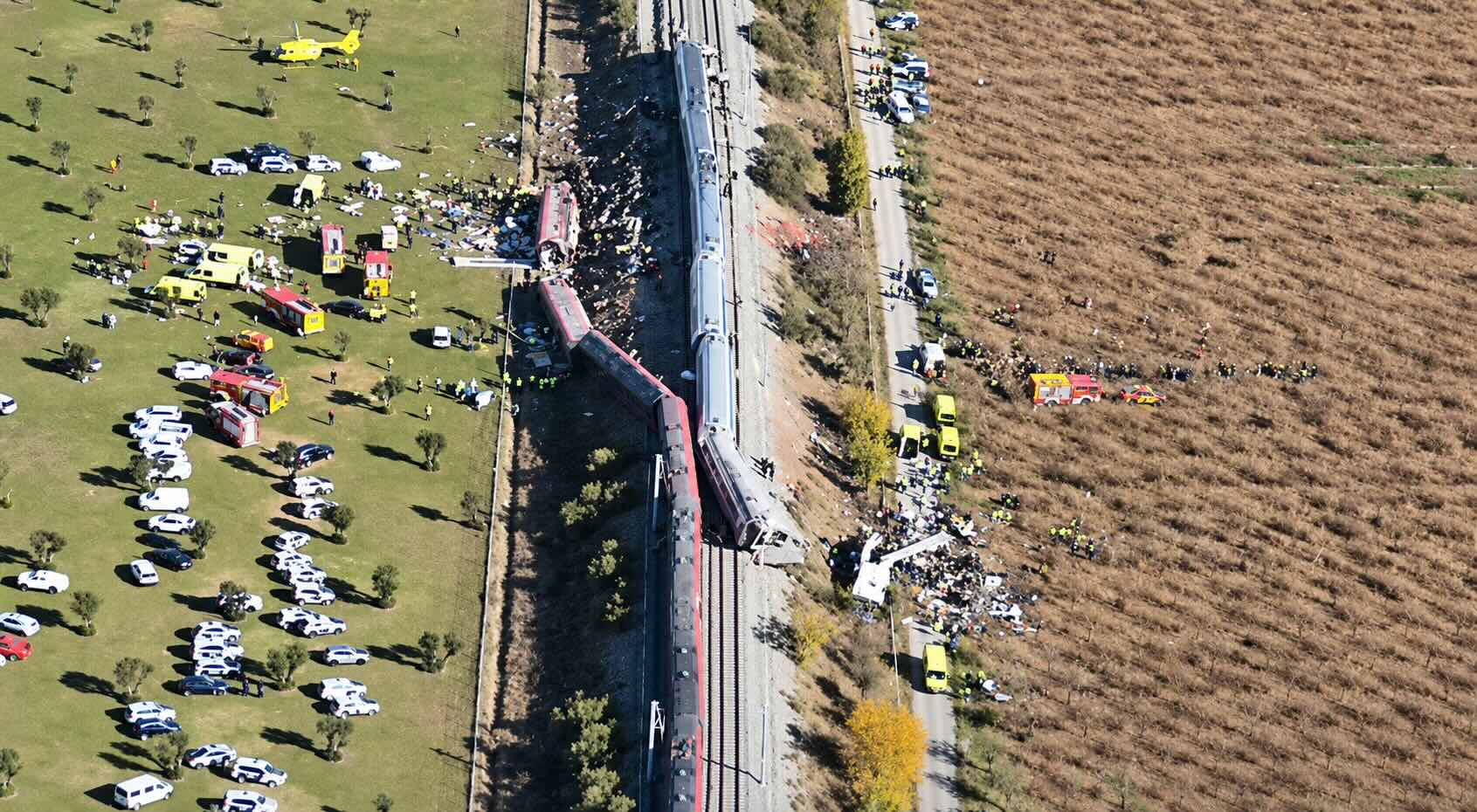
The collision occurred on 28 October near Urda, on the Madrid–Seville high-speed line, when a Renfe AVE train struck a stationary Iryo service.
It followed another fatal accident on the same railway corridor in January, when 46 people died near Adamuz in Córdoba province.
The latest disaster has raised questions about how Spain manages one of Europe’s largest high-speed railway networks and whether its safety systems have kept pace with expanding passenger traffic.
According to an updated report from Spain’s public broadcaster RTVE, 56 of the 69 confirmed fatalities had been identified by Saturday evening, 31 October.
Forty-one injured passengers remained in hospital, including 19 receiving intensive care. The authorities were continuing their investigation and identification work.
The investigation is focusing on events that unfolded after the railway’s automatic train-control system failed.
The LZB signalling system, which monitors train movements and can intervene to prevent collisions, reportedly stopped functioning at approximately 8.31am.
Several trains were brought to a halt. Responsibility for controlling their movements then passed to a central operations facility in Madrid.
At approximately 8.36am, controllers authorised a Renfe service to resume its journey at normal speed, despite another train remaining stationary farther along the line.
The collision occurred at approximately 8.53am.
According to preliminary findings from the independent accident investigation authority, the Renfe train was travelling at an estimated speed of between 160 and 200 kilometres per hour when it struck the Iryo service.
The precise speed remains subject to examination of the train’s recorded data.
Transport Minister Óscar Puente has said that the decision to authorise normal-speed travel appears to have breached a safety protocol requiring a maximum speed of 40 kilometres per hour under such circumstances.
However, the investigation has not yet established the full sequence of technical and organisational failures or determined legal responsibility.
The accident has exposed disagreements between the government and railway unions over the condition of Spain’s infrastructure.
Puente has highlighted the apparent decision taken by traffic controllers after the signalling failure.
Railway workers’ representatives argue that attention should also be directed towards equipment reliability, staffing levels and the pressures facing control-centre personnel.
As Reuters reported, the minister acknowledged that the LZB system experiences approximately 170 interruptions annually, describing this frequency as consistent with historical averages.
The Madrid–Seville route is undergoing an upgrade to the European Rail Traffic Management System, intended to improve interoperability and train protection across European railways.
The upgrade has been delayed.
A contract awarded in 2021 envisaged the installation of the newer system by early 2026. Following contractual changes, the equipment is now expected to enter operation in early 2027.
Puente has attributed the delay partly to the complexity of upgrading infrastructure while maintaining railway services.
The investigation will need to establish what relationship, if any, exists between the delayed modernisation programme and the circumstances of the collision.
The disaster has occurred at a particularly sensitive moment for Prime Minister Pedro Sánchez.
Spain is preparing for an early general election on 29th November, with the government already facing political scrutiny over public services and economic management.
The collision has substantially altered the political debate.
Opposition parties have demanded explanations about railway maintenance and the government’s handling of safety concerns. Some political figures and railway unions have called for Puente’s resignation.
The minister has rejected those demands, arguing that his immediate responsibility is to establish what happened and address the resulting safety problems.
Sánchez has promised a full investigation and acknowledged that public confidence in the high-speed railway system has been severely damaged.
According to RTVE’s account of the political response, most political parties temporarily suspended their pre-election activities following the disaster.
Spain’s high-speed railway network has frequently been presented as an example of successful infrastructure investment, connecting major cities and providing an alternative to domestic air travel.
The system has also undergone significant commercial change.
The opening of high-speed passenger services to competition has increased the number of operators and contributed to rising demand.
Passenger journeys increased from approximately 35 million in 2019 to 49 million in 2024, according to figures cited by the Associated Press from Spain’s competition regulator.
These developments do not establish a connection between market liberalisation and the accidents. They do, however, raise questions about whether investment in infrastructure, signalling and operational capacity has accompanied the expansion of services.
EU Today’s initial report on the Toledo collision examined the immediate consequences of the disaster. The emerging investigation now places greater emphasis on the decisions taken after the signalling failure and the adequacy of the systems designed to prevent such decisions from becoming fatal.
Two major accidents on the same high-speed corridor within one year have made railway safety a central political issue.
The findings of the independent investigation will be critical not only for determining responsibility, but also for establishing whether Spain’s railway management and safety procedures require wider reform.
With the general election approaching, the government faces pressure to provide explanations before investigators have completed their technical assessment.
EUToday publishes articles from a variety of outside sources which express a wide range of viewpoints.Opinions expressed in these articles are not necessarily those of EUToday.
Stay connected with EU Today and be among the first to hear about new reporting, interviews, events and subscriber updates.
EU Today brings you the latest news and commentary from across the EU and beyond.
A new EU Today white paper examines how fossil energy is used for war and coercion.
© EU Today 2014–2026. All rights reserved.
EU Today LTD, 71–75 Shelton Street, Covent Garden, London WC2H 9JQ
Privacy and cookie settings | Sitemap | Contact Us
About the Author