3 November 2026
Andrew Rosindell
3 November 2026, 7:00am
Following the invasion of Ukraine, we have seen a breakdown in the norms of international affairs and an unparalleled shift in the post-Cold War order. Whether it’s Ukraine or increasingly Iran, these proxy conflicts are the consequence of increasing multipolarisation. Without an unchallenged Western hegemon, and consequently all-powerful and predictable allies, the preservation of the nation-state and its interests is increasingly dependent upon projected force.
The modern tendency to subordinate national sovereignty to supranational structures has encouraged the dangerous illusion that hard power is no longer necessary. Yet institutions do not deter aggressors. Projected force must be sufficient to deter or deny any encroachment of national sovereignty, or the sovereignty of our allies.
Britain retains not all, but some of its political and military clout. Nato is not as unified as it once was, but our participation still counts for something, as does the frayed special relationship with the United States, and not least our position as the world’s fifth-largest economy. Yet, in today’s world of rogue states and dangerous non-state actors, alongside decades of domestic policy that has stripped Britain’s military capability to the bone, our assumptions of national security are breaking down. The US is no longer a nation we can assume will stand in for our defence. With the rise of China and the permeation of Chinese interests throughout the organs of international governance, the United States faces a strategic competitor of such scale that it can no longer be relied upon to provide comprehensive protection for Britain and its interests overseas.
Given this context, the longer the United Kingdom fails to get a grip on defence spending and prolongs the necessary cuts to realise this objective, the worse our situation becomes. While the sovereignty of Great Britain will likely never be in question due to our participation within Nato, our ability to deter and deny actions against uniquely British interests is increasingly in question.
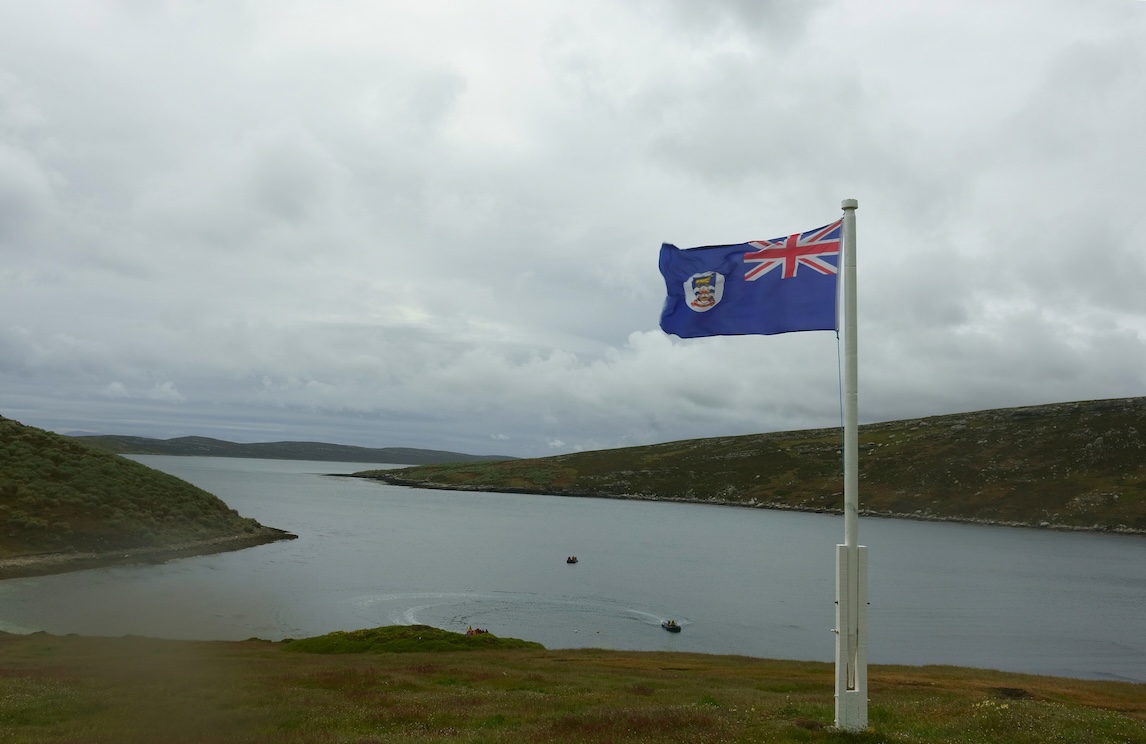
The key example of a uniquely British interest would be our territory in the Falklands, and the most prominent display of decline is in the Royal Navy.
Argentina invades the Falkland Islands
Since 2020, the Royal Navy has gone from 13 frigates to seven, and more ships are due to retire before their replacements arrive. Frigates and destroyers are the backbone of the fleet, and without them our two aircraft carriers cannot safely put to sea. Last year’s carrier strike group to the Indo-Pacific relied on Norwegian, Canadian, and Spanish ships as escorts. Fielding a fully sovereign strike group is now a huge stretch. Only a handful of our six destroyers are available at any one time, too few to meet our Nato commitments and project strength elsewhere. This summer, not one of our attack submarines was at sea, held back by repairs, refits, and a shortage of crews, while the focus goes on renewing the ageing nuclear deterrent. Lose the ships and you lose the skills to sail them. that spiral is very hard to reverse.
The consequences are already on full display. When an Iranian drone struck RAF Akrotiri in March, it took more than a week for a single destroyer to sail for Cyprus. If a British Overseas Territory came under threat tomorrow, could we send a task force as we did in 1982 and keep our other commitments? I am not confident we could.
At House of Commons defence questions on 19 October, I asked the secretary of state for defence, Wes Streeting, whether he would take the defence of His Majesty’s Overseas Territories seriously and rebuild our naval capability. He replied that it was “irresponsible, not to mention inaccurate” to suggest the UK could not defend the Falkland Islands, and that we had seen “a very visible demonstration” of that only recently. He then chose a party-political jibe over engaging with a single figure I put to him.
Oral questions
That answer did not address my concerns. Nobody doubts the courage of the forces stationed in the South Atlantic. The question is whether Britain could reinforce the islands quickly if it had to, and whether a navy with seven frigates and no attack submarines at sea is a credible deterrent to anyone watching. Reassurance is not a plan.
Every government since the end of the Cold War has let this happen, and it is getting worse. Most of the extra money the Ministry of Defence asks for now goes on keeping existing commitments going, not on building new capability. Since George Osborne moved the cost of renewing the nuclear deterrent onto the defence budget in 2010, it has squeezed everything else.
In my new capacity as a Reform UK MP, I would suggest the following. First, the Treasury must fund the deterrent separately from the defence budget, as it did before. Second, defence spending must then rise significantly. Germany has committed to spending 3.5% of GDP on defence by 2029, while this government will only promise a path to 3% by 2030. Third, the defence of the Falklands and our other Overseas Territories must be built into naval planning. That means ships ready to reinforce them without stripping our Nato commitments.
Britain cannot defend what it is not prepared to pay for. Our Overseas Territories have stood by us, and Reform UK will make sure we stand by them.
Starmer announces defence spending hike ahead of Trump meeting
DAILY
Politics@Lunch
WEEKLY
Week in Review
About the Author