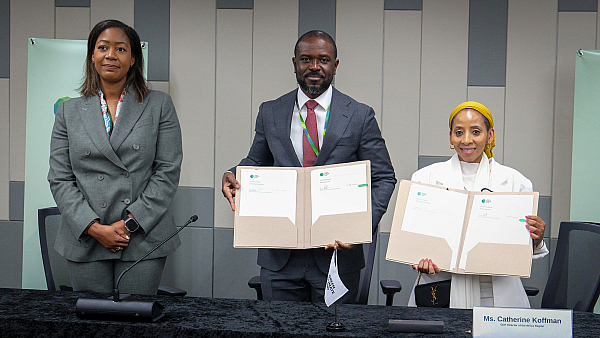
Africa Finance Corporation (AFC) (www.AfricaFC.org), the continent’s leading infrastructure solutions provider, and the Green Climate Fund (GCF) today launched the Africa Sovereign Climate Facility (ASCF) at a signing ceremony in Korea, marking a significant step towards scaling up climate finance and accelerating low-carbon, climate-resilient development across Africa.
With total financing of US$690 million, the ASCF is designed to help African countries address the growing impacts of climate change while advancing their economic development priorities. By combining technical assistance, capacity building and large-scale blended finance, the programme will support governments in integrating climate considerations into national development planning and accelerating the implementation of their Nationally Determined Contributions (NDCs).
The programme’s first phase will focus on Angola, Benin, Côte d’Ivoire and Nigeria, countries facing significant climate vulnerabilities, infrastructure deficits and rising greenhouse gas emissions. Through an integrated, country-led approach, the ASCF will support interventions across critical sectors, including clean energy, health and well-being, food and water security, and climate-resilient infrastructure and the built environment.
Samaila Zubairu, President and Chief Executive Officer of AFC, said: “The infrastructure we build today must both power Africa’s growth and withstand the climate pressures of tomorrow. Through this partnership with GCF, we are combining concessional finance with AFC’s project development expertise and capital to help governments turn national priorities into reliable energy, stronger food and water systems, and resilient infrastructure. Success will be measured in businesses that keep producing, communities better protected and jobs sustained. That is how climate finance becomes an investment in Africa’s lasting prosperity.”
Catherine Koffman, GCF Regional Director for Africa, said: “The Africa Sovereign Climate Facility will help Angola, Benin, Côte d’Ivoire and Nigeria turn national climate priorities into investable projects in clean energy, resilient infrastructure, food systems and water security. GCF’s USD 280 million is designed to work alongside substantial co-financing, reaching an estimated 4.5 million people and avoiding 3.4 million tonnes of emissions. This partnership shows how blended finance can strengthen sovereign investment systems and deliver climate capital at scale.”
The launch builds on AFC’s longstanding partnership with GCF to mobilise climate finance and advance sustainable infrastructure development across Africa. In 2023, GCF committed US$253 million to AFC Capital Partners’ Infrastructure Climate Resilient Fund (ICRF), supporting the development of climate-resilient infrastructure as an investable asset class and helping catalyse additional investment from institutional and private-sector investors. The collaboration reflects a shared commitment to using innovative financing structures to address Africa’s infrastructure needs while strengthening resilience to climate change.
As part of its participation in the ASCF, AFC will arrange and fully fund a parallel commercial facility of up to US$260 million, with a tenor of up to 10 years, for Angola, Benin, Côte d’Ivoire and Nigeria through their respective Ministries of Finance. The facility will complement concessional climate financing, expanding the capital available to support eligible investments while helping participating governments integrate climate resilience and low-carbon development into national planning.
Over its lifetime, the ASCF is expected to reduce, avoid, remove or sequester approximately 5.78 million tonnes of carbon dioxide equivalent (tCO₂e) in greenhouse gas emissions — roughly equivalent to removing 1.3 million cars from the road for one year. The programme is also expected to reach 5.2 million beneficiaries through climate adaptation interventions, equivalent to the current estimated population of Cape Town, South Africa.
Africa remains particularly exposed to the effects of climate change, with rising temperatures, increasingly unpredictable rainfall and more frequent extreme weather events threatening livelihoods, food and water security, infrastructure and economic productivity. Rapid population growth and urbanisation are adding further pressure on public services and infrastructure systems, reinforcing the urgency of embedding climate resilience into the continent’s development trajectory.
The ASCF aims to strengthen the link between national climate priorities and investable infrastructure opportunities, helping participating countries move beyond incremental responses towards more coordinated and transformational climate action. Its integrated financing model is designed to mobilise additional concessional and commercial capital alongside technical assistance and capacity building, addressing barriers to investment and supporting projects capable of delivering climate and development benefits at scale.
The launch reinforces AFC’s commitment to mobilising capital and deploying innovative financing solutions to address Africa’s infrastructure needs while supporting sustainable, inclusive and climate-resilient economic growth. Through its partnership with the Green Climate Fund, AFC aims to help bridge the gap between Africa’s climate ambitions and the financing required to translate those ambitions into tangible development outcomes.
Media Enquiries:
Yewande Thorpe
Communications
Africa Finance Corporation
Mobile +234 1 279 9654
Email: yewande.thorpe@africafc.org
About AFC:
AFC was established in 2007 to be the catalyst for pragmatic infrastructure and industrial investments across Africa. AFC’s approach combines specialist industry expertise with a focus on financial and technical advisory, project structuring, project development, and risk capital to address Africa’s infrastructure development needs and drive sustainable economic growth.
Nineteen years on, AFC has developed a track record as the partner of choice in Africa for investing and delivering on instrumental, high-quality infrastructure assets that provide essential services in the core infrastructure sectors of power, natural resources, heavy industry, transport, and telecommunications. AFC has 49 member countries and has invested over US$20 billion in 36 African countries since its inception.
www.AfricaFC.org
Disclaimer: The contents of this press release was provided from an external third party provider. This website is not responsible for, and does not control, such external content. This content is provided on an “as is” and “as available” basis and has not been edited in any way. Neither this website nor our affiliates guarantee the accuracy of or endorse the views or opinions expressed in this press release.
The press release is provided for informational purposes only. The content does not provide tax, legal or investment advice or opinion regarding the suitability, value or profitability of any particular security, portfolio or investment strategy. Neither this website nor our affiliates shall be liable for any errors or inaccuracies in the content, or for any actions taken by you in reliance thereon. You expressly agree that your use of the information within this article is at your sole risk.
To the fullest extent permitted by applicable law, this website, its parent company, its subsidiaries, its affiliates and the respective shareholders, directors, officers, employees, agents, advertisers, content providers and licensors will not be liable (jointly or severally) to you for any direct, indirect, consequential, special, incidental, punitive or exemplary damages, including without limitation, lost profits, lost savings and lost revenues, whether in negligence, tort, contract or any other theory of liability, even if the parties have been advised of the possibility or could have foreseen any such damages.
© ZAWYA 2026
About the Author