Home » Opinion »
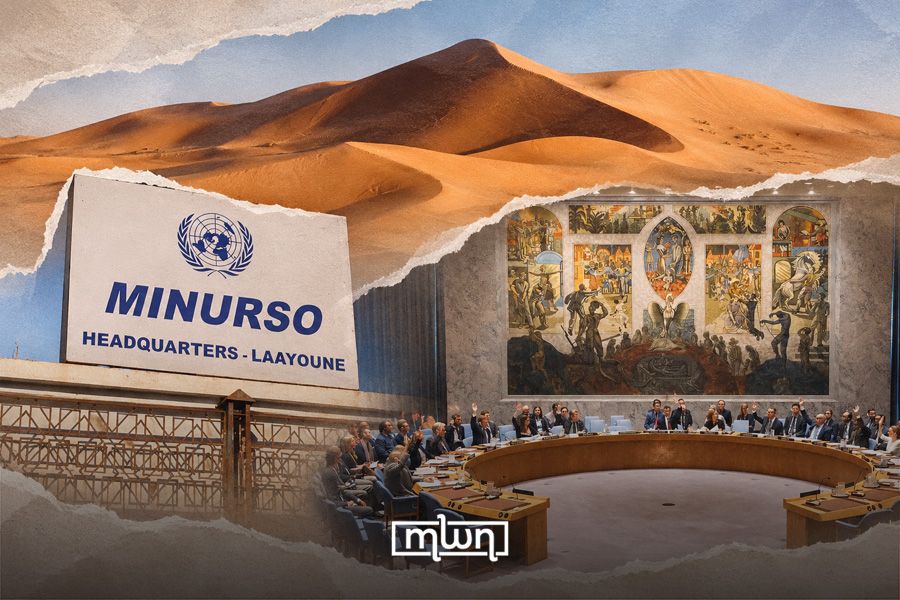
A composite image featuring MINURSO’s mission headquarters, the United Nations Security Council chamber, and Western Sahara. / MWN Design Team
On 30 October 2026, the Security Council failed to adopt either of two competing draft resolutions concerning the future of MINURSO. The American draft, which proposed a one-year extension of the mission while revising its name and operational framework and placing Morocco’s Autonomy Proposal under Moroccan sovereignty at the centre of negotiations, received eleven votes in favour. It was vetoed by Russia, while China, Pakistan and Somalia abstained.
The Russian alternative, proposing a straightforward one-year renewal of MINURSO, received only three votes in favour. The United States voted against it, while eleven members abstained. Neither draft therefore secured the Council’s agreement.
The significance of this double failure lies not simply in the absence of a renewed mandate. It lies in the Council’s inability to agree on the political framework through which the dispute should henceforth be addressed. The American initiative sought to move the process towards a different negotiating basis; the Russian alternative tried to preserve the existing institutional framework. Their failure exposed a deeper disagreement over the relationship between self-determination, autonomy, the MINURSO’s original mandate and the future role of the United Nations.
The expiry of MINURSO’s mandate is not equivalent to the closure of the Sahara question within the United Nations. The Security Council retains its authority, while the Secretary-General’s good offices and the wider political process are conceptually distinct from the continued existence of a particular peacekeeping mission. The immediate consequence is therefore an institutional and political uncertainty, rather than a definitive legal settlement.
To understand why the dispute remains so resistant to political transformation, it is necessary to look beyond the immediate diplomatic confrontation and examine the institutional legacy of the Cold War.
The admission of the auto-proclaimed Sahrawi Arab Democratic Republic (SADR) to the Organisation of African Unity ( OAU) in February 1982, as its fifty-first member, took place within a highly polarised continental and international environment. The issue became a major source of division within the OAU and contributed to Morocco’s withdrawal from the organisation in 1984.
The subsequent transformation of the OAU into the African Union (AU), formally launched in 2002 following the adoption and entry into force of its Constitutive Act, was intended to establish a new framework for continental integration, development, peace and security. Yet the SADR’s membership, acquired under the OAU, was carried into the new organisation.
This institutional continuity illustrates how a political position established during the Cold War survived the transformation of the organisation that had originally accommodated it.
The question is not merely whether the AU inherited the OAU’s membership structure, but whether the persistence of that structure has also preserved political divisions that the new organisation was expected to transcend.
From this perspective, the OAU–AU transition offers an important example of the Cold War prism through which the Sahara question has continued to be viewed. It might not, by itself, prove that the transition was deliberately designed to consolidate the Sadr’s position. Nevertheless, the institutional outcome is clear: the dispute was carried into a new continental organisation without resolving the political contradiction that had divided its predecessor.
The same historical perspective is relevant to Algeria’s role. Its support for the Polisario Front and its diplomatic engagement in the dispute cannot be understood exclusively through the formal distinction between parties and neighbouring states.
Algeria has consistently defended the principle of self-determination as the basis for a settlement, while Morocco considers its Autonomy Proposal under Moroccan sovereignty to be the basis for negotiations. These positions reflect not only competing legal and political interpretations but also strategic assumptions inherited from an earlier regional order.
The question is whether the continuation of these assumptions remains compatible with the international environment now emerging. The Security Council vote suggests that the dispute has become increasingly entangled with wider geopolitical competition, particularly the divergent approaches of the United States and Russia.
This does not mean that every position taken by Moscow or Washington should be reduced to an extension of Cold War alignments. Their respective positions must be assessed on their own terms. Yet the use of the veto, followed by the failure of the Russian alternative, demonstrates how great-power disagreement can prevent the Council from agreeing even on the continuation of an existing UN instrument.
For Morocco, the non-renewal of MINURSO’s mandate represents an opportunity to demonstrate that the international approach should move beyond an institutional framework that has failed to produce a definitive settlement over more than three decades.
That political interpretation must be distinguished from the legal consequences of the vote. The end of the mission does not automatically remove the issue from the Security Council’s agenda, nor does it establish that the Moroccan proposal has been accepted as a final settlement. Resolution 2797 (2025), which preceded the October 2026 vote, had already placed Morocco’s Autonomy Proposal at the basis of negotiations while retaining the objective of a mutually acceptable political solution consistent with the UN Charter and the principle of self-determination.
The challenge now is to determine whether the absence of an agreed MINURSO mandate can lead to a more effective political process, rather than a further institutional deadlock.
This also requires addressing the humanitarian dimension of the dispute, particularly the prolonged situation of the population in the Tindouf camps. Algeria’s role as host country, its political influence and its participation in the UN process raise questions of political and institutional responsibility. These questions should be examined separately from any assertion of international legal liability, which requires a specific legal basis and evidence.
The metaphor of the phantom limb refers here to the persistence of political reflexes and institutional arrangements after the international environment that produced them has fundamentally changed.
The Western Sahara dispute is one illustration of this phenomenon. Its present framework remains influenced by decisions, alliances and strategic perceptions formed during the Cold War.
The OAU–AU transition demonstrates the institutional dimension of this continuity; the Security Council vote of 30 October 2026 reveals its continuing geopolitical consequences.
The failure of the Council to adopt either draft should therefore be read neither as a definitive victory for one side nor as the end of international involvement. It is a moment of institutional uncertainty that exposes the limits of the existing approach and that invites the United Nations to explore other political framworks that can lead to a definitive, just and lasting solution.
Hence, the central question is whether the actors concerned can move beyond inherited strategic positions and engage with the realities of a changing international order.
A durable settlement will require more than the preservation or abandonment of MINURSO. It will require a political framework capable of reconciling the relevant principles of international law with the need for regional stability, cooperation and a mutually acceptable outcome.
Ultimately, the challenge is not simply to close the chapter of MINURSO, but to prevent the Cold War’s institutional legacy from continuing to determine the future of the region. This is precisely what the Royal Cabinet Communique of 30 October 2026 reveals in its depth.
Copyright 2026 Morocco World News. All rights reserved. Morocco World News is not responsible for the content of external sites.
Read about our approach to external linking.
Login to your account below
Please enter your username or email address to reset your password.
All Right Reserved © 2026 Morocco World News .
About the Author