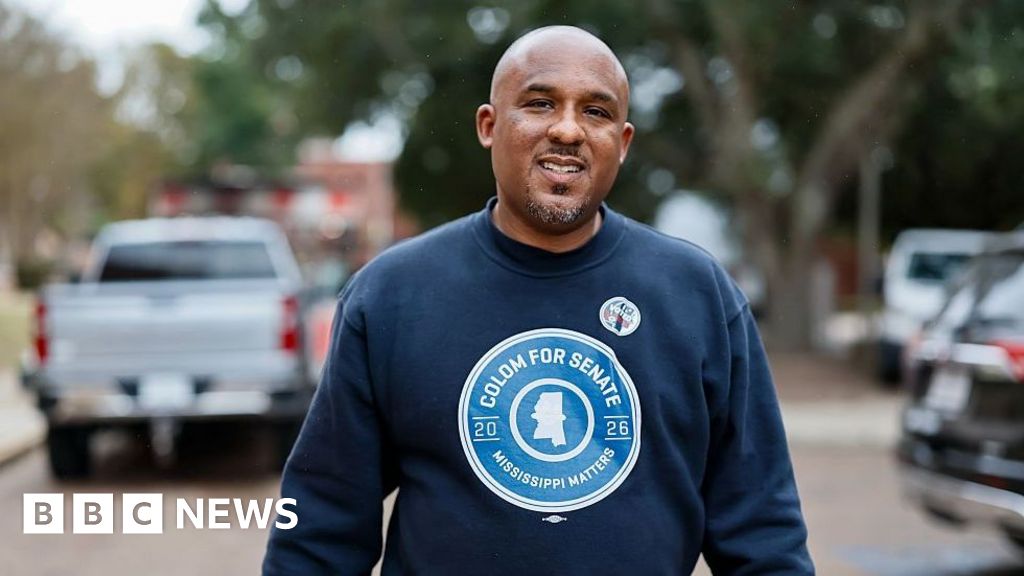
Democrat Scott Colom and Republican incumbent Cindy Hyde-Smith are locked in a tight race for a US Senate seat in Mississippi, a state that has not elected a Democratic candidate to the upper chamber in more than 40 years.
With 96% of votes counted by Wednesday morning, Colom was leading by 65 votes, with about 50,000 ballots still to be counted.
Hyde-Smith, the first woman to represent Mississippi in the US Congress, was elected in 2018 and has been endorsed by Donald Trump. The president won the state by more than 22 points in 2024.
If Colom wins the race, he would be the first black US senator elected in Mississippi since 1875.
The race comes as Democrats won control over both chambers of Congress, scoring victories in deep red states such as South Carolina, Texas and Kansas, which had not elected Democratic senators in decades.
The Democratic Party had sent extra funding to the Mississippi race in recent weeks, seeing an unexpected opportunity to flip the seat.
Hyde-Smith led the race early on with about 30% of votes counted, but as more ballots were processed Colom started to gain a small edge over his opponent.
Mississippi does not have automatic recounts for tight races or allow candidates to request recounts. The state also allows mail-in ballots to be counted if they are postmarked by Election Day and received within five business days later.
That means the race is very likely not to be called until at least 10 November, said Julie Wronski, an associate professor of political science at the University of Mississippi.
"Because the difference between the two candidates is so narrow, really, we're going to have to wait for every single vote received in any capacity to be counted," Wronski said.
On the campaign trail, Colom, a district attorney, focused his message on his Christian faith and plans to address economic concerns. He took aim at Trump's policies including the war in Iran and the rising cost of living in the US.
Wronski said Hyde-Smith, who was appointed to the role in 2018 to fill a vacancy, ran a mostly lacklustre campaign, relying on the state's reliably conservative base to deliver.
"The lack of public appearances was quite striking," Wronski added.
Trump campaigned alongside Hyde-Smith last month, saying he was there "because Cindy's doing great, but I just got to make sure. I can't take a chance".
Mississippi is a state home to the largest percentage of African Americans in the US, at nearly 40%, a group that overwhelmingly votes Democratic and reportedly showed up in large numbers this election.
Charles Taylor, director of the NAACP's Mississippi branch, told the BBC his organisation saw a huge swell in black voter participation leading into Election Day.
"We saw long lines for absentee voting," Taylor said. "We saw long lines in person yesterday. Folks everywhere were motivated across the state."
"So, when the data comes back, I think it's going to tell a story that black voters turned out and turned out big."
Colom told the Washington Post in October that Democrats had not typically done well in Mississippi because large wins from Republicans in recent years led them to direct resources elsewhere.
In 2020, Democrats threw their support behind Mike Espy, a former US secretary of agriculture who they believed had captured momentum, but he lost to Hyde-Smith by a wide margin.
National Democrats are "conditioned not to care about Mississippi", Colom told the outlet. "To me, you can't be a party that cares about working people if you don't care about working rural people in Mississippi who are struggling."
From angry voters to an unpopular president, here is why Americans in traditional Republican areas turned to Democrats.
The BBC's Nada Tawfik breaks down what the president could do now after losing both chambers of Congress in the midterm elections.
The BBC spoke to voters from different states for their reaction to Democrats taking control of both the Senate and the House of Representatives.
President Donald Trump earlier acknowledged the Iran war was a factor but stood defiant on his decision to launch the attacks.
The BBC's Asma Khalid looks at how the two chambers of the US Congress could put an end to the months-long conflict, which began in February.
Copyright 2026 BBC. All rights reserved. The BBC is not responsible for the content of external sites. Read about our approach to external linking.
About the Author