EUalive NEWS & VIEWS
Foreign Ministry spokesperson Maria Zakharovathat European countries have no place at the negotiating table over Ukraine
November 7, 2026 22:37
Russian Foreign Ministry spokesperson Maria Zakharova stated on Saturday that European countries have no place at the negotiating table over Ukraine and that the deployment of foreign armed contingents on Ukrainian territory is categorically unacceptable.
“This once again confirms that Europeans have no place at the negotiating table,” Zakharova said in a statement published on the Russian Foreign Ministry website. She added that the West continues to ignore Russia’s security concerns and fuel escalation.
“We once again confirm that the deployment of foreign armed contingents in Ukraine is categorically unacceptable, neither through the so-called coalition of the willing, nor under the auspices of any other associations. The deployment will de facto mean military intervention and the deliberate projection of additional threats to Russia’s security.”
She further described any such military units as legitimate targets for Russian forces and accused France and the United Kingdom of seeking a foothold against Russia. The remarks were issued in direct connection with the start of military exercises by the Multinational Force Ukraine (MNF-U).
European allies to rehearse in Poland post-peace deployment force for Ukraine
Those exercises, known as Exercise Koalicja (“Coalition” in Polish), are scheduled for 9-22 November at the Nowa Dęba training area in southeastern Poland, roughly 100 km from the Ukrainian border. Approximately 2,800 troops from 11 nations (Belgium, Estonia, France, Germany, Lithuania, the Netherlands, Poland, Spain, Sweden, Turkey, and the United Kingdom) are taking part. The United Kingdom and France are jointly leading the drill; France is contributing the largest contingent (around 1,100 personnel) and the UK is sending roughly 300, including elements of the British Army’s 7 Brigade. The exercise tests movement of personnel and supplies, command-and-control, integration of land and air components, and defensive measures such as counter-drone capabilities. Turkish forces are running a parallel maritime simulation focused on Black Sea mine clearance.
Official descriptions from UK and French authorities stress that the MNF-U is not a wartime combat force, nor a traditional peacekeeping or ceasefire-monitoring mission. Any actual stationing of these troops inside Ukraine would occur only after fighting has stopped and only at the invitation of the Ukrainian government. Its stated postwar roles include helping regenerate Ukrainian forces so they can deter future aggression, supporting safer skies and seas, and providing a defensive presence away from any residual front line. UK Defence Secretary Wes Streeting has called it “a real force, ready to help Ukraine once the fighting stops.”
Zakharova’s comments come on the eve of planned trilateral talks involving Ukraine, the United States, and Russia in Abu Dhabi (scheduled around 10-11 November) and days after European and Ukrainian officials publicly insisted that no settlement can exclude them. On November 6 in Warsaw, during an informal meeting of Baltic Sea states foreign ministers, Polish Foreign Minister Radosław Sikorski, EU High Representative Kaja Kallas, and Ukrainian Foreign Minister Andriy Sybiha stressed that any peace deal must include Ukraine and Europe.
“There will be no second Yalta”: Sikorski, Kallas and Sybiha warn Trump
Sikorski stated: “No solution can be imposed on Ukraine without its consent and presence at the table.” He added that Europe’s security likewise cannot be discussed without European states. Kallas said: “Any agreement, in order to be implemented, will require the involvement of the European Union… The European Union cannot be bypassed. We are not a mediator. We stand firmly on Ukraine’s side.” Sybiha summarized the shared position as: “nothing about Ukraine without Ukraine, and nothing about Europe’s security without Europe.” He added that there would be “no second Yalta or Munich.” The ministers also reaffirmed support for further military and financial aid to Ukraine, tighter sanctions on Russia, and the principle that concessions must come from the aggressor.
The contrast is clear: European and Ukrainian officials argue that credible security guarantees, reconstruction, sanctions policy, and Ukraine’s European trajectory all require EU involvement, while Moscow treats both European participation in negotiations and any post-ceasefire foreign military presence as unacceptable escalations. The timing of Exercise Koalicja – just before the Abu Dhabi talks – has sharpened the disagreement over who belongs at the table and what form any postwar security arrangements for Ukraine might take.
Overnight on 6-7 November, Russian forces struck Kyiv with multiple waves of ballistic missiles (including Iskander-M and Zircon types) and more than 170 drones, according to Ukrainian officials.
The barrage heavily targeted energy infrastructure in the Kyiv region, damaging substations that connect nuclear plants to the capital and central Ukraine and causing widespread disruptions to electricity, heating, and water supplies. Ballistic missiles also hit the Pivnichnyi (Northern) Bridge across the Dnipro River – President Volodymyr Zelenskyy said six were fired at it, with four striking – closing it to traffic in both directions after damaging the roadway, trolleybus overhead lines, and power lines. Residential buildings and a kindergarten were damaged, with at least five people injured in the capital, including a child.
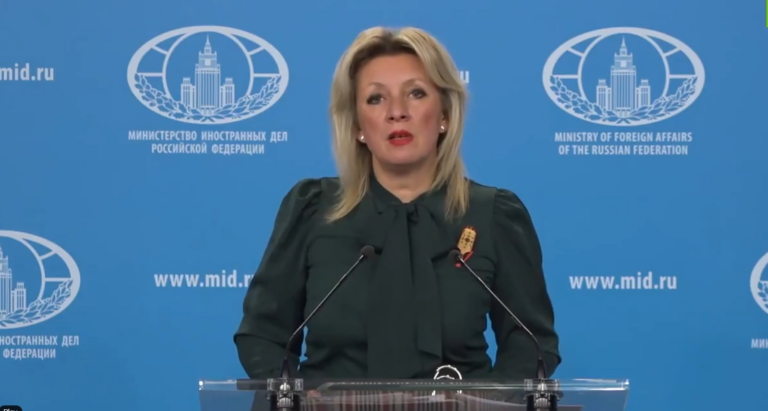
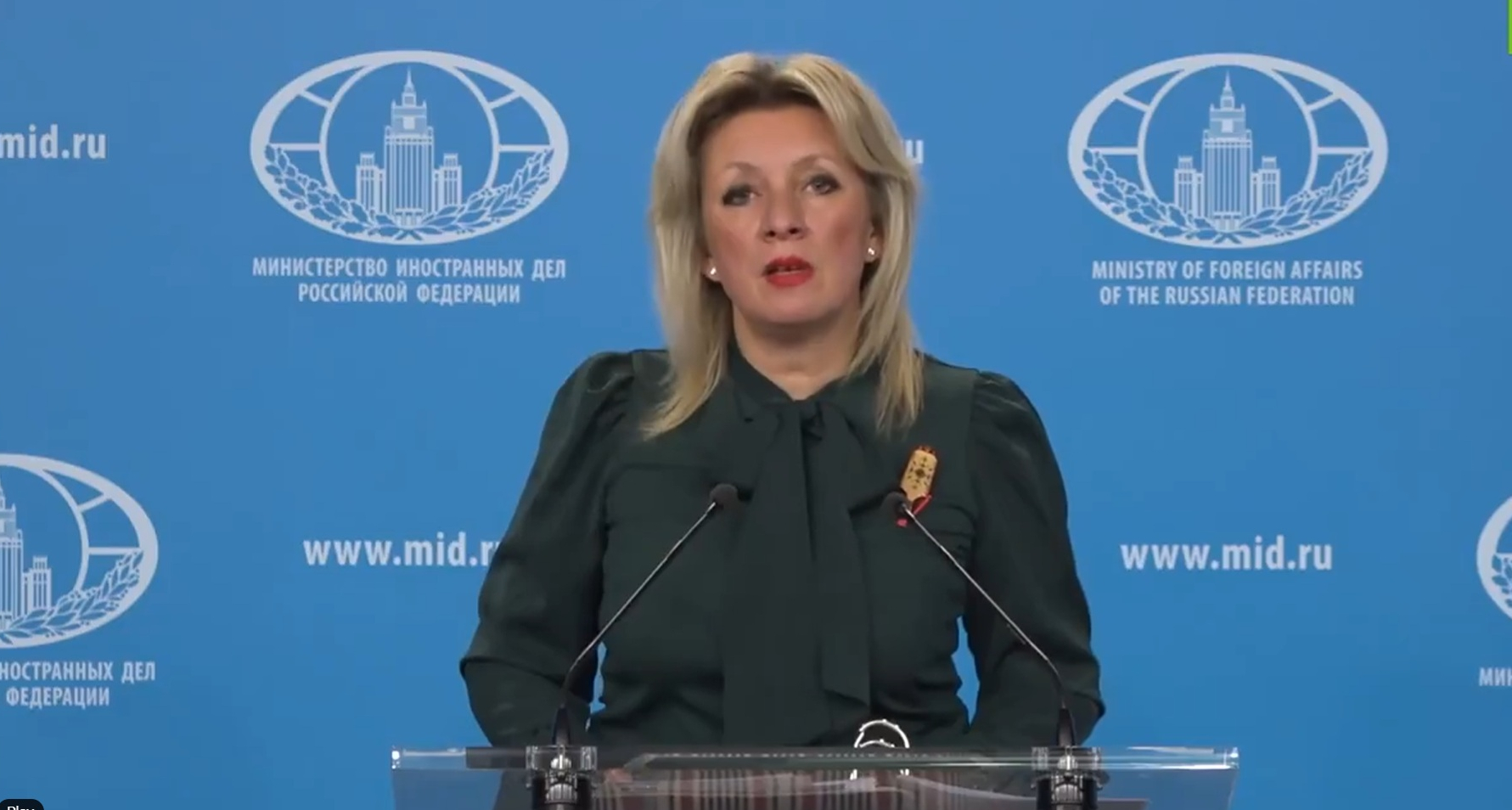
Caption: Screenshot, Maria Zakharova, spokesperson of Russia’s foreign ministry [EUalive]
Updated: November 7, 2026 – 22:37
Reports from Italian media identify the hacker group as NoName057(16), a pro-Russian collective widely described as linked to Russia’s GRU military intelligence
European and Ukrainian diplomats insist any peace deal must include them and cannot be imposed over their heads
Turkey is exploring a new meeting between the Russian and Ukrainian leaders, as Melania Trump presented the Oleshky ceasefire as a possible step towards peace
Poland’s Interior Minister Marcin Kierwinski said that everything points to the attacker having been “fascinated by far-right ideologies”
Reports from Italian media identify the hacker group as NoName057(16), a pro-Russian collective widely described as linked to Russia’s GRU military intelligence
His longtime aide, who is known for being caustic and uncompromising, replaces Susie Wiles, regarded as a rare voice of reason in the Wite House
Poland’s Interior Minister Marcin Kierwinski said that everything points to the attacker having been “fascinated by far-right ideologies”
5 hours ago
Reports from Italian media identify the hacker group as NoName057(16), a pro-Russian collective widely described as linked to Russia’s GRU military intelligence
8 hours ago
The four southern countries continue to face arrival numbers that the Commission considers disproportionate relative to their size
10 hours ago
His longtime aide, who is known for being caustic and uncompromising, replaces Susie Wiles, regarded as a rare voice of reason in the Wite House
13 hours ago
European and Ukrainian diplomats insist any peace deal must include them and cannot be imposed over their heads
1 day ago
The Commission president’s trip comes amid growing concerns over attacks on commercial shipping, with Sofia and Bucharest working on a joint maritime security hub
1 day ago
Despite the setbacks, the embattled Slovak prime minister says he will govern on until the 2027 elections
1 day ago
The alliance, often called the “broad field” (campo largo) in Italian politics, ranges from the centre to the left
1 day ago
Subscribe to our
NEWS & VIEWS
Eualive 2025
“EUalive” and the “eye” logo are registered trademarks
About the Author