This is The Poynter Report, your daily guide to the news about news. Subscribe to get it in your inbox every weekday.
This is not hyperbole.
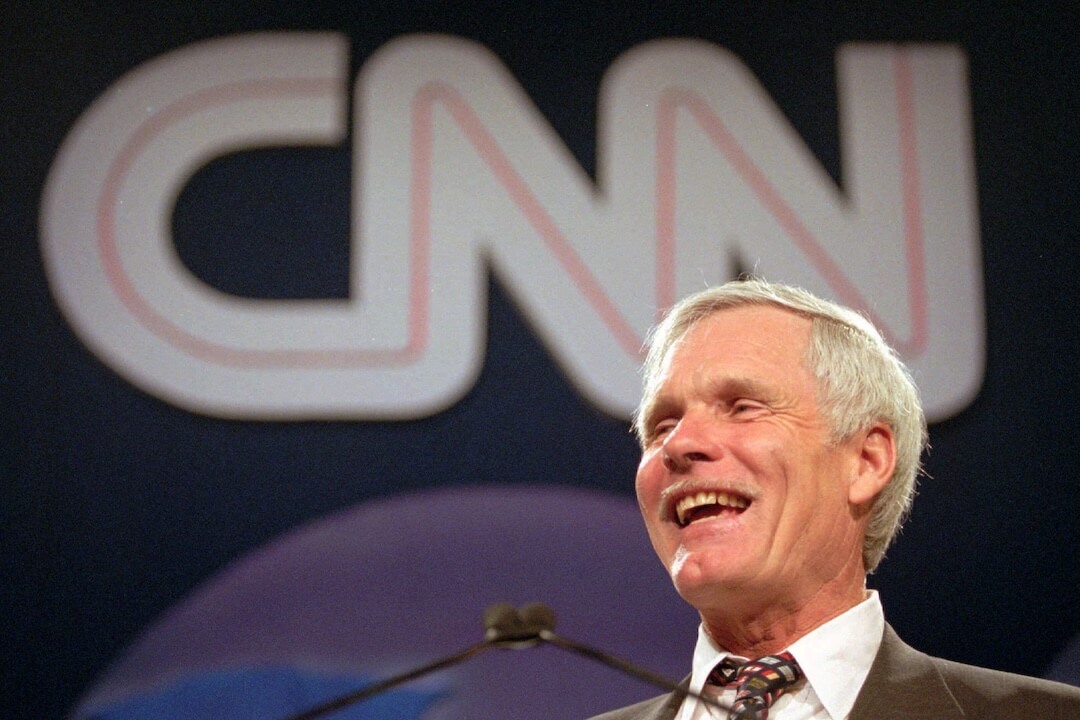
Ted Turner was one of the most important figures in the history of media. In fact, one could argue that Turner had as much influence on the current media landscape as anyone.
His pioneering vision was to create a 24-hour news network that covered events from around the world in real time, a channel where people could get their news anytime. And in 1980, that vision became a reality with CNN.
That led to other cable news networks such as CNN Headline News, TNT, Turner Classic Movies and Cartoon Network. The 24-hour “SuperStation” TBS — which nationally aired Atlanta Braves games and rerun favorites such as “The Andy Griffith Show” — started a few years before CNN.
But it was CNN that transformed cable TV news.
On Wednesday, the brash media mogul who also owned a baseball team (the Braves) and was an America’s Cup yachtsman, among other interests, died at the age of 87. A cause of death has not been made public.
CNN chairman Mark Thompson said in a statement, “Ted was an intensely involved and committed leader, intrepid, fearless and always willing to back a hunch and trust his own judgment. He was and always will be the presiding spirit of CNN. Ted is the giant on whose shoulders we stand, and we will all take a moment today to recognize him and his impact on our lives and the world.”
Versant CEO Mark Lazarus, former president of Turner Sports, wrote on LinkedIn, “I saw firsthand his willingness to take risks and his belief that media could be something bigger and more impactful. He pushed all of us to think beyond what was comfortable. His legacy is not just in what he built, but in how he inspired others to build. The industry will be served well if we can all ‘find our inner Ted.’ He will be remembered for generations.”
CNN’s Christiane Amanpour said, “He was the original. He made us all proud, he made us all hopeful, and he made us all strive for his vision of a better world.”
In a piece for The New York Times, Jonathan Kandell wrote, “Whether covering the fall of the Berlin Wall, the crushing of the Chinese student movement in Tiananmen Square or the Persian Gulf war of 1991, Mr. Turner’s CNN was the vehicle to view history in the making.”
Kandell noted that President George H.W. Bush said at the time of the Gulf War, “I learn more from CNN than I do from the C.I.A.”
It was the first Gulf War that changed CNN’s fortunes. As I wrote in a piece for Poynter last March:
In its first decade, CNN had already delivered live coverage of national tragedies, drawing millions of viewers. They watched in horror as the Space Shuttle Challenger exploded 73 seconds after takeoff in 1986. Perhaps most famously, CNN kept viewers riveted for 58 hours as rescuers fought to save Jessica McClure, the 18-month-old who fell into a well in Midland, Texas, in 1987 — a moment that proved the power of 24-hour news to hold the world’s attention in real time.
But round-the-clock coverage of Operation Desert Storm — not only after the U.S. strikes began but in the months leading up to it — showed the capabilities of an international, well-sourced and appropriately stationed news organization that aired coverage 24 hours a day, seven days a week, 365 days a year.
In 1991, the year of Operation Desert Storm, Turner was named “Time Person of the Year.”
Tom Johnson, CNN’s president from 1990 to 2001, told The Associated Press, “His first love was family and he had five children. But very close behind, he’s always told me that his greatest achievement was CNN.”
Turner’s vision of a 24-hour news network came from personal experience of missing the news. He once said, “I worked until 7 o’clock, and when I got home, the news was over. So I missed television news completely. And I figured there were lots of people like me.”
Of course, Turner was much more than his media company.
He owned the Atlanta Braves and was a fixture at World Series and playoff games, next to his then-wife Jane Fonda. He also owned the Atlanta Hawks of the NBA and pumped life into the entertaining World Championship Wrestling in its rivalry with the WWE.
The Associated Press’ David Bauder and John Seewer wrote, “He acquired millions of acres in ranches complete with roaming buffalo. He spoke often of reviving the West’s bison herds, and in 2002 started a restaurant chain serving bison burgers, Ted’s Montana Grill. Forbes estimated his net worth at $2.8 billion at the time of his death. He had enough time, and money, to devote his energy to such lofty goals as promoting world peace and protecting the environment.”
The AP added, “Turner’s 1997 pledge to give $100 million a year for 10 years to United Nations charities made him a leader in American philanthropy. He made good on his promise even as his fortune shrank after the AOL Time Warner merger, calling it the best hope for peace.”
Not that Turner’s life was perfect. Far from it. He was accused over the years of insensitive racial and religious remarks. He also had a history of infidelity along with his three marriages.
He started to move away from the media world in the mid-1990s.
The Los Angeles Times’ Matt Pearce and Meg James wrote, “In 1996, Turner Broadcasting merged with Time Warner to form the world’s largest media company, marking the beginning of the end of Turner’s apex in corporate media. Time Warner’s 2000 merger with budding internet giant AOL, then the largest-ever corporate merger, ended in disaster. Turner, who had not been a key player in the negotiations and had made no secret of his disdain for that deal, was fired as an executive.”
But his impact on our media cannot be overstated.
President Donald Trump called him “one of the greats.”
Fox News founder Rupert Murdoch (and sometimes Turner rival) said in a statement, “Ted Turner’s vision for 24-hour cable news transformed the media industry and gave viewers everywhere a front seat to witness history unfold. His impact as a trailblazer has left an indelible mark on our cultural landscape. He was a great American and friend.”
Turner is now gone, but his legacy will last for generations.
CNN’s Brian Stelter wrote that “through it all, through all the changes in ownership, CNN endures. When I walked into CNN’s Burbank bureau the other day, whose face was on the wall in the lobby? Turner’s face. There was also a famous quote of his on the wall: ‘Do something. Either lead, follow or get out of the way.’ Turner created something that outlasted him. That’s his legacy. His immortality. And today, especially, the CNN staff feels that obligation to carry it forward.”
FBI director Kash Patel, shown here last month. (AP Photo/Jacquelyn Martin)
Back on April 17, The Atlantic’s Sarah Fitzpatrick dropped a bombshell story about FBI director Kash Patel: “The FBI Director Is MIA.” Fitzpatrick talked to more than two dozen people, including current and former FBI officials, staff at law enforcement and intelligence agencies, hospitality industry workers, members of Congress, political operatives, lobbyists and former advisers. They described Patel as erratic, suspicious of others and prone to jumping to conclusions before he has the necessary evidence. The story included allegations of “excessive drinking” as well as “conspicuous inebriation and unexplained absences” while Patel has been in charge of the FBI.
Patel responded angrily on social media and TV, and then filed a defamation lawsuit against The Atlantic, seeking $250 million in damages.
Now something even more concerning: MS NOW’s Ken Dilanian and Carol Leonnig report that, according to their sources, the FBI has launched a criminal leak investigation focusing on Fitzpatrick.
Dilanian and Leonnig wrote, “The sources said the so-called insider threat investigation is highly unusual because it did not stem from a disclosure of classified information and because it is focused on leaks to a reporter. The agents involved are part of an insider threats unit based in Huntsville, Alabama, the sources added. Typically, leak investigations look into government officials who may have disclosed state secrets or classified documents. Journalists who receive and publish such information have typically only been involved as potential witnesses.”
If there is such an investigation targeting a journalist, it is deeply concerning in a country that touts a free and independent press.
FBI spokesperson Ben Williamson denied there was such an investigation, telling MS NOW, “This is completely false. No such investigation like this exists and the reporter you mention is not being investigated at all.”
Williamson then added, “Every time there’s a publication of false claims by anonymous sources that gets called out, the media plays the victim via investigations that do not exist.”
Jeffrey Goldberg, editor-in-chief of The Atlantic, said in a statement, “If confirmed to be true, this would represent an outrageous attack on the free press and the First Amendment itself. We will defend The Atlantic and its staff vigorously; we will not be intimidated by illegitimate investigations or other acts of politically motivated retaliation; we will continue to cover the FBI professionally, fairly, and thoroughly; and we will continue to practice journalism in the public interest.”
In a column — “A Dangerous New Attack on Press Freedom” — The Atlantic’s David A. Graham wrote, “The Trump administration’s war against freedom of the press has reached a startling new low.”
Graham added, “Filing a flimsy civil lawsuit as a private citizen is Patel’s right, though it is also plainly an inappropriate attempt to smother unflattering reporting. But if Patel’s bureau has launched a criminal investigation into a reporter, employing the power of the federal government, that would be a significant escalation.”
He also wrote, “This situation lacks even a pretense of national-security threat. If the report is true, Patel appears to have launched a criminal investigation into a reporter simply because he was embarrassed by her reporting. Even for an administration with an awful record on press freedom, and a bureau with a history of unsavory actions by directors, this is a dangerous step.”
For this item, I turn it over to my colleague Angela Fu.
The New York Times surpassed 13 million subscribers and reported a profit last quarter, helped in part by a sharp increase in digital advertising revenue, the company announced Wednesday.
The Times added 310,000 digital subscribers last quarter, putting it on track to hit its goal of 15 million subscribers by the end of next year. The paper also grew its adjusted operating profit 27.2% year-over-year to $117.9 million. Total revenue increased 12% compared to the same period last year to hit $712.2 million.
One revenue stream that has been particularly successful for the Times is digital advertising. That sector grew 31.6% year-over-year to $93.3 million. In contrast, publicly traded media companies USA Today Co. (formerly known as Gannett) and Lee Enterprises reported decreases in digital advertising revenue during their most recent quarter. Times CEO and president Meredith Kopit Levien said on an earnings call that the Times has been able to distinguish itself by offering advertisers many potential spaces to reach audiences. In addition to its traditional news product, the Times’ cooking and games verticals, its sports journalism site The Athletic, and its product reviews site Wirecutter all attract different kinds of marketers.
“The big underlying driver is big spaces, lots of audience engagement in those spaces, really powerful ad products relative to, I think, what another publisher might be able to do because we have so much first-party data — all of that is working,” Kopit Levien said.
Kopit Levien also highlighted the Times’ decision to lean into video content, stating that the company doubled the number of reporter videos it produced. She said the Times is at the beginning of its strategy, focusing on ramping up production before it can increase engagement and monetization.
“We see video as a big, long-term opportunity,” Kopit Levien said. “What we’re really aiming for here is to establish the Times as a preferred brand for watching news.”
Like a prize fighter getting ready for a heavyweight championship bout, longtime sports commentator Skip Bayless is hyping up his reunion with Stephen A. Smith on this Friday’s “First Take” on ESPN. Bayless last appeared on “First Take” with Smith in June 2016, before moving to his own show on Fox Sports 1. Bayless left FS1 in August 2024.
ESPN says this Friday’s Smith-Bayless reunion is a “one-time” thing, but if it turns out to be a big hit, do you think ESPN would not do it again?
Anyway, Bayless went all caps in this social media post Wednesday:
COUNTING DOWN TO 10 A.M. EASTERN THIS FRIDAY ON ESPN. I’VE BEEN SAVING UP 10 YEARS OF DISAGREEMENTS WITH HIM. I AM GOING TO UNLEASH LIKE NEVER BEFORE. I LOVE HIM LIKE A BROTHER BUT BROTHERS ARGUE. I HOPE HE’S READY BECAUSE I SURE AM. 10 A.M. EASTERN … FRIDAY.
The Athletic’s Andrew Marchand reports that ESPN is considering giving NFL insider Peter Schrager his own show on weekday afternoons starting this football season. The show would air at 2 p.m. Eastern, right after Pat McAfee’s show.
Marchand also reports the latest on ESPN’s 5 p.m. Eastern slot. That was the “Around the Horn” slot from 2002 to 2025, but that show was canceled. After the cancellation, ESPN started airing “SportsCenter” for that half-hour as a lead-in to the still popular “Pardon the Interruption.” Marchand reports that it’s likely ESPN will simply continue airing “SportsCenter” at 5 p.m.
But, Marchand writes, nothing has been finalized.
Marchand wrote, “Schrager, 44, has been on the rise since he joined ESPN a little more than a year ago, appearing on several studio shows, including ‘Get Up,’ ‘NFL Live’ and McAfee’s program. He has also guest-hosted ‘Get Up’ in place of Mike Greenberg, which gave ESPN executives even more confidence that he could handle his own hour. Since nothing is official, Schrager’s cohorts are still to be determined.”
Not that I get a vote, but I think this would be a smart decision. Schrager is sharp and has an accessible and friendly TV personality, perfect for hosting his own show. And he deserves it. The guy works hard.
Have feedback or a tip? Email Poynter senior media writer Tom Jones at tjones@poynter.org.
The Poynter Report is your daily dive into the world of media, packed with the latest news and insights. Get it delivered to your inbox Monday through Friday by signing up here. And don’t forget to tune into our biweekly podcast for even more.
Poynter’s fact-checking, watchdog reporting, and journalism training is possible because readers like you support us. Will you join our community of over 1,500 donors with a gift today?
The company is also cutting corporate overhead and expanding local sports coverage, Hoffmann said
Journalists from leading news organizations selected for intensive training focused on leadership, strategy and newsroom impact
Experts in online disinformation, investigative journalism and financial sustainability will anchor the annual conference on fact-checking.
The CNN founder redefined news as a constant, global presence and raised expectations for speed and access
Students partnered with local newsrooms to solve real reporting problems and learned to start with the need, not the technology
You must be logged in to post a comment.
This site uses Akismet to reduce spam. Learn how your comment data is processed.
Don't miss out on a year of learning.
Get the Poynter newsletter that’s right for you.
Support responsible news and fact-based information today!
Poynter’s fact-checking, watchdog reporting, and journalism training is possible because readers like you support us. Will you join our community of over 1,500 donors with a gift today?
About the Author