news Alerts
There are no new alerts at this time
Welcome to From the Politics Desk, a daily newsletter that brings you the NBC News Politics team’s latest reporting and analysis from the White House, Capitol Hill and the campaign trail.
Subscribe to read this story ad-free
Get unlimited access to ad-free articles and exclusive content.
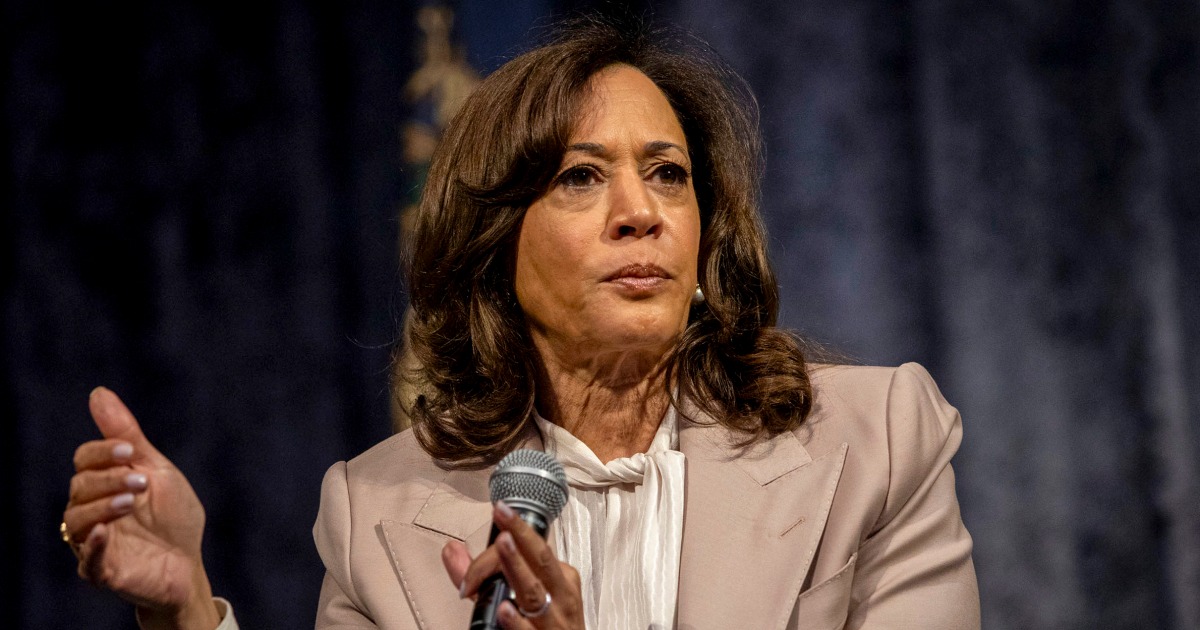
In today’s edition, Jonathan Allen explores how Kamala Harris is navigating the controversy around Democrats’ buried 2024 postmortem ahead of a possible 2028 bid. Plus, Jane C. Timm reports on the latest state to pass a new congressional map.
Sign up to receive this newsletter in your inbox every weekday here.
— Adam Wollner
Kamala Harris isn’t exactly demanding that the Democratic National Committee air the dirty laundry from her failed 2024 presidential campaign.
But it makes sense that the former vice president is telling allies that she thinks an autopsy commissioned by DNC Chairman Ken Martin should be released publicly — conversations first reported by NBC News today.
Some Democrats are up in arms over Martin’s decision to keep the findings under wraps after he promised to make them public, and there has been plenty of speculation among Harris’ critics that he is suppressing the postmortem to protect her.
But protect her from what?
By now, everyone interested in politics knows what Harris did right and wrong as a candidate. Her role was largely public. She was the one who rallied Democrats at their convention and performed well on a debate stage against President Donald Trump. She’s written a book about her campaign, as have others.
The oxen left to be gored are the political professionals — on her campaign, at the DNC, in the Biden White House and at Future Forward, the main super PAC supporting the Democratic effort — who made decisions that contributed to the defeat. After all, Harris took over the 2024 plane midflight, with a captain and crew picked by President Joe Biden before he withdrew from the race.
Critics of Harris have suggested that a big reveal would be that her position in support of Israel, which was consistent with the administration she served in, hurt her in key swing states. But that has been well established by now. And, for what it’s worth, it’s not clear that withholding their votes or casting ballots for Trump has put pro-Palestinian voters in a better place.
What’s more clear is that Harris risked taking never-ending hits from Democratic activists if she remained silent on the autopsy or called for it to be suppressed. At the same time, there’s no reason for her to antagonize the DNC as she considers another run for the presidency. So, she’s let her position be known without shouting it from the rooftops.
It remains to be seen how Martin will handle the building pressure to open the books. But for Harris, the time for looking backward should be over. The question for her in 2028 is whether she’ll be more prepared to answer questions like what she would do differently this time and what her presidency would mean for Americans’ bank accounts.
Tennessee’s Republican-led Legislature passed a new congressional map splitting up the state’s lone majority-Black district, swiftly responding to the U.S. Supreme Court’s major redistricting ruling last week.
The redrawn map puts Republicans in position to gain a seat in this fall’s midterm elections and secure full control over Tennessee’s congressional delegation.
The new map carves up a Memphis-based seat held by longtime Rep. Steve Cohen, D-Tenn., into three districts, spreading the Democratic voters into more rural, Republican districts that stretch hundreds of miles east. It also further splits the Nashville metropolitan area, the state’s other Democratic stronghold, into five districts.
Gov. Bill Lee moved quickly to call lawmakers into a special session this week to take up a new map proposal ahead of Tennessee’s Aug. 6 primaries.
The big picture: Tennessee will become the ninth state to enact a new congressional map ahead of the midterms, an unusually active mid-decade redistricting cycle that first started last year when President Donald Trump urged Republican-led states to redraw their lines to shore up the party’s narrow House majority.
Republicans could pick up as many as 14 seats as a result of the campaign, compared to upwards of 10 for Democrats, though several maps are still facing litigation.
[map]
A seismic Supreme Court ruling last week that effectively eliminated racial gerrymandering protections from the Voting Rights Act (more on that below) has supercharged the trend. Louisiana and Alabama Republicans are laying the groundwork to redraw their maps, while South Carolina lawmakers are debating whether to do the same. The three states have five majority-minority districts represented by Democrats between them.
Read more →
🗺️ Related read: Indiana Republicans who lost their jobs after bucking Trump on redistricting have ‘zero regrets’
In a ruling just seven years ago, at least some conservative Supreme Court justices appeared to view partisan gerrymandering as a societal problem that the court was ill-suited to solve.
But in a momentous decision last week, the court found that attempts by lawmakers to further entrench their own party’s power are a legitimate use of government power.
Keep reading →
⚖️ Related read: Chief Justice John Roberts says American public wrongly views the justices as ‘political actors’
That’s all From the Politics Desk for now. Today’s newsletter was compiled by Adam Wollner.
If you have feedback — likes or dislikes — email us at politicsnewsletter@nbcuni.com
And if you’re a fan, please share with everyone and anyone. They can sign up here.
© 2026 NBCUniversal Media, LLC
About the Author