The BBC’s fevered interest in Israel’s participation in the Eurovision Song Contest exploded this week, with over 100 stories appearing across Radio 1, Radio 4, and BBC News television.
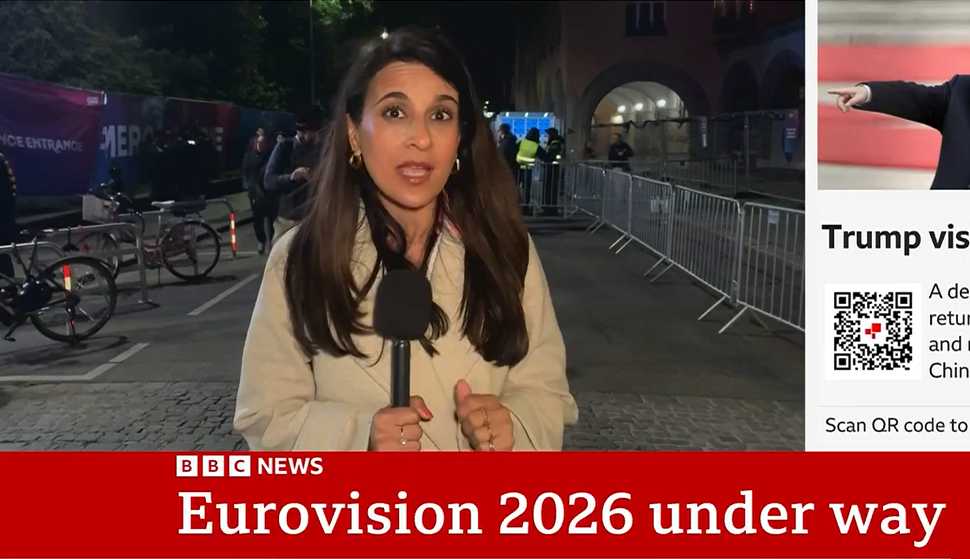
At CAMERA, we have covered extensively the lack of any proven rule-breaking and the bias shown towards Israel in these reports, including the BBC’s own reporting that no rules had been broken. What is now being called the “voting manipulation scandal” is simply another false allegation being reported as fact. Take, for example, this report by Nomia Iqbal on BBC News at 9.50am on May 13:
Iqbal: “As we know, Israel has been mired in controversy here at Eurovision. There are five countries that are boycotting Eurovision because of the inclusion of Israel. It’s to do with the war in Gaza but also the voting manipulation scandal.”
The phrase “voting manipulation scandal” is doing a great deal of subtle framing work here. Within that label, the BBC avoids making an outright allegation, yet the audience is led to assume that proven voting manipulation is an established fact.
But what exactly is the “voting manipulation” of which Israel is accused? Nomia Iqbal reported later that same day on BBC News:
Iqbal: “The other controversy around Israel is to do with voting. Those countries that are boycotting believe that the Israeli government tried to influence the votes last year and the year before by running state-funded advertising campaigns. The televote, for example, in the last two years, did see Israel finish in the top two, and many countries believe that those campaigns contributed to that… only just a few days ago, Noam Bettan was given a warning over social media videos that he posted in which he was instructing people to vote for him ten times. Everyone basically gets ten votes, and so that has also caused some upset.”
Iqbal also interviewed Martin Green, the director of Eurovision, about whether acts are allowed to promote themselves. Interestingly, the interview made no mention of whether any rules had actually been broken. Instead, it focused on whether promotion rules were too “subjective”:
Green: “Some of the promotion by some of the broadcasters was a little disproportionate, which is why we put some new rules in this year, some guidance for artists around promotion and broadcasters…”
Iqbal: “How do you monitor that, though? How do you enforce it? Because so much of it is open to interpretation, like that word ‘discouraging’ or ‘disproportionate’.”
According to Iqbal’s own reporting, this “scandal” consists of the Israeli delegation engaging in entirely rule-abiding self-promotion and the supposed crime of winning the popular vote. Iqbal notes that “Israel claims it is being unfairly targeted,” but she makes no effort to examine the validity of that claim.
On the morning of May 13, a BBC reporter was offered a perfect opportunity to test the argument that Israel is being unfairly singled out. Arts and Culture Correspondent David Sillito interviewed Antigoni, the UK-born Cypriot representative:
Sillito: “Have you tried for the UK?”
Antigoni: “I haven’t. The thing is for me, I love London, I love the UK, I was born and raised there, but my music generally is with bouzouki, with Greek elements. It would feel like I was doing it just for the platform.”
Sillito: “And with her mum having 50 first cousins, she might get a few points from the Cypriot UK phone vote.”
Antigoni: “Because it’s such a big community of Greeks and Cypriots in the UK as well. So I think not only am I representing…”
Sillito: “And they can all vote for you.”
Antigoni: “They can all vote for me, exactly. Fingers crossed [to camera] vote for Cyprus!”
Sillito [Laughing]: “Other contestants are available for voting.”
Antigoni: “They’re not, actually. You can only vote for Cyprus. There’s no other option, sorry.”
Is this framed as a “Cyprus voting manipulation scandal”? No. It is treated as a light-hearted moment full of fun and laughter. There is no pushback against Antigoni and no challenging questions. Contrast this with how Iqbal describes her conversation with the Israeli contestant, Noam Bettan:
Iqbal: “Now I did ask Noam Bettan about [the videos] and he made the point that Israel removed those videos straight away. There are some supporters of Israel who believe that the country is being unfairly targeted, and they point to other countries that also promote their artists. I sat down with the director of Eurovision a couple of days ago and put to him what the core distinction was. He said that Israel had just gone that step further and that’s why they got this warning. But I think those countries that are boycotting would say, look, there is a pattern here.”
In all the noise surrounding Israel at Eurovision, the BBC never asks one fundamental question: Could it be that ordinary voters at home don’t possess an obsessive hatred of Israel and care mainly about which song they like? Could the disparity between the judges’ votes and the public vote be caused not by “manipulation,” but by a genuine difference in the worldview of those two groups?
Instead, we see the creation of a story where there is none. Behavior that all other acts engage in, even when broadcast on the BBC as we saw with Antigoni, becomes “scandalous” only when engaged in by Israel. This is despite there being no evidence of rule-breaking.
Perhaps if the BBC were to reflect on the blatant disparities within its own reporting, the question of whether Israel is being unfairly targeted might finally be treated with the gravity it deserves.
Comments are closed.
CAMERA Arabic
CAMERA Hebrew
“Israel Apartheid Week“
CAMERA’s Partnership of Christians and Jews
Eyes on Israel Curriculum
About the Author