This is read by an automated voice. Please report any issues or inconsistencies here.
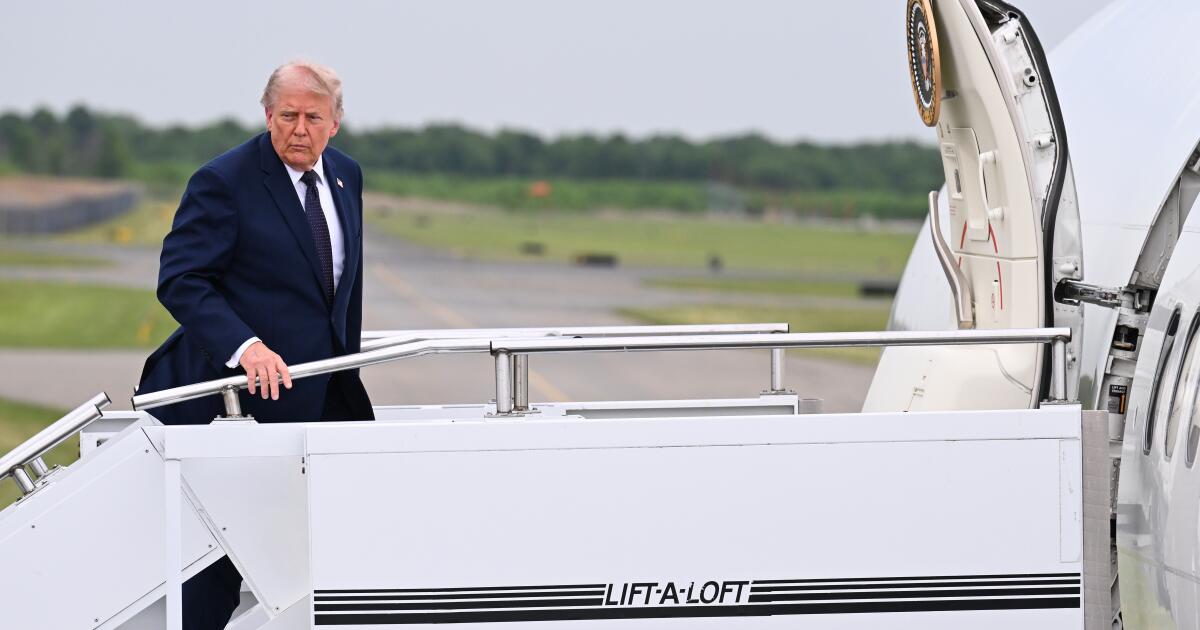
WASHINGTON — President Trump said Saturday that the United States and Iran have agreed on the basic terms of an agreement to end the two countries’ nearly three-month-long war and reopen the Strait of Hormuz.
“An Agreement has been largely negotiated,” Trump wrote in a social media post. “Final aspects and details of the Deal are currently being discussed, and will be announced shortly. In addition to many other elements of the Agreement, the Strait of Hormuz will be opened.”
Iran’s state television network quoted Foreign Ministry spokesman Esmail Baghaei as saying the draft pact will be a “framework agreement” that defers talks toward limiting Iran’s nuclear program until later. Trump did not mention the nuclear issue in his statement.
If that is the form the deal takes, it would represent at least a short-term concession from the president, who initially demanded a definitive end to Iran’s nuclear program as the price of peace.
Trump has also relaxed an earlier U.S. demand that Iran give up its right to enrich uranium and says he would be satisfied with a deal to “suspend” enrichment for 20 years.
Business
Gasoline will be a pain point for travelers this Memorial Day weekend. For many Americans, cutting back has already become the new reality after gas prices topped $4.50 a gallon for the first time in nearly four years.
Those signs of U.S. flexibility have raised alarm from Iran hawks, reportedly including Israeli Prime Minister Benjamin Netanyahu. They say they fear Trump is so intent on restoring the flow of oil from the gulf that he might agree to a deal that falls far short of U.S. goals.
Mark Dubowitz, a leading critic of past agreements with Iran, said he worries that Trump might settle for “a foolish agreement” to reopen the Strait of Hormuz.
“I’m concerned that the administration is looking to cut some ‘Phase One’ deal” in which Iran is given “significant sanctions relief in exchange for agreement to reopen the strait,” he said in an interview Friday. “I think that would be a foolish agreement. Iran would get real money, but they could continue to close the strait any time they wanted simply by making threats.”
Robert Kagan, a conservative foreign policy scholar at the Brookings Institution, wrote that a deal to reopen the strait while deferring the nuclear issue would amount to a U.S. “surrender.”
“On the present trajectory, Iran will emerge from the conflict many times stronger and more influential than it was before the war,” Kagan wrote in the Atlantic.
When the war began in February, Trump said he wanted not only to end Iran’s nuclear activities and destroy its ballistic missile program, but bring about regime change as well.
Instead, the nuclear talks have focused on narrower, more achievable goals: a “suspension” of nuclear enrichment for 20 years or less and removal or destruction of Iran’s highly enriched uranium, the essential ingredient for a nuclear weapon.
“A basic agreement shouldn’t be impossible to achieve,” said John W. Limbert, who worked on Iran policy at the State Department for three decades, and was one of the American hostages seized by Iranian militants in 1979. “The deal would be some kind of verifiable limits on the nuclear program in return for economic relief.”
“The fact that we’re talking about a suspension of all enrichment, and the question is whether it will be five years, 20 years or halfway in between — that’s important,” said Nate Swanson, an Iran expert who worked at the National Security Council under President Biden and Trump. “That sounds like you really have the basis for an agreement. … But don’t fool yourself to think that completely addresses the situation.”
Swanson said other issues, including Iran’s nuclear research and its advanced ballistic missiles, haven’t been addressed.
Despite signs of progress toward an agreement, the gaps between the two countries remain large.
Part of the problem is that both sides appear to believe they have won the war, said Danny Citrinowicz, a former Iran analyst at Israel’s defense intelligence agency.
Business
President Trump has called off plans to sign a new executive order on artificial intelligence hours before an expected White House ceremony.
Trump and other U.S. officials frequently assert that the United States has gained the upper hand by destroying Iran’s navy, air force and many of its missiles.
But the Iranians use a different scoring system, Citrinowicz said.
“Iran does not measure success the same way Washington often does,” he wrote in an email. “From Tehran’s perspective, simply holding firm in the face of American pressure can be framed as a win.”
“Tehran believes time is working against Trump politically and strategically,” he added. “Iran is prepared for prolonged confrontation; the United States, far less so.”
And even if a negotiated agreement is reached, the deals under discussion now won’t resolve all the conflicts between the two countries.
“An interim deal to buy time [is] probably where we end up,” Swanson said. “Buying time is not a bad thing. Ending a war is not a bad thing. But it’s not a comprehensive solution.”
Politics
Politics
World & Nation
Author and CBS News correspondent Jonathan Vigliotti attempts to answer some questions about rebuilding communities in his new book about the Palisades Fire — and names a motive for a quick rebuild: the Olympic games coming to Los Angeles in 2028.
Today we discuss one of the pivotal events of the 1960s: the assassination of Robert F. Kennedy. Though the gunman was caught at the scene, confessed at trial, and even bragged about the shooting, his motives have largely been forgotten.
Modern LA earned its first smoggy nickname 450 years ago, as the “bay of smokes.” At the La Brea tar pits, we take a short walk through a long history with curator Regan Dunn, who explains how and why the first Angelenos would have set fires that filled the broad bowl of LA and foretold the curse of smog.
Politics
Politics
Subscribe for unlimited access
Site Map
Follow Us
MORE FROM THE L.A. TIMES
About the Author