Editor’s note: third in a series.
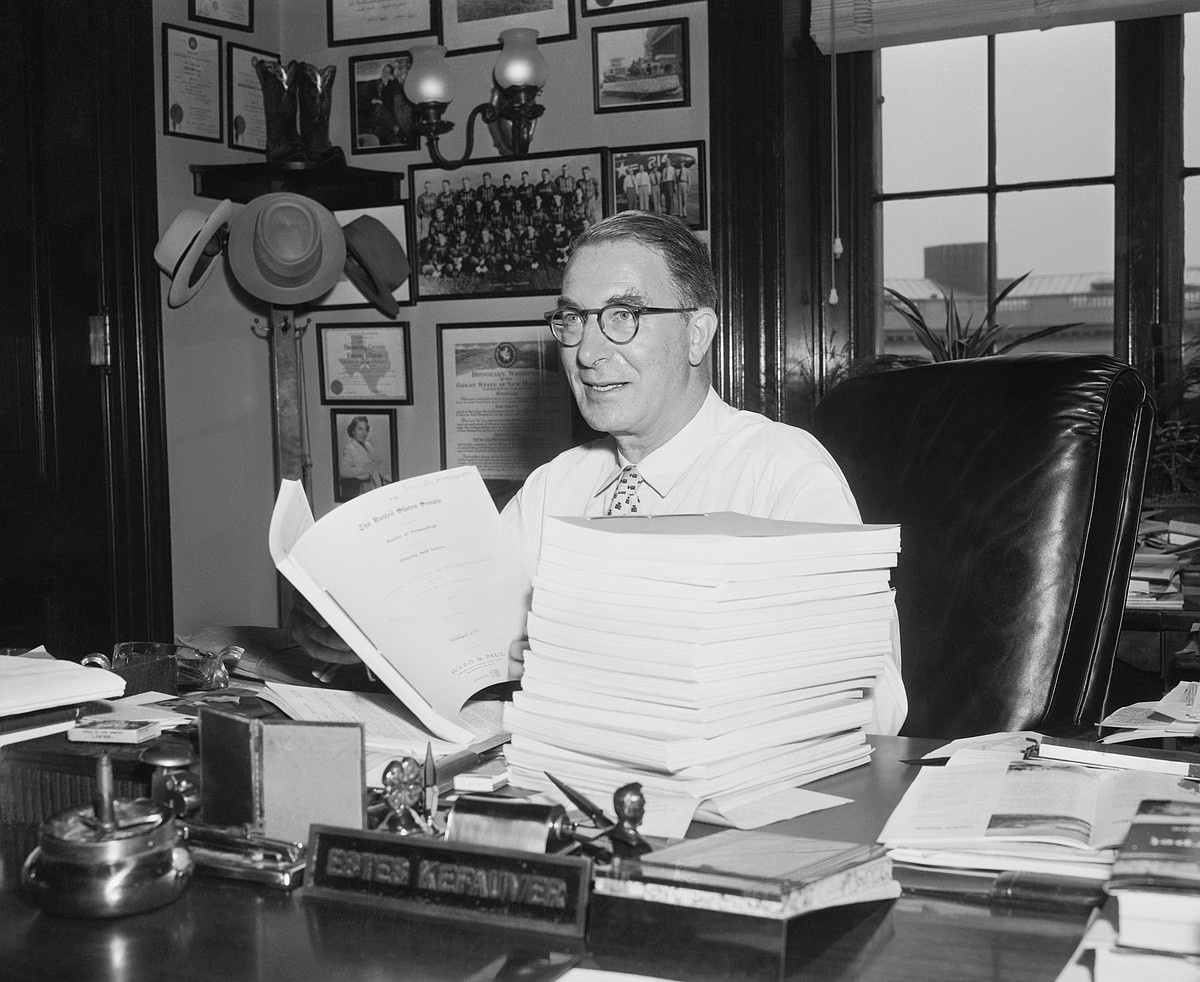
Chattanooga’s Estes Kefauver was elected to the U.S. House of Representatives in 1939, after campaigning as a progressive supporting President Franklin D. Roosevelt’s New Deal. Within a week after winning a special election for the seat vacated at the death of Rep. Sam D. McReynolds, Kefauver was in Washington, D.C., advocating for his 3rd Congressional District.
He quickly separated himself from Tennessee’s conservative delegation and pursued his own agenda.
What issues garnered the congressman’s attention?
First, now that the Chickamauga Dam and other structures controlled the Tennessee River’s depth, the congressman recognized the need for bridges across the river. While ferries had served the area well for decades, bridges improved economic cooperation and growth while uniting the citizens of his district.
(READ MORE: Local History: Estes Kefauver got his political start in Chattanooga)
On Jan. 18, 1940, the Chattanooga Daily Times headlined that Rep. Kefauver would ask the House of Representatives “to appropriate $1,000,000 for the construction of a steel and concrete bridge over the top of Chickamauga Dam.” Only days earlier, the Tennessee Valley Authority’s budget had been “slashed by $8,000,000.” While the allocation for foundation repair at Hales Bar Dam had been left untouched, Kefauver was adamant that TVA’s priorities should include a bridge at Chickamauga. As he noted, “the Chickamauga Dam has been designed so that a bridge may be built over it. The high cost of the bridge would be due to … it having to be built over the two gantry cranes which will be operated on top of the dam to lift the gates in the spillway section.” That the economic gains would recoup the construction costs within a reasonable time and the communities would be “connected” for easier interaction justified the costs. It was a simple issue of “return on investment.”
While the bridge was not constructed until 1954, after the congressman had moved to the Senate, the Chickamauga bridge and others — along with a close watch over TVA’s economic impact on the region — remained high on Kefauver’s list of accomplishments and goals.
Simultaneously, the Madisonville native used his legal expertise and strong voice to champion congressional reform and anti-monopoly measures while attacking political corruption at the local, regional and national levels.
In 1946, Kefauver was appointed chairman of the House Select Committee on Small Business, and he immediately began working to close loopholes in the Clayton Antitrust Act of 1914. The congressman knew that corporations often evaded antitrust actions by simply acquiring assets of other firms instead of their “stock” — in compliance with the law as written but counter to the intent of the legislation. His experience in the House increased his concern that economic concentration in the hands of major corporations lessened business competition and caused citizens to suffer from higher costs in a less responsive marketplace.
The Cellar-Kefauver Act, not passed until 1950, led to a stricter scrutiny of mergers, as courts became more involved in deciding merger cases and encouraged firms to choose diversification. Kefauver became the recognized leader in a return to anti-monopoly initiatives with a call for free and unfettered markets. Campaigning on the issue, the congressman reminded audiences that prevention was always preferable to regulation. A series of landmark court rulings during the next decade supported his efforts and offered a further counter-force against excessive corporate influence.
Then, in 1948, the congressman tackled one of the biggest issues — back home in Tennessee with Edward Hull Crump. “Boss Crump,” the most powerful political boss in Tennessee history, frequently dictated the results of local and state elections, starting in the early 20th century and extending into the 1940s. His machine controlled the vote through “a system that paid the poll taxes of voters” in return for their “sometimes coerced” allegiance to his endorsed candidates. Kefauver identified Crump’s political control and bloc voting as corruption and swore to end the Boss’s reign.
When told that Kefauver was investigating his political activities, Crump supposedly laughed and responded, “Kefauver reminds me of the pet coon that puts its foot in an open drawer … and invariably turns its head while it is feeling around in the drawer.”
Kefauver’s reply, carried by newspapers across the nation, was direct. “I may be a pet coon but I’ll never be Mr. Crump’s pet coon.”
Kefauver’s opposition and public scrutiny lessened Crump’s iron grip on politics, and the congressman gained a reputation for championing the little people.
Kefauver’s progressive stance would propel him to the U.S. Senate.
Linda Moss Mines is the official Chattanooga and Hamilton County historian. For more on local history, visit Chattahistoricalassoc.org.
Did you mean:
Copyright © 2026, Chattanooga Times Free Press, Inc.
All rights reserved.
This document may not be reprinted without the express written permission of Chattanooga Times Free Press, Inc.
Material from the Associated Press is Copyright © 2026, Associated Press and may not be published, broadcast, rewritten, or redistributed. Associated Press text, photo, graphic, audio and/or video material shall not be published, broadcast, rewritten for broadcast or publication or redistributed directly or indirectly in any medium. Neither these AP materials nor any portion thereof may be stored in a computer except for personal and noncommercial use. The AP will not be held liable for any delays, inaccuracies, errors or omissions therefrom or in the transmission or delivery of all or any part thereof or for any damages arising from any of the foregoing. All rights reserved.
About the Author