Thank you for visiting nature.com. You are using a browser version with limited support for CSS. To obtain the best experience, we recommend you use a more up to date browser (or turn off compatibility mode in Internet Explorer). In the meantime, to ensure continued support, we are displaying the site without styles and JavaScript.
Advertisement
Communications Earth & Environment volume 7, Article number: 543 (2026)
Combatting climate change requires political action. However, whether politicians in democratic countries implement climate actions depends on their perception of the voters’ willingness to accept such actions. We contacted a unique sample of incumbent German politicians via their professional email addresses and compared the 1,599 respondents’ perceptions of the publics’ willingness to support climate action with the actual willingness reported in two nationally representative samples of about 1,000 Germans each. Across political parties, respondents underestimated public acceptance of taxes and laws, and the willingness to contribute 1% of income to mitigate climate change. This pluralistic ignorance effect was even more pronounced than the pluralistic ignorance effect obtained in the population, and it was strongest in the policy domains that are most effective in combatting climate change. These findings suggest that effectively addressing climate change may require raising awareness within the political sphere of actual public support for climate action.
Combatting climate change is a pressing challenge. While human behavior is ultimately the cause of climate change, it is also likely part of the solution. This is because tackling climate change will require collective action to implement climate change mitigation measures. Indeed, previous surveys have found widespread support for such climate action among the global population1,2. However, effectively fighting climate change requires not only individual behavior change, but also structural measures (e.g., carbon taxes) that need to be implemented by policymakers3. Because policymakers act on what they believe their voters’ opinion is4,5, it is crucial that policymakers in democratic societies accurately estimate the existing public support for such measures. Yet, research about the accuracy of policymakers’ perceptions of public support for climate action remains scarce. To address this question, we contacted active German politicians via their professional email addresses to compare the respondents’ estimates of the German population’s willingness to support climate action with the actual willingness as self-reported by two representative samples of the German population.
Previous work suggests that the public itself underestimates the widespread support for climate policies among itself1,6,7. Such misperceptions (underestimations or overestimations) are known as pluralistic ignorance – the widespread and collective misperception of a social norm pertaining to one’s own group: When most people believe that a particular view is prevalent in their group when, in fact, most members of the group do not hold that view8,9,10. Pluralistic ignorance may refer to misperceptions of other peoples’ views (e.g., whether people approve or disapprove of a certain action) but also to misperceptions of how common a particular behavior is (e.g., whether people engage in a certain action). Pluralistic ignorance has been documented in many domains, including overestimating approval of aggressive behavior11 and drinking behavior9, overestimating support for affirmative action12, and underestimating support for gender equality13, among others14.
In the domain of climate action, several large-scale studies suggest that the public misperceives how widespread support for climate action is. Early in the public discourse, U.S. citizens underestimated their fellow citizens’ willingness to discuss climate change as a problem6. Later, a large majority of Americans (80–90%) underestimated concern about climate change and support for climate policies7. Going beyond the U.S., a cross-cultural study involving eleven countries from four continents found that people underestimate the share of citizens who believe climate change is real and human-caused15. The largest study to date, a global survey of nearly 130,000 respondents from 125 countries, found that most people are even willing to actively combat climate change by contributing 1% of their income, while substantially underestimating others’ willingness to do the same. Not only the general public but even attendees of a United Nations Environment Assembly, including representatives from media, NGOs, and governments, underestimated the global willingness to contribute 1% of their income16. Pluralistic ignorance among the public can be a barrier to climate action, because people’s willingness to contribute to a common good such as climate protection depends on their estimate of others’ willingness to contribute as well6,7,17,18.
However, if pluralistic ignorance about support for climate action is also present in politicians, it may pose an even more formidable barrier to enacting climate policies than misperceptions among the public, because politicians have more power and resources to implement such policies. Longstanding research from political science suggests that politicians’ actions reflect both their own preferences and, crucially, also their perception of public opinion4. Indeed, in many policy domains, politicians’ perception of public opinion is the dominant link between the public’s preferences and politicians’ actions (i.e., their voting for or against specific policies). However, politicians’ perceptions of public opinion are often far from accurate: Politicians discount the opinions of voters, with whom they disagree19. They also overestimate how strongly public opinion is shaped by their own messages20 and underestimate how strongly it is shaped by messages citizens receive from their peers and immediate social surrounding21. Politicians also generally hold too simplistic views of citizens’ voting behavior22.
These misperceptions extend to perceptions of support or opposition for specific policies. A survey on misperceptions about nation-specific policies (e.g., lowering the electoral age to 16) in four countries, Canada, Germany, Switzerland, and Belgium, found that politicians considerably misjudged public support for these policies. This pattern held true for the general public and for their own party voters23. Some studies also focused on perceived support for climate policies: For example, U.S. congressional staffers were asked to estimate the share of Americans who agree that the U.S. should regulate CO₂ emissions. Comparing staffers’ estimates to the best available national estimate24, the researchers found that staffers underestimated public support for regulating CO₂ emissions25. Another study from the U.S. examined elected local politicians’ (county, municipality, township) perceptions of public endorsement for climate solution narratives (e.g., systemic changes, individual behavior changes, technological solutions) and compared their perceptions to the actual self-reported endorsement from a nationally representative sample. Politicians underestimated the public’s endorsement for the most popular narratives (e.g., changes in policy and behavior, better education, and technological solutions, among others26. Yet another study, this time conducted in Belgium, asked elected local (municipal, city, provincial) politicians to estimate how much citizens would agree with each of six climate-mitigation policies (e.g., meat tax, ban wood-burning stoves, electrify public busses), and compared those estimates with answers to identical items from a nationally representative sample. Politicians underestimated public support for five of the six policies27.
Politicians may perceive public opinion as less supportive of climate action than it actually is because, especially on a municipal level, they are in more direct contact with conversative opinions, with more extreme opinions, and with the opinions of wealthier citizens who tend to be more conservative (one-sided lobbyism28,29). An accurate perception of support for climate action is paramount, however, because underestimating support could prevent politicians from implementing effective climate policies for fear of losing voter support. Research also suggests that politicians adjust their positions and actions when they receive credible information about their voters’ opinion5.
Our study advances knowledge about misperceptions of public support for climate action in several ways. First, we contacted an exceptionally large sample of elected German politicians via their professional email addresses. Contacted politicians were from all levels of government, including many from the highest levels (federal and state), rather than only local politicians or staffers. Second, we used two independent, nationally representative public samples, allowing us to compare politicians’ and citizens’ misperceptions. Third, we assessed misperceptions across multiple dimensions of climate action support as differentiated by the integrative public-policy framework30. Fourth, our large sample allowed us to examine party differences in misperceptions. Fifth, we studied a country where public discourse about climate change is especially salient due to Germany’s distinctive energy policy, the energy transition (Energiewende). Finally, we employed rigorous methods, including preregistration and sample weighting. While prior studies each addressed some of these elements, we integrated them into a single design.
To assess our principal outcome measure, public support for climate action, and compare it with respondents’ perceptions of this support, we build on the integrative public-policy-acceptance framework30. This framework involves three main components: The public’s acceptance of climate policies (information, taxes, and laws) depends on their desire for government support, which in turn is driven by their awareness of the problem of climate change. These three measures capture awareness as a precursor, desire for support as a motivational component, and policy acceptance as an attitudinal component that shapes whether people are willing to passively accept climate policies. To complement these measures with a fourth, more active, behaviorally relevant component, we also measured willingness to contribute a personal sacrifice, 1% of one’s income, in exchange for more effective climate policies. This measure was taken from the global survey by Andre et al.1, which documented widespread global support for climate action and public underestimation of that support. In addition to the validated measure of perceived willingness to contribute 1% of income, to examine misperceptions of willingness to contribute a much smaller sacrifice, we also measured willingness to make a microdonation of one’s choice (between 0 and 100 cents) to an NGO combatting climate change.
In summary, we aimed to test the accuracy of politicians’ perceptions of the public support for climate action. To achieve this, we assessed respondents’ perceptions and compared them with the self-reported support among the public in two large representative samples. We also assessed the perceptions within the public itself to examine whether respondents are more or less accurate in estimating the public’s beliefs than the public itself. We focused on four dimensions of support for climate action: (a) Policy acceptance regarding three types of policy measures (information, taxes, laws), (b) the desire for government support, (c) problem awareness, and (d) two types of willingness to contribute (1% of income, microdonation).
We contacted active German politicians via their professional email addresses. Despite their crucial role in implementing climate action policies, politicians remain an understudied group, and researchers have emphasized the need to study perceptions of public support among political decision-makers31. To compare respondents’ perceptions of public support for climate action with actual self-reported public support, we additionally recruited a representative, stratified sample from Germany via a professional polling company (Population Sample 1; N = 1034). Table 1 provides an overview of the demographic characteristics of our recruited samples and the respective characteristics from the German population. Supplementary Fig. S1 depicts the party membership distribution among the respondents compared to the actual party representation in the national, state, and communal parliaments. As a further benchmark for one dimension – the willingness to contribute 1% of one’s income – we also compared respondents’ perceptions with the responses of the nationally representative German sample from the global survey by Andre et al. (1; Population Sample 2; N = 1000).
All German politicians (N = 6074) whose professional email addresses we were able to locate from publicly available sources were contacted by email and invited to participate in our survey. Of those invited, 1599 respondents completed the short online questionnaire. The respondents came from all regions of Germany, all major political parties, and all levels of parliaments (federal, state, district, municipal, town; Table 1), including many high-ranking officials from the national parliament. Because we cannot completely rule out the possibility that invited politicians delegated the questionnaire to staff, in the following we will refer to the recruited sample as politicians/legislative offices. We discuss the possibility of staff responding in the Discussion.
As we did not compensate respondents for their participation, we kept the survey as short as possible to maximize the response rate (median completion time: ~3 min). As we were interested in perceptions of public support for climate action, we asked only eight questions on this topic, along with some demographic questions. Specifically, we asked respondents to estimate the extent to which the average citizen (a) would accept three types of climate policies differing in regulatory depth or “intrusiveness”: information, taxes, and laws, (b) desires government support to reduce climate-damaging behaviors, and (c) has awareness that such behaviors are problematic. The items were designed based on the dimensions differentiated by the public-policy-acceptance framework30. Additionally, as a measure of perceived willingness to contribute, we asked respondents to (d) estimate what proportion of the population would be willing to contribute 1% of their income to combat climate change, using the same empirically validated item from Andre et al.1, and to estimate the amount (0–100 cents) they believe people would be willing to give as a microdonation to an NGO combatting climate change. The verbatim items are in the online methods section.
We recruited a large, nationally representative German sample (Population 1; N = 1034) through the professional survey company Kantar. The company conducts weekly online omnibus surveys from a panel of over 4.5 million participants aged 16 or older who have internet access. Because citizens from some German regions are underrepresented in the panel, Kantar provides sample weights for stratification by gender, age, and region. Polls conducted via this omnibus survey have been shown to predict election outcomes with high accuracy, supporting their high validity. The survey was conducted online.
Analogous to our politician survey, we asked participants about their perceptions of the average person’s (a) policy acceptance (information, taxes, laws), (b) desire for government support, and (c) problem awareness. We also asked about their perceptions of the average person’s (d) willingness to contribute 1% of their income and make a microdonation. In addition to assessing these perceptions, we asked participants to report their own willingness to support climate action on the same dimensions. Research on pluralistic ignorance suggests that the order of questions about perceptions of others’ beliefs and one’s own beliefs does not affect responses9,12. Therefore, we kept the order of the questions the same for all participants. Moreover, also following previous work on pluralistic ignorance9,32, we kept the wording of the questions about perceptions of others’ support and own support as parallel as possible.
We used the German sample (N = 1000) from the global survey by Andre et al.1. The data are openly available. The sample was collected as part of the Gallup World Poll 2021/2022. National representativeness was ensured through computer-assisted telephone interviews with randomly selected telephone numbers or addresses. Because citizens from some regions of German were more likely to respond than others, the survey used sampling weights to account for underrepresented groups. The sampling procedure, survey items, and weighting methodology are described in Andre et al.1. The survey included the question about participants’ willingness to contribute 1% of their income and their estimate of what proportion of the population would be willing to contribute 1%. Other items from our survey were not included.
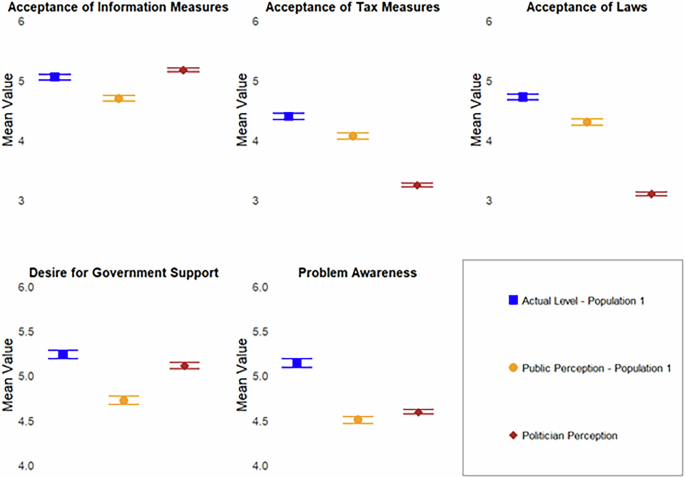
We report analyses using unweighted scores below. When we used weighted scores, the means changed only minimally, and all statistical conclusions remained identical, with one exception: There was no difference between politicians’ perceived public problem awareness and the awareness reported by the public. Results of both unweighted and weighted analyses were very similar (see Supplementary Tables S1–5). The estimated means from the unweighted analyses are depicted in Figs. 1 and 2. Furthermore, the results were robust when applying post-stratification weights to correct for party representation (Supplementary Table S10) as well as when matching the Population 1 and politician/legislative offices samples on gender and age (Supplementary Fig. S4 and Supplementary Table S11).
The diagrams show discrepancies between self-reported public support for climate action and perceived support by both respondents from politicians/legislative offices and the public. Support is measured by acceptance for information, taxes, and laws; desire for government support, and problem awareness. Dot size represents sample size, and bars indicate standard deviations.
The diagram shows discrepancies between self-reported willingness to contribute 1% of income for climate action and the perceived willingness by both politicians/legislative offices and the public (Population 1 and Population 2).
Following our preregistration, we compared respondents’ perceived public support for climate action with the public’s self-reported support (Population 1) using simple contrast tests with false-discovery-rate adjusted p-values (Benjamini–Yekutieli method). Respondents did not underestimate the acceptance of information, Mdiff = 0.12, p = 0.24, 95% CI [−0.08, 0.31], d = 0.11. Strikingly, respondents underestimated the acceptance of taxes, Mdiff = −1.15, p < 0.001, 95% CI [−1.35, −0.95], d = 1.09, and acceptance of laws, Mdiff = −1.62, p < 0.001, 95% CI [−1.82, −1.42], d = 1.55, to a large to extremely large degree. Respondents did not underestimate desire for government support, Mdiff = −0.12, p = 0.190, 95% CI [−0.28, −0.03], d = 0.11, but they underestimated problem awareness to a medium degree, p < 0.001, Mdiff = −0.54; 95% CI [−0.68, −0.41], d = 0.57.
Perhaps most strikingly, respondents vastly underestimated the public’s willingness to contribute 1% of their income compared to our representative online sample (Population 1), Mdiff = −29.35, p < 0.001, 95% CI [−33.21, −25,50], d = 0.97. This effect also replicated in comparison to the representative sample from Andre et al. (1; Population 2), Mdiff = −55.93, p < 0.001, 95% CI [−59.84, −52,02], d = 1.86. The corresponding effect sizes were large to extremely large. Finally, respondents overestimated rather than underestimated the microdonation amount, Mdiff = 15.40, p < 0.001, 95% CI [11.71, 19.10], d = 0.80.
Following our preregistration, we compared the public’s perceived public support with the public’s self-reported support (Population 1) using simple contrast tests. However, rather than using least-significant-difference tests as mentioned in our preregistration, in this and all following analyses, we used false-discovery-rate adjusted p-values using Benjamini-Yekutieli method) as this is a more conservative test of our hypotheses. Unlike politicians/legislative office respondents, the public did underestimate acceptance of information, Mdiff = −0.36, p < 0.001, 95% CI [−0.52, −0.20], d = 0.34; however, the discrepancy was small. Similar to the politician/legislative office respondents, the public also underestimated acceptance of taxes, Mdiff = −0.33, 95% CI [−0.50, −0.16], p < 0.001, d = 0.32, and laws, Mdiff = −0.43, 95% CI [−0.59, −0.26], p < 0.001, d = 0.41, though discrepancies were small rather than large. Unlike the politicians/legislative offices, the public underestimated the desired for government support, Mdiff = −0.51, 95% CI [−0.64, −0.47], p < 0.001, d = 0.47; this discrepancy was medium. Like the politicians/legislative offices, the public also underestimated problem awareness to a medium degree, Mdiff = −0.63, 95% CI [−0.74, −0.66], p < 0.001, d = 0.66.
Like the politicians/legislative offices, the public underestimated the willingness to contribute 1% of income compared to our representative online sample (Population 1), Mdiff = −14.04, 95% CI [−17.93, −10.14], p < 0.001, d = 0.47, and compared to the sample by Andre et al. (1; Population 2), Mdiff = 40.61, 95% CI [−44.91, −36.31], p < 0.001, d = 1.35; the discrepancy was medium and extremely large, respectively. Finally, the public underestimated the microdonation amount, Mdiff = −0.51; 95% CI [−0.64, −0.39], p < 0.001, d = 0.47.
Exploratory analyses revealed that the more left-wing respondents (politicians/legislative offices) self-reported to be (Likert scale ranging from, 1 = left to 7 = right), the greater their perceived public acceptance of information, taxes, and laws; desire for government support; and willingness to contribute. However, these relationships were small or very small, with rs ranging from 0.05 to 0.18, ps <0.05. As mentioned in the preregistration, we also conducted exploratory analyses to examine differences in perceived public support between parties (Linke/BSW, SPD, Greens, FDP, CDU, AfD, see Supplementary Fig. S1 for party membership distribution). ANOVAs with Benjamini–Yekutieli adjusted p-values revealed differences between parties on all seven outcome variables (Supplementary Table S6), except for the willingness to contribute 1% of income. Follow-up exploratory contrasts indicated that these differences were primarily driven by the far-right party (AfD), which consistently perceived lower support than almost all other parties (Supplementary Text, Supplementary Table S7). Importantly, all parties significantly underestimated public support for the most impactful measures: acceptance of taxes and regulations, and willingness to contribute (Supplementary Fig. S2 and Supplementary Table S7).
We set out to examine misperceptions of public support among elected politicians across all levels of government whom we contacted via their professional email addresses. Comparing respondents with the public, we found that misperceptions are even larger in the political domain than among the public and largest for the most effective instruments—acceptance of taxes, laws, and willingness to contribute a share of one’s income—while they are smaller or absent in less influential domains such as problem awareness and desire for government support. These misperceptions appeared across all parties, albeit somewhat less among left-leaning parties, with the far-right as the clear outlier. Using weighted analyses for both the public sample (by region) and the sample of politicians/legislative offices (by party representation across levels), as well as matched-sample analyses aligning both samples on comparable demographics (by gender and age), we rule out sampling bias as an explanation. Together, these features provide a rigorous test of the observed effects.
Our results replicate findings that there is broad public support for climate actions across most of the political spectrum33, in particular when climate policies are perceived as fair and effective34. Politicians’ misperceptions of this public support can hinder effective climate policies1,6,7. In democratic societies, effective climate action relies on a dynamic relationship between public and political decision-makers, who influence and depend on each other. Misjudging public resolve can lead to a ‘tragedy of the commons’18, where political inaction stems from the mistaken belief that the public is unwilling to act.
Crucially, our study expands previous work by including respondents from the highest political levels, who wield significant influence over climate policymaking. Misperceptions were largest for the acceptance of taxes and laws. This underestimation is concerning, as taxes and laws are among the most effective tools for mitigating climate change35. Without an accurate estimation of public support, decision-makers may be reluctant to pursue impactful policies. Respondents also dramatically underestimated the public’s willingness to contribute financially to climate mitigation. This pattern suggests that political decision-makers may underestimate both collective support for structural policies and individual willingness to contribute.
Respondents underestimated collective problem awareness to the same extent as the public, indicating a shared blind spot in recognizing climate issues. While they accurately perceived the public’s desire for government intervention on climate action, a deeper examination of the specific tools of governance reveals a significant disconnect. Respondents did not underestimate the acceptance of information-based tools, perhaps reflecting their own preference for less restrictive measures27,36, while substantially underestimating support for policies with greater “regulatory depth”37, such as taxes and laws. This misalignment suggests that while respondents correctly gauged the general appetite for government action, they fail to recognize the public’s willingness to embrace impactful, systemic interventions. By favoring informational tools, respondents may unintentionally prioritize measures that align with their own roles and preferences while overlooking the public’s openness to deeper regulatory changes.
One finding stood out against our initial hypotheses: Respondents (politicians/legislative offices) but not the public overestimated rather than underestimated the amount the public was willing to give as a microdonation. This may be because, unlike the 1% income contribution measure, the microdonation measure was not well-calibrated to people’s actual income. We suspect that respondents may have used their own income as a comparison standard, making a microdonation between 0 and 100 cents appear negligible to them.
Our findings also align with research showing that politicians underestimate public support for liberal policies in several domains28,29. For example, a large-scale survey conducted in the U.S28. found small misperceptions for amnesty for undocumented immigrants (d = 0.37) and support for same-sex marriages (d = 0.39), medium misperceptions for always legalizing abortion (d = 0.53), and large to very large misperceptions for banning assault rifles (d = 0.89) and background check for guns (d = 1.37). These effect sizes were well within the range of the effect sizes observed in our study. Indeed, the largest misperceptions in our study – for acceptance of climate laws (d = 1.55) and taxes (d = 1.09) were comparable in size to the largest misperception observed by Broockman and Skovron28.
Another study examined misperceptions of public support for specific climate policies among politicians27. Effect sizes for the underestimation of support of climate policies were small to medium, ranging from d = 0.21 (electrifying public transport) to d = 0.47 (fewer legal opportunities to block new wind-turbine sitings). Interestingly, in this study, politicians did not underestimate the relatively low support for a meat tax. These effect sizes were comparatively lower than in our study, suggesting that perceptions may be more accurate when politicians gauge the public support for specific climate policies rather than broader policy fields.
We aimed to recruit an exceptionally large sample of politicians by contacting each invitee in a personalized email addressed by name. As noted above, and as with all online surveys distributed through professional email channels, it is not possible to verify with absolute certainty that the named recipient personally completed the questionnaire. However, we deem that it is unlikely that such cases were sufficient to explain the observed pattern of results for the following reasons.
First, the response-rate pattern is more consistent with differences in willingness or availability across political levels than with delegation to staff: participation was lowest at the federal level (9.8%) and higher at the state (17.8%) and local levels (19.0%). These rates are broadly comparable to those reported in prior elite surveys, including studies with longer questionnaires or interviews that found similar or higher response rates22,23,28. Studies with lower overall response rates20,27 nevertheless reported rates similar to those for our respondents from the federal-level.
Second, our findings were robust across parliamentary levels, including in analyses controlling for party membership within each level of government. Because delegation, if it occurred, would plausibly be more common at higher levels, the consistency of the results across levels suggests that any such cases did not fundamentally alter our conclusions.
Third, participation was voluntary, the survey was brief, and there was no compensation or professional incentive to respond. Although some cases cannot be ruled out, widespread staff participation sufficient to bias the results appears implausible. Moreover, online surveys distributed via professional email can never fully guarantee that the named recipient personally responded. This limitation applies to all email-based surveys.
To minimize self-selection bias among contacted politicians/legislative offices with a strong interest in climate change, we deliberately avoided mentioning climate change in the mailed invitations. Instead, we used a more neutral topic: ‘trends in German society’. Nevertheless, recipients with a strong rather than weak interest in academic research might have been more likely to respond. Because academia in general is more left-leaning than right-leaning38 respondents with an interest in academic research may also be disproportionally left-leaning. Moreover, respondents who are high rather than low in agreeableness may be more likely to participate in surveys. However, because agreeableness is not consistently linked to political orientation39,40, it is not immediately evident how this potential self-selection bias would influence the results.
The attrition rate in our politician/legislative office sample was 29%. That is, of the 2254 respondents who accessed the first page of the survey, 655 did not complete the survey. Of those 655 politicians, the vast majority (99%) dropped out of the survey after seeing the first page. Because respondents learned on the first page that the survey was about climate change, those with a strong interest in climate change might have been more likely to complete the survey. As these are typically more left-leaning, our sample might be skewed toward more left-leaning respondents. Because left-leaning respondents underestimated public support to a lesser degree than right-leaning ones, if anything, the true underestimation of public support might even be larger. However, as can be seen in Supplementary Fig. S1, the party membership distribution in our sample closely matched the party representation at each level of parliament (national, state, communal). Nevertheless, to adjust for potential sampling bias, we conducted auxiliary analyses: Specifically, we weighed the scores for the actual party membership ratios at each level of government. When we repeated our principal analyses with the weighted scores, the pattern of results remained the same.
Moreover, because the respondents (politicians/legislative offices) may differ from the population in terms of key demographic characteristics, such as being older and more likely to be male, we conducted another set of auxiliary analyses to examine whether our results are due to the different sample composition: Specifically, when we compared subsamples (Politician/Legislative Offices vs. Population Sample 1) matched for gender and age, the pattern of results remained the same.
Pluralistic ignorance is a group-level phenomenon. That is, only groups can exhibit pluralistic ignorance, not individuals10,14. This is because pluralistic ignorance is conceptualized as a situation in which group members significantly overestimate or underestimate the extent of agreement with a given position. Although pluralistic ignorance is not reducible to individual-level perceptions, it does arise from individual perceptions14, and an array of different mechanisms can contribute to pluralistic ignorance in the domain of perceived climate policy support.
For example, research on social projection (false consensus bias) suggests that politicians infer public opinion by assuming that citizens share their own views4. This yields smaller gaps when politicians estimate the views of their own voters rather than those of the public at large36. Consistent with this mechanism, we observed slightly smaller misperceptions among left-leaning than right-leaning respondents. False consensus is a conceptually distinct, individual-level phenomenon, but it may contribute to pluralistic ignorance in perceptions of climate policy support when a majority of right-leaning respondents project their own views onto the population.
Moreover, system-justification beliefs might contribute to the observed misperceptions. According to system-justification theory41, people are motivated to defend the status quo to satisfy various psychological needs. Consistent with this idea, system justification is typically stronger among those who benefit most from the status quo. Politicians may therefore be especially motivated to see far-reaching policy change as less desired by the public, which is consistent with our respondents’ particularly large underestimates for more intrusive instruments (taxes and laws). In addition, right-leaning (vs. left-leaning) respondents, who tend to endorse stronger system-justification beliefs, perceived the lowest public support.
Finally, group-level processes may shape individual perceptions: a vocal minority may receive disproportionate visibility in traditional media or produce a disproportionate share of comments on social media14. People’s perceptions of attitude change may also show a well-documented conservative lag, falling behind actual change14.
Across all parliamentary levels and political parties, the survey revealed substantial underestimation of public support for climate action. These misperceptions were larger than those observed among the public, and were particularly pronounced for the most effective climate policies. Thus, such underestimation may represent an important barrier to effective climate policy.
We contacted all German politicians personally via their professional email addresses, which typically included the recipient’s first and last name (e.g., name.surname@bundestag.de). However, even when personal email addresses are used, such accounts may be screened by staff and responses may sometimes be delegated to staff. Therefore, we refer to this sample as politicians/legislative offices throughout the manuscript and discuss this limitation further in the Discussion. These addresses were obtained through an internet search and a company that provides contact details for local politicians (Kürschners Politikkontakte). Between September 26 and November 5, 2024, we emailed 6074 politicians, inviting them to participate in a five-minute survey on ‘Trends in German Society’. To minimize self-selection bias among those with a strong interest in climate change, we deliberately avoided mentioning the topic in the email. The email included a link to the online survey. Fifteen to 18 days after the initial email, we sent a reminder to encourage participation.
Of the 6074 politicians/legislative offices contacted, 2254 accessed the online questionnaire (response rate before attrition: 36.8%). To maximize the response rate, we kept the survey as short as possible. Median completion time was only about 3 min. Following our preregistration, we excluded 655 of these respondents because they completed less than 50% of the questionnaire. Our final sample therefore consisted of 1599 respondents (completion rate after attrition: 26.3%). Demographic information is presented in Table 1. Party membership distribution compared to the actual party representation at each level of parliament (nation, state, communal) is presented in Supplementary Fig. S1.
Participants were presented with the following items. The complete materials and preregistrations are available at: https://shorturl.at/6YY5d.
First, we provided respondents with the following definition of global warming: “The following questions are about global warming. Global warming means that the average global temperature has risen significantly within the past 150 years and could rise further in the future.”
“In your opinion, to what extent does the average person in the German population believe that climate-damaging behaviors are problematic?” (7-point scale, 1 = not at all problematic, 4 = neither/neutral, 7 = very problematic).
“In your opinion, to what extent does the average person in the German population would like the state to support people in reducing such behaviors?” (7-point scale, 1 = no support desired, 4 = neither/neutral, 7 = a lot of support desired).
“In your opinion, to what extent would the average person in the German population accept the following measures for more climate protection: a) communication and information measures, b) taxes on climate-damaging products and behaviors, c) laws and regulations” (7-point scales, 1 = not at all accept, 4 = neither/neutral, 7 = very much accept).
We used the following item adapted from Andre et al.1: “We are asking these questions to 100 persons from the German population. How many do you think are willing to contribute at least 1% of their household income every month to fight global warming?” Participants could enter a number between zero and 100 in a designated field.
“Imagine that the average person in the German population is given €1 for taking part in a survey. The person is then given the opportunity to donate the whole €1 or a smaller amount to an organization campaigning to fight global warming. How many cents of the €1 do you think the person would donate?” Participants could enter a number between 0 and 100 in a designated field.
We asked the following questions:
“Which party do you belong to?” (10 answer options, including the most common German parties)
“Which party office do you hold?” (1 = federal chair, 2 = state chair, 3 = local chair, 4 = prefer not to answer, 5 = other)
“Which mandate do you hold?” (1 = federal parliament, 2 = state parliament, 3 = district parliament, 4 = municipal parliament, 5 = town parliament, 6 = prefer not to answer, 7 = other) d) “In which federal state do you hold your party office or mandate?” (answer options included all 16 federal states plus prefer not to answer)
“Is your mandate in government or in opposition?” (1 = government, 2 = opposition, 3 = prefer not to answer)
“What is your political orientation? (8-point scale; 1 = left, 7 = right, 8 = prefer not to answer) g) “What is your age?” (1 = 18–24 years, 2 = 25–34 years, 3 = 35–44 years, 4 = 45–54 years, 5 = 55–64 years, 6 = 65 years or older, 7 = prefer not to answer)
h) “Which gender do you identify with?” (1 = male, 2 = female, 3 = non-binary, 4 = prefer not to answer)
We recruited participants through the professional survey company Kantar, which specializes in nationally representative surveys in Germany. Our questionnaire was part of a weekly online survey conducted among a nationally representative pool of German residents aged 16 or older with an internet connection. The participants in this pool were from all regions of Germany. Following our preregistration, we recruited 1034 participants who completed the online questionnaire in full. The response rate was 58%. Our questions appeared in the first third of the complete questionnaire. Demographic information is provided in Table 1. Participants were presented with the following items:
From Grelle and Hofman42: “To what extent do you think that climate-damaging behaviors are problematic?” (7-point scale, 1 = not at all problematic, 4 = neither/neutral, 7 = very problematic).
Same as in the politician survey.
From Grelle and Hofman42: “To what extent do you think the government should support people to reduce such behaviors?” (7-point scale, 1 = no support desired, 4 = neither/neutral, 7 = a lot of support desired).
Same as in the politician survey.
Adapted from Grelle and Hofman42:“To what extent would you accept the following measures for more climate protection: a) communication and information measures, b) taxes on climate-damaging products and behaviors, c) laws and regulations?” (7-point scales, 1 = not at all accept, 4 = neither/neutral, 7 = very much accept).
Same as in the politician survey.
From Andre et al.: “Would you be willing to contribute 1% of your household income every month to fight global warming? This would mean that you would contribute 1€ for every 100€ of this income.” (yes/no)
Same as in the politician survey.
“Imagine you were paid €1 for taking part in this survey. How many cents of that amount would you be willing to donate to an organization campaigning to fight global warming?”
Same as in the politician survey.
The questionnaire included demographic questions that are routinely part of the weekly online omnibus surveys by the survey company. These questions covered a) current party preference, b) age, c) gender, d) occupation, e) social class, f) income, among others.
Participants were 1000 Germans representative of the German national population from the global survey conducted by Andre et al.1. They answered the questions as part of the Gallup World Poll 2021/2022. Participants were contacted via telephone by Gallup and completed the survey through a computer-assisted telephone interview. Detailed information on the sampling procedure and interview method can be found here: https://www.nature.com/articles/s41558-024-01925-3. The telephone survey included the following items:
The same item as used in our German online population survey. The item was originally developed by Andre et al.
The same item as used in our German politician survey and our German online population survey. The item was originally developed by Andre et al.
This item was not included in our analyses: Do you think the national government should do more to fight global warming? (binary scale: yes, no).
This item was not included in our analyses: Do you think that people in [the United States] should do try to fight global warming? (binary scale: yes, no).
The study was approved by the ethics committee of faculty of psychology at the Ruhr University Bochum.
Further information on research design is available in the Nature Portfolio Reporting Summary linked to this article.
All data and materials used in the analyses are available at: https://shorturl.at/6YY5d. Data sources for Table 1:Gender: Federal Statistical Office of Germany (Destatis), https://www.destatis.de/DE/Themen/Gesellschaft-Umwelt/Bevoelkerung/Bevoelkerungsstand/_inhalt.html; Age: Statista, https://de.statista.com/statistik/daten/studie/1351/umfrage/altersstruktur-der-bevoelkerung-deutschlands/; Party preference (German federal election, 2021): Wikipedia, https://de.wikipedia.org/wiki/Bundestagswahl_2021; State population: Statista, https://de.statista.com/statistik/daten/studie/71085/umfrage/verteilung-der-einwohnerzahl-nach-bundeslaendern/.
The analysis code is available at: https://shorturl.at/6YY5d.
Andre, P., Boneva, T., Chopra, F. & Falk, A. Globally representative evidence on the actual and perceived support for climate action. Nat. Clim. Chang. 12, 100–108 (2024).
Google Scholar
Frings, N. L., Helm, J. F. & Hahnel, U. J. J. The energy crisis differentially impacted Swiss and German citizen’s energy literacy and efficiency preferences but not their support for climate policies. Commun. Earth Environ. 5, 544 (2024).
Article Google Scholar
Chater, N. & Loewenstein, G. The i-frame and the s-frame: How focusing on individual-level solutions has led behavioral public policy astray. Behav. Brain Sci. 46, 1–84 (2023).
Article Google Scholar
Miller, W. E. & Stokes, D. E. Constituency influence in Congress. Am. Polit. Sci. Rev. 57, 45–56 (1963).
Article Google Scholar
Butler, D. M. & Nickerson, D. W. Can learning constituency opinion affect how legislators vote? Results from a field experiment. Q. J. Polit. Sci. 6, 55–83 (2011).
Article Google Scholar
Geiger, N. & Swim, J. K. Climate of silence: pluralistic ignorance as a barrier to climate change discussion. J. Environ. Psychol. 47, 79–90 (2016).
Article Google Scholar
Sparkman, G., Geiger, N. & Weber, E. U. Americans experience a false social reality by underestimating popular climate policy support by nearly half. Nat. Commun. 13, 4779 (2022).
Article CAS Google Scholar
Katz, D. & Allport, F. H. Student Attitudes: A Report of the Syracuse University Reaction Study (The Craftsman Press, 1931).
Prentice, D. A. & Miller, D. T. Pluralistic ignorance and alcohol use on campus: some consequences of misperceiving the social norm. J. Pers. Soc. Psychol. 64, 243–256 (1993).
Article CAS Google Scholar
Miller, D. T. A century of pluralistic ignorance: what we have learned about its origins, forms, and consequences. Front. Soc. Psychol. 1, 1260896 (2023).
Article Google Scholar
Vandello, J. A., Ransom, S., Hettinger, V. E. & Askew, K. Men’s misperceptions about the acceptability and attractiveness of aggression. J. Exp. Soc. Psychol. 45, 1209–1219 (2009).
Article Google Scholar
Van Boven, L. Pluralistic ignorance and political correctness: the case of affirmative action. Polit. Psychol. 21, 267–276 (2000).
Article Google Scholar
Sevincer, A. T. & Stoet, G. The pluralistic illusion of gender inequality. Psychol. Rep. (2025).
Sargent, R. H. & Newman, L. S. Pluralistic ignorance research in psychology: a scoping review of topic and method variation and directions for future research. Rev. Gen. Psychol. 25, 163–184 (2021).
Geiger, S. J. et al. White, What we think others think and do about climate change: a multicountry test of pluralistic ignorance and public-consensus messaging. Psychol. Sci. 36, 421–442 (2025).
Fang, X., Ettinger, J. & Innocenti, S. United Nations Environment Assembly attendees underestimate public willingness to contribute to climate action. Commun. Earth Environ. 6, 622 (2025).
Article Google Scholar
Frantz, C. M. & Mayer, F. S. The emergency of climate change: why are we failing to take action?. Anal. Soc. Issues Public Policy 9, 205–222 (2009).
Article Google Scholar
Hardin, G. The tragedy of the commons. Science 162, 1243–1248 (1968).
Article CAS Google Scholar
Butler, D. M. & Dynes, A. How politicians discount the opinions of constituents with whom they disagree. Am. J. Polit. Sci. 60, 975–989 (2016).
Article Google Scholar
Broockman, D. E., Kalla, J. L., Caballero, C. & Easton, M. Political practitioners poorly predict which messages persuade the public. Proc. Natl. Acad. Sci. USA 121, e2400076121 (2024).
Article CAS Google Scholar
Kertzer, J. D. & Zeitzoff, T. A bottom-up theory of public opinion about foreign policy. Am. J. Polit. Sci. 61, 543–558 (2017).
Article Google Scholar
Lucas, J. et al. Politicians’ theories of voting behavior. Am. Polit. Sci. Rev. 119, 1304–1321 (2025).
Article Google Scholar
Walgrave, S. et al. Inaccurate politicians: elected representatives’ estimations of public opinion in four countries. J. Polit. 85, 209–222 (2023).
Article Google Scholar
Howe, P. D., Mildenberger, M., Marlon, J. R. & Leiserowitz, A. Geographic variation in opinions on climate change at state and local scales in the USA. Nat. Clim. Chang. 5, 596–603 (2015).
Article Google Scholar
Mildenberger, M. & Tingley, D. Beliefs about climate beliefs: the importance of second-order opinions for climate politics. Br. J. Polit. Sci. 49, 1279–1307 (2019).
Article Google Scholar
Sparkman, G., Ginn, J., Attari, S. Z. & Weber, E. U. Americans and policymakers underestimate endorsement for the most popular climate solution narrative, combining personal and political action. Commun. Earth Environ. 6, 525 (2025).
Article Google Scholar
Walgrave, M. & Soontjens, K. Responsive nor responsible? Politicians’ climate change policy preferences and public opinion perceptions. Environ. Polit. 35, 522–546 (2025).
Broockman, D. E. & Skovron, C. Bias in perceptions of public opinion among political elites. Am. Polit. Sci. Rev. 112, 542–563 (2018).
Article Google Scholar
Pilet, J. B. et al. Do politicians outside the United States also think voters are more conservative than they really are?. Am. Polit. Sci. Rev. 118, 1037–1045 (2024).
Article Google Scholar
Grelle, S. & Hofmann, W. When and why do people accept public-policy interventions? An integrative public-policy-acceptance framework. Perspect. Psychol. Sci. 19, 258–279 (2024).
Article Google Scholar
Weber, U. in Policy Shock: Regulatory Responses to Oil Spills, Nuclear Accidents, and Financial Crashes (eds, Carrigan, C., Coglianese, C., Shapiro, S.M.) 89–113 (Cambridge University Press, 2017).
Sevincer, A. T., Galinsky, C., Martensen, L. & Oettingen, G. Political ideology outdoes personal experience in predicting support for gender equality. Polit. Psychol. 44, 829–855 (2023).
Article Google Scholar
Van Boven, L., Ehret, P. J. & Sherman, D. K. Psychological barriers to bipartisan public support for climate policy. Perspect. Psychol. Sci. 13, 492–507 (2018).
Article Google Scholar
Bergquist, M., Nilsson, A., Harring, N. & Jagers, S. C. Meta-analyses of fifteen determinants of public opinion about climate change taxes and laws. Nat. Clim. Chang. 12, 235–240 (2022).
Article Google Scholar
Sterner, T. Distributional effects of taxing transport fuel. Energy Policy 41, 75–83 (2012).
Article Google Scholar
Sevenans, J. et al. Projection in politicians’ perceptions of public opinion. Polit. Psychol. 44, 1259–1279 (2023).
Article Google Scholar
Hofmann, W. & Grelle, S. What makes people want more impactful climate policy? Curr. Opin. Behav. Sci. 61, 101479 (2025).
Duarte, J. L. et al. Political diversity will improve social psychological science. Behav. Brain Sci. 38, e130 (2015).
Article Google Scholar
Fatke, M. Personality traits and political ideology: a first global assessment. Polit. Psychol. 38, 881–899 (2017).
Article Google Scholar
Hirsh, J. B., DeYoung, C. G., Xu, X. & Peterson, J. B. Compassionate liberals and polite conservatives: Associations of agreeableness with political ideology and moral values. Pers. Soc. Psychol. Bull. 36, 655–664 (2010).
Article Google Scholar
Jost, J. T., Banaji, M. R. & Nosek, B. A. A decade of system justification theory: accumulated evidence of conscious and unconscious bolstering of the status quo. Polit. Psychol. 25, 881–919 (2004).
Article Google Scholar
Grelle, S. & Hofmann, W. The desire for governmental support as a motivational foundation of climate policy acceptance. Motiv. Sci. 12, 282–291 (2025).
Download references
This research was supported in part by a fellowship by the Hanse-Wissenschaftskolleg, Delmenhorst – Institute for Advanced Study (HWK) for ATS. Open Access funding enabled and organized by Projekt DEAL.
Institute of Sustainability Psychology, Leuphana University, Lüneburg, Germany
A. Timur Sevincer, Luisa Hostlowsky & Fenja Styhler
Faculty of Psychology, Ruhr University, Bochum, Germany
Wilhelm Hofmann
German Center for Mental Health (DZPG), Partner site Bochum-Marburg, Bochum, Germany
Wilhelm Hofmann
PubMed Google Scholar
PubMed Google Scholar
PubMed Google Scholar
PubMed Google Scholar
A.T.S. designed and performed the research, analyzed the data, and wrote the paper. L.H. performed the research, analyzed the data, and wrote the paper. F.S. performed the research. W.H. co-designed the research, analyzed the data, and wrote the paper.
Correspondence to A. Timur Sevincer.
The authors declare no competing interests.
Communications Earth & Environment thanks Karolin Soontjens and the other, anonymous, reviewer(s) for their contribution to the peer review of this work. Primary Handling Editors: Miranda Boettcher, and Martina Grecequet. A peer review file is available
Publisher’s note Springer Nature remains neutral with regard to jurisdictional claims in published maps and institutional affiliations.
Open Access This article is licensed under a Creative Commons Attribution 4.0 International License, which permits use, sharing, adaptation, distribution and reproduction in any medium or format, as long as you give appropriate credit to the original author(s) and the source, provide a link to the Creative Commons licence, and indicate if changes were made. The images or other third party material in this article are included in the article’s Creative Commons licence, unless indicated otherwise in a credit line to the material. If material is not included in the article’s Creative Commons licence and your intended use is not permitted by statutory regulation or exceeds the permitted use, you will need to obtain permission directly from the copyright holder. To view a copy of this licence, visit http://creativecommons.org/licenses/by/4.0/.
Reprints and permissions
Sevincer, A.T., Hostlowsky, L., Styhler, F. et al. Public support for climate action is underestimated in the German political domain. Commun Earth Environ 7, 543 (2026). https://doi.org/10.1038/s43247-026-03721-7
Download citation
Received:
Accepted:
Published:
Version of record:
DOI: https://doi.org/10.1038/s43247-026-03721-7
Anyone you share the following link with will be able to read this content:
Sorry, a shareable link is not currently available for this article.
Provided by the Springer Nature SharedIt content-sharing initiative
Advertisement
Communications Earth & Environment (Commun Earth Environ)
ISSN 2662-4435 (online)
© 2026 Springer Nature Limited
Sign up for the Nature Briefing: Anthropocene newsletter — what matters in anthropocene research, free to your inbox weekly.
About the Author