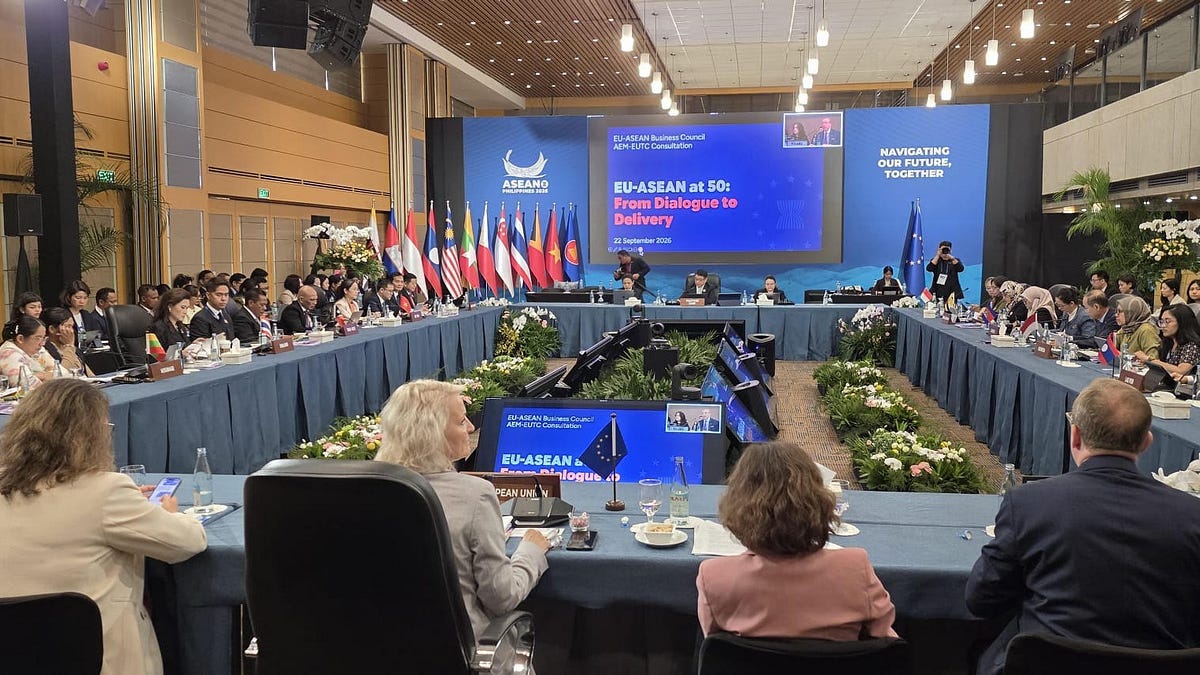
Southeast Asian and European government and enterprise executives have gathered to discuss strengthening the trade agreement between both regions at the 12th ASEAN-EU Business Summit as part of ASEAN’s 58th Economic Ministers’ Meeting in Manila on 22 September 2026.
The meeting focused on five critical long-term growth areas: energy transition, financial inclusion, digital connectivity, AI transformation, and health-nutrition.
The Summit was led by Ditte Juul Jørgensen, European Commission’s Director-General for Trade and Economic Security, and Satvinder Singh, ASEAN Deputy Secretary-General. It was also attended by executives from HSBC, Prudential, SWIFT, FrieslandCampina and Coca-Cola Europacific Partners.
The Southeast Asia Desk is a reader-supported publication. To receive new posts and support my work, consider becoming a free or paid subscriber.
This summit signals a strong commitment to partnership development between the two blocs, particularly in trade and investment.
The European Union has considerably prioritised strengthening its economic partnership with ASEAN in recent years. It has also shown that the EU is trying to diversify markets to reduce excessive dependence on the United States and China.
Southeast Asian countries see the EU as a strategic partner able to hedge against uncertainties from US-China rivalry. ASEAN member states also recognise the EU as a reliable partner associated with a rules-based international order and multilateralism.
✨ Southeast Asian countries’ trust in the EU has reached 55.9%, the second highest amongst ASEAN Strategic Partners.
🛡️ The EU (37.7%) remains ASEAN’s most preferred and trusted “third-party” strategic partner to hedge against US-China rivalry.
💶 EU total foreign direct investment (FDI) is the largest in ASEAN, valued at US$31.3 billion in 2025, nearly double the previous year.
📈 In 2024, EU FDI stocks into ASEAN accounted for €363.4 billion, while ASEAN’s investment in the EU totalled €294.1 billion. The EU remains ASEAN’s third-largest investor, after the US and China.
🌐 ASEAN is the EU’s third-largest trading partner outside Europe, with US$313.1 billion in goods trade in 2025. Bilateral services trade amounted to €139.2 billion in 2024.
Thanks for reading The Southeast Asia Desk! This post is public so feel free to share it.
Share
Leaders welcomed the EU-Philippines Free Trade Agreement (FTA), expected to be ratified in 2027. Similar deals with Thailand and Malaysia are also expected to conclude next year, adding to existing FTAs with Indonesia, Vietnam, and Singapore.
The two blocs also pursue a broader region-to-region economic framework to mark the 50th anniversary of ASEAN-EU partnership next year. The EU-ASEAN Business Council urged adoption of an ASEAN-EU Economic Framework Agreement allowing advanced economic integration.
According to a release, Jens Ruebbert, Chairman of the EU-ASEAN Business Council, stated that these bilateral deals should not be the endpoint but the foundation for a more ambitious, longer-term goal to establish a region-to-region FTA.
He added that the council strongly believed a regional deal would provide a competitive edge for European and Southeast Asian companies alike, bringing trade and investment to a level that reflects the scale and strategic importance of the ASEAN-EU relationship.
Share The Southeast Asia Desk
According to the EU-ABC 12th Sentiment Survey, 74% of European businesspeople believe an ASEAN-EU FTA would deliver more benefits than bilateral agreements, and 49% want negotiations for a regional FTA next year.
There is a set of opportunities and challenges for those looking to expand in ASEAN.
📊 ASEAN ranks as the region offering the strongest economic opportunities for the EU for the fourth consecutive year, with 61% choosing it over China and South Asia — up from 56% in 2025.
📈 Nearly four in five (78%) EU business representatives expect to increase trade and investment in ASEAN over the next five years.
💰 US tariff policy uncertainty remains a key concern, with 81% saying it has weakened business confidence in ASEAN.
🚧 Nearly three-quarters (73%) of European businesses see too many barriers for efficient supply-chain usage, while 67% identified the lack of harmonised regulations as a key challenge.
According to United Nations Comtrade data, the largest Southeast Asian-European trade commodity is primarily agricultural and livestock products. Southeast Asia’s strongest export to the EU is coffee, valued at US$3.8 billion**. The most widely accepted European commodity is **milk and cream**, valued at **US$620.9 million in 2025.
🇻🇳 Vietnam: US$85.7 billion
☕ Largest export to EU: **Coffee** (US$3.3 billion)
🥛 Largest import from EU: Milk & Cream (US$116 million)
🇲🇾 Malaysia: US$54.7 billion
🌴 Largest export to EU: **Palm Oil** (US$1.28 billion)
🥩 Largest import from EU: Meat of Swine (US$206.3 million)
🇸🇬 Singapore: US$53.5 billion
⛏️ Largest export to EU: **Copper Ore** (US$256.3 million)
🥩 Largest import from EU: Meat of Swine (US$83.3 million)
🇹🇭 Thailand: US$49.6 billion
🍖 Largest export to EU: **Prepared/Preserved Meat** (US$416.8 million)
🌾 Largest import from EU: Wheat & Meslin (US$63.9 million)
🇮🇩 Indonesia: US$31.2 billion
🌴 Largest export to EU: **Palm Oil** (US$1.12 billion)
Largest import from EU: Milk & Cream (US$141 million)
The numbers are no longer the question. The EU is ASEAN’s largest foreign investor, its third-largest trading partner outside Europe, and the strategic partner Southeast Asians trust second-most after decades of hedging between Washington and Beijing.
What remains unresolved is architecture. Europe and Southeast Asia are building their relationship one bilateral FTA at a time—the Philippines in 2027, Thailand and Malaysia close behind—while the larger prize, a region-to-region agreement, stays on the drawing board.
Three-quarters of European businesses say they want it. The question is whether governments will move at the same speed as the capital already flowing between them.
If they do, the 50th anniversary next year could mark more than a milestone. It could mark the moment ASEAN and the EU stopped treating each other as alternatives to somewhere else—and started treating each other as the destination.
ASEAN STATS Flows of Inward Foreign Direct Investment (FDI) to ASEAN by Source Country and Industry (in million US$)
Deutsche Welle Trust in EU grows in Southeast Asia, but challenges remain
EU-ASEAN Business Council ASEAN remains top growth market for EU firms as 78% expect trade and investment to rise: 12th Business Sentiment Survey 2026
EU-ASEAN Business Council EU-ABC urges ASEAN, EU to launch regional trade framework at meeting with economic chiefs
EU-ASEAN Business Council 12th EU-ASEAN Business Sentiment Survey
European Comission EU trade relations with the Association of South East Asian Nations. Facts, figures and latest developments
Europe Relations Balancing Influence and Partnership: The EU’s Indo-Pacific Ambitions and ASEAN Centrality
ISEAS – Yusof Ishak Institute The State of Southeast Asia 2026 Survey Report
Lee Kuan Yew School of Public Policy ASEAN-EU Partnership | Multilateralism & Cooperation
UN Comtrade Database Trade Data
(ADE/ELS)
No posts
About the Author