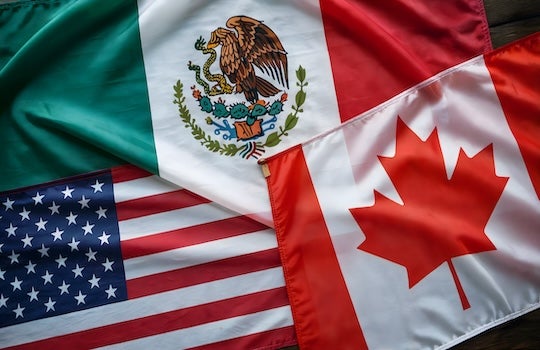
As the United States, Canada and Mexico navigate tariffs, shifting trade policies and growing competition with China, the future of the United States-Mexico-Canada Agreement (USMCA) is increasingly uncertain.
Four experts with extensive experience in the trade and economic policy of these countries discussed the challenges facing the agreement and the broader North American economy in a webinar hosted by the Baker Institute for Public Policy at Rice University. Their discussion focused on the priorities of each country, the impact of tariffs on integrated industries and whether the three nations can work together to remain globally competitive.
For Luis Lozano, president and CEO of Toyota Motor de México, Mexico’s immediate concern is economic stability.
Mexico’s relationship with the United States extends beyond trade, he noted, encompassing issues such as border security, immigration and narcotics. That broader relationship makes negotiations over the USMCA particularly complex.
Lozano said Mexico is also dealing with a weak economy and needs greater certainty to encourage investment and job creation. U.S. tariffs and ongoing uncertainty make that more difficult, increasing pressure on Mexico to reach an agreement with Washington.
Energy could prove especially challenging. Mexico’s energy policy is closely connected to questions of sovereignty, Lozano said, making the issue politically sensitive as the United States presses its concerns.
At the same time, he emphasized the importance of North American economic integration. Mexico can diversify its trade relationships, but the economic pull of the United States remains difficult to replace.
Meredith Lilly, a nonresident scholar at the Baker Institute’s Claudio X. González Center for the United States and Mexico and a professor at Carleton University, described a different set of challenges facing Canada.
Canadian and U.S. officials had been discussing potential concessions involving issues including liquor, procurement, dairy and retaliatory tariffs. Those talks stalled, however, and Lilly said public support in Canada for resisting U.S. pressure makes it politically difficult for the government to return to negotiations without a compelling reason. Economic pressure could change that calculation for both countries.
“If you ask Canadians are they willing to pay the price in terms of higher costs for that decision, support goes down somewhat,” Lilly said, noting that affordability and inflation could eventually affect Canadians’ willingness to support a prolonged confrontation with Washington.
Lilly also noted that Canada is pursuing greater trade diversification, including stronger relationships with Europe and other markets. The country is looking for opportunities in areas such as energy, defense and critical minerals as it reduces its dependence on the U.S. market.
Still, she cautioned that diversification cannot fully replace Canada’s relationship with the U.S. Geography and the scale of cross-border trade continue to make the U.S. Canada’s most important economic partner.
Simon Lester, a lawyer and Baker Institute nonresident fellow specializing in international trade law, focused on the growing use of U.S. tariffs justified on national security grounds.
The expanded use of Section 232 tariffs raises an important question for the USMCA, Lester said: If the U.S. can impose tariffs while invoking national security, what protection does the trade agreement ultimately provide?
Despite those concerns, Lester said the USMCA continues to have practical value. Some goods that meet the agreement’s requirements remain eligible for preferential treatment, and the agreement could become more significant under a future U.S. administration.
The formal 2027 review of the USMCA is also being overshadowed by current negotiations, Lester said. Rather than waiting for the scheduled review, the Trump administration is pursuing bilateral discussions with Canada and Mexico and seeking significant concessions from both countries.
Steve Verheul, a former senior Canadian trade official who served as Canada’s chief negotiator during the creation of the USMCA, emphasized the consequences of disrupting the region’s highly integrated manufacturing system.
The auto industry is a prime example. Vehicles and parts routinely cross the U.S.-Canada-Mexico borders during production, meaning tariffs imposed on one country can quickly affect manufacturers and consumers throughout North America.
Verheul argued that efforts to shift production back to the U.S. through tariffs could ultimately make the region less competitive. If North American countries impose barriers on one another, they risk undermining the integrated supply chains that have helped the region compete globally.
The discussion also highlighted the auto industry’s broader transition. Lester pointed to the growing importance of electric vehicles and questioned whether a U.S. focus on larger, gasoline-powered vehicles could leave American manufacturers vulnerable as other markets move toward EVs.
Lozano noted that the industry remains dependent on supply chains that extend beyond North America, including Chinese components used in connected vehicles and other technologies.
The panelists agreed that China presents a major strategic challenge, but they differed on how North America should respond.
Lilly and Verheul emphasized the value of deeper integration among the three countries. A stronger North American market, they argued, could provide a foundation for competing with China and other global producers.
Lester offered a more cautious view of current U.S. policy. He suggested that the Trump administration’s approach is not simply aimed at building a stronger North American bloc to compete with China. It is also focused on addressing U.S. trade deficits with Canada and Mexico.
“They don’t want a ‘fortress in North America’ — what they really want is a ‘fortress U.S.,’” Lester said.
That tension could make it more difficult for the three countries to develop a coordinated regional strategy.
The panelists ultimately returned to the importance of North American integration.
Lilly noted that Canada’s willingness to withstand U.S. pressure could change if tariffs begin to impose greater economic costs. Verheul argued that the United States also has an interest in preserving the regional market because disrupting Canadian and Mexican production can hurt U.S. companies and consumers.
Lozano emphasized the strategic importance of North America to the United States, while Lester pointed to the potential significance of upcoming U.S. elections for trade policy.
As the 2027 USMCA review approaches, the panelists suggested that the central issue extends beyond the agreement itself: whether Canada, Mexico and the United States can preserve the economic integration that has made North America competitive while responding to a rapidly changing global economy.
The Baker Institute’s Claudio X. González Center for the United States and Mexico seeks to have a meaningful, positive impact on the U.S.-Mexico relationship through original research, actionable policy solutions to binational issues and high-level convenings that bridge the worlds of ideas and action.
The center’s research agenda focuses on several key areas of importance to both nations, including U.S.-Mexico diplomatic and political relations, politics and democracy in Mexico, security cooperation and rule of law in Mexico, trade and economic integration, immigration and labor markets, sustainability and the binational commons as well as AI policy and governance.
6100 Main St., Houston, TX 77005-1827 |
Mailing Address: P.O. Box 1892, Houston, TX 77251-1892 |
713-348-0000 | Privacy Policy | Campus Carry
About the Author