AI FOMO (Fear of Missing Out) is no longer a new term, and few people even mention FOMO anymore. When the tide of AI rises to the neck of human workers, surviving the battle royale is far more important than anxiety and outcry. 该文观点仅代表作者本人,36氪平台仅提供信息存储空间服务。
At least at the macro level, this is exactly the case, as can be seen from the layoff statistics.
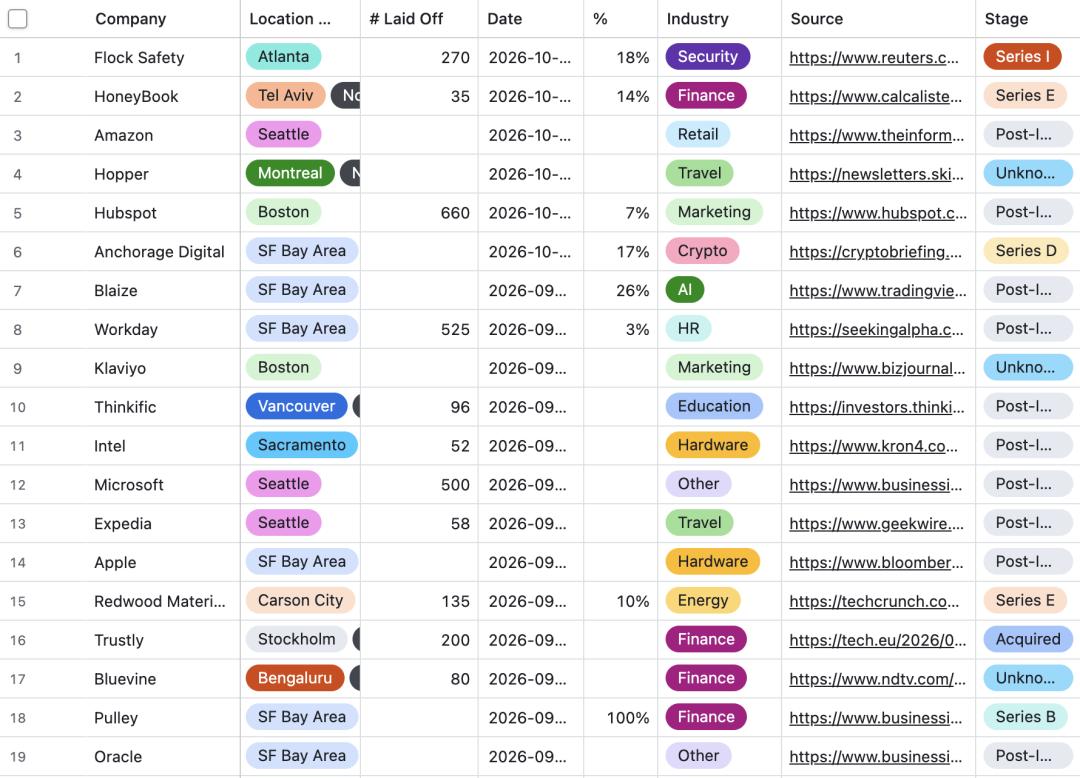
Layoffs.fyi, a website dedicated to tracking layoff data of global tech companies, shows: In 2026, 33% of layoff incidents are AI-related, while in 2024, this figure was only 1%. Amazon, Meta, Oracle, Microsoft, Paypal… Those large corporations that used to be the ultimate career destination for tech practitioners have all appeared on the layoff list, showing their justifiable harsh side. In terms of the total number of laid-off employees, 92,913 tech company layoffs worldwide this year can be attributed to AI, accounting for 72% of the total layoffs. (Data source: crunchbase.com)
As of press time, Layoffs.fyi has tracked more than 130,000 layoffs this year
The layoff date, number, involved department, AI relevance and information source are all strictly marked in the table
In enterprises, the AI FOMO sentiment has gradually been put into practice: metrics like “lobster farming” and Token usage have been included in the KPI assessment mechanism of some teams, and Tokenmaxxing (maximizing Token consumption) has become a symbol of the working class. No matter in content creation, social networking or e-commerce sectors, adding AI functions to applications has become a common practice to boost future expectations and corporate valuation. Wudaokou and Zhongguancun, which once fell into recession, have gathered a large number of AI startups again, creating jobs while bringing opportunities for rapid career advancement.
While creating jobs, AI is also eliminating jobs. On recruitment platforms, the title of “AI” has been added in front of countless traditional positions, forcing job seekers to revise and polish their resumes over and over again as models and agents iterate. In the gold rush era, very few people get the full benefit, some get a share of the profit, and more only smell the attractive scent of success, only to find that what is simmering in the iron pot when they reach the stove is themselves. Not everyone is qualified to sell shovels, but the tools for digging one’s own grave still need to be prepared. Before the tombstone is completed, you may dig out a gold mine by chance.
The real nature of my work. Source: Boss Zhipin
A survey summary on Howworks.ai shows: In 2026, 51% of American workers are worried about losing their jobs due to AI; 72% of professionals lack confidence in their ability to adapt to AI; and 16% of American employees pretend to use AI at work just to please their bosses. It does not matter if you cannot use AI, the important thing is not to let your boss think you cannot use it. Before you master AI proficiency, it is better to show a positive attitude towards AI first — 60% to 70% of tech leaders indicate that FOMO is exactly the important reason why they make their departments or organizations invest in AI. The trick for modern practitioners to achieve long-term survival is to meet the needs and ease the anxiety of their managers.
Fear comes from the unknown. Fabre will not suffer from insect phobia, and materialists believe that Cthulhu is nothing more than a fictional supernatural monster. The more you know about AI, the less FOMO you will feel, which sounds not a big deal. However, most of the information pouring into us in the current content field is not intended to lead people to the truth and dispel the unknown, but to further exaggerate the irreplaceability of the AI industry. Ask yourself, have we really become more relaxed in the massive amount of AI information and paid subscriptions? Probably not. We can only catch our breath during the legal holidays away from the city and the office, but we are still shocked by the performance of opus5.5 again and again when we scroll through short videos before going to bed.
The romantic and philosophical part is now also managed by Claude. Source: Bilibili
Sheep have a natural tendency to gather towards the center of the flock. The first principle of sheepdogs is to run, bark and stare around the flock to drive the stray individuals back to the center of the group. The sense of security surrounded by peers is written in our genes. People who have a reversed jet lag wake up before dark and always feel empty and desolate in their hearts, which is exactly the feeling of a monkey abandoned by the group, and also the psychological prototype of FOMO.
Source: workingsheepdogs.uk
The last large-scale collective FOMO experienced by human beings should be the social media FOMO of Generation Z. In many film and television works depicting the life of young people in Europe and the United States, it is an essential shot to show the Instagram, Facebook and TikTok content on their mobile phones. Teenagers who fail to participate in and pay attention to the messages on their smartphones in time are very likely to be excluded or even bullied by the group. The FOMO brought by the Imoo children’s smart watch among Chinese primary school students also falls into this category.
In the era of social media FOMO, the FOMO of WeChat Moments is more related to the life of Chinese adults. Scroll through WeChat frequently, don’t miss your friends’ weddings, your mentors’ academic conferences, your leaders’ trips to Europe and the newborns in old classmates’ families. All these are worth liking to show your attention, and can also be used as ice-breaking topics when you meet next time. Even if you have nothing to do, you can conduct social stalking to confirm that you are doing the right thing at the right age, appropriately continuing the 5,000-year-old East Asian ethnography. In order to get rid of this FOMO state, more and more people now choose to disable or stop posting on WeChat Moments to escape from the vain anxiety.
Source: The Simpsons
Social FOMO brings the sense of being abandoned by the group, while AI FOMO makes human beings feel a real existential crisis — in 2026, a meta-analysis paper on understanding AI anxiety (AIAX) based on terror management theory shows that AI anxiety reflects a deep-seated fear of non-existence (that is, death), which is closely related to death anxiety. It is not just a kind of technical anxiety caused by lack of skills and confidence, but also involves individuals’ fear of technological dominance and symbolic concern that human beings will be eliminated.
In June this year, a survey published by Nature covering 1907 researchers from 75 countries around the world shows that 48% of respondents hold negative views on AI, 30% hold positive views, and 22% hold neutral views; 63% of respondents believe that the risks outweigh the benefits when using LLM and other AI tools for data or literature analysis, and nearly 60% of respondents say they will fall behind if they do not use AI tools. In September, a joint statement by 26 Fields Medal winners including Terence Tao also expressed the academic community’s concern and prudence towards AI, but this letter was interpreted from another perspective as: the vested interests in the academic circle are a little unable to afford to lose in front of AI.
(Before the release of this article, OpenAI released 722 mathematical achievements at one time, which led to another public boycott by the Association of Human Mathematicians (AHM). The aggressive invasion of AI has forced human workers to clearly draw boundaries in their own fields for self-preservation.)
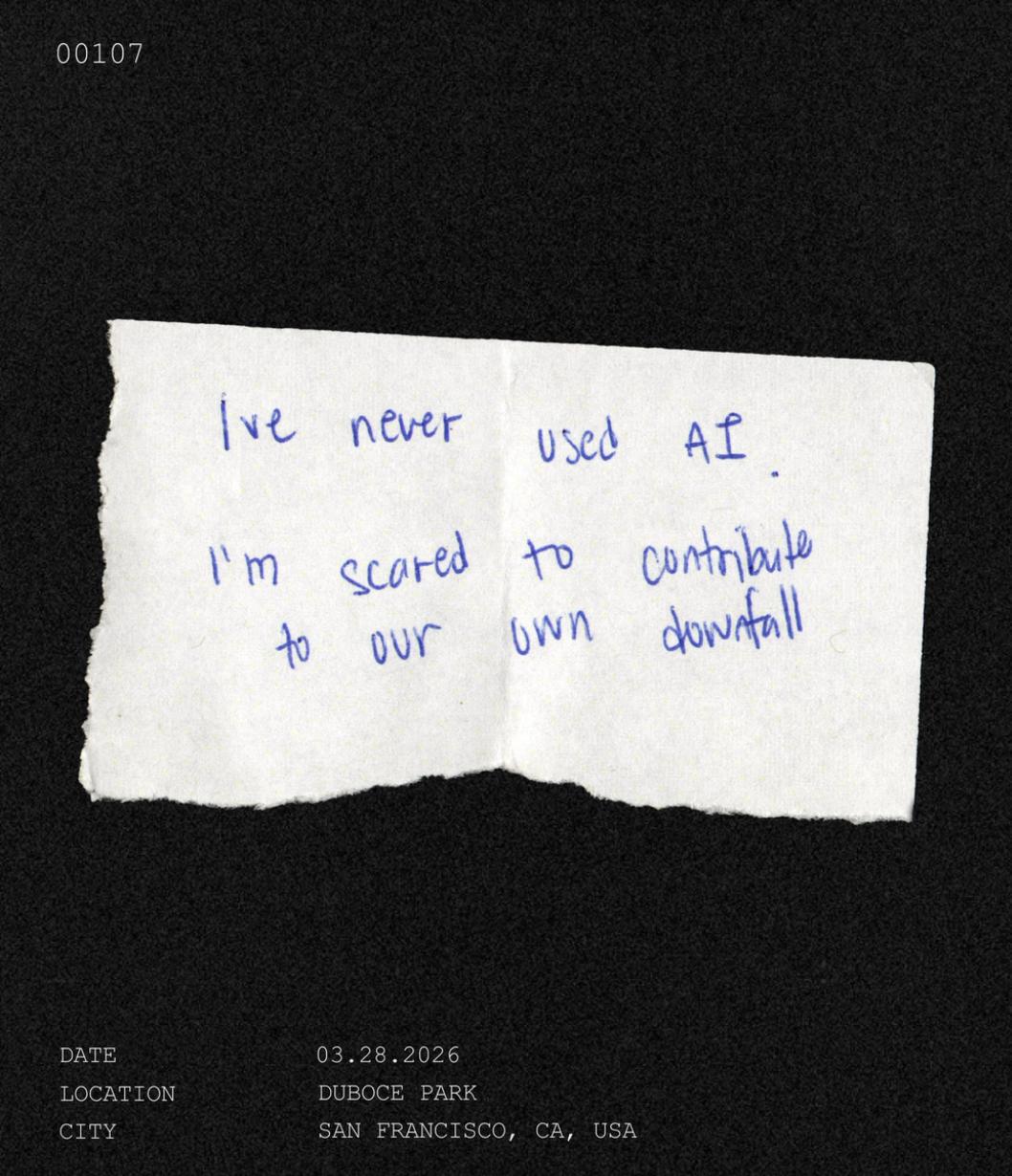
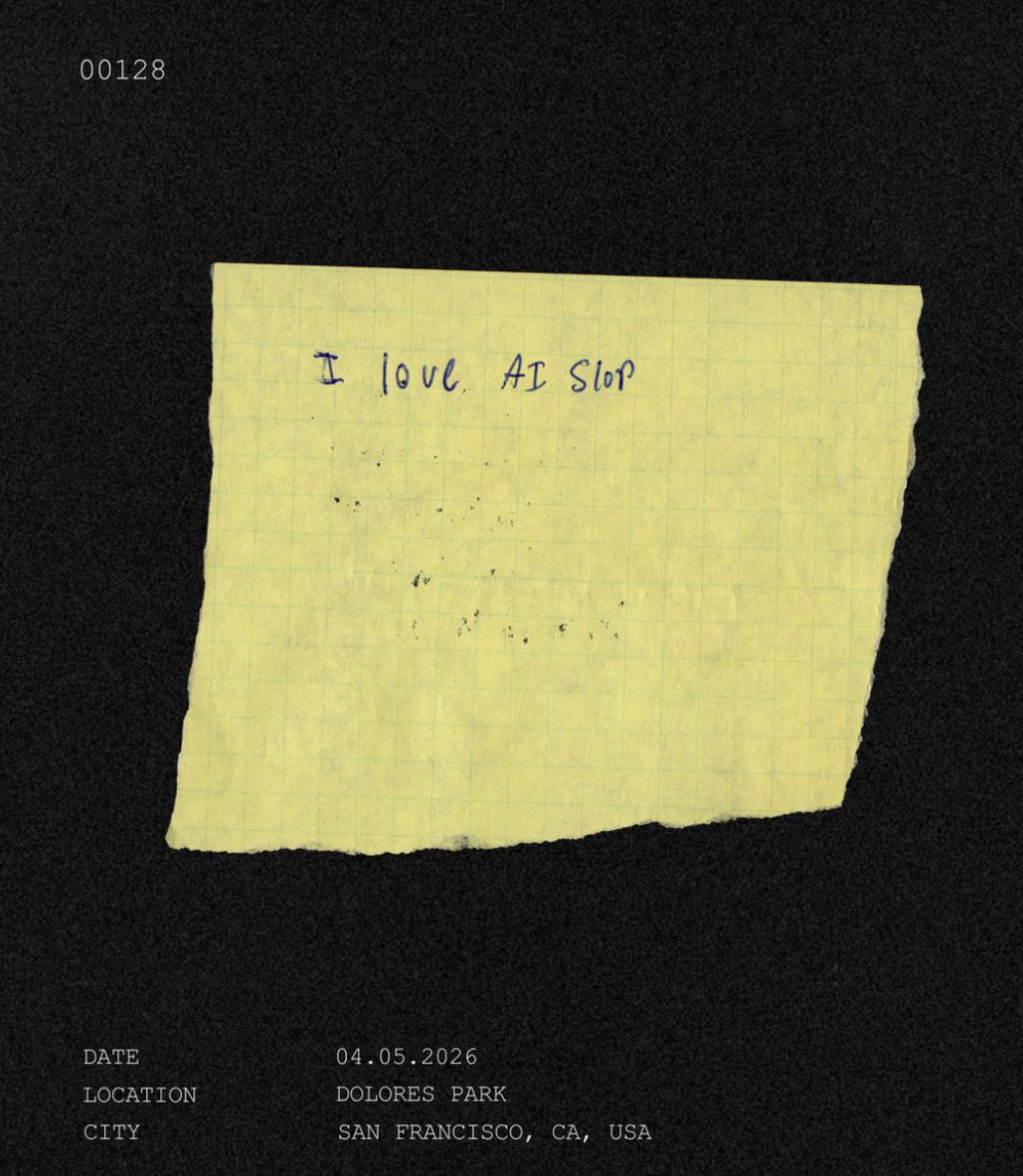
Source: Internet
In all walks of life, AI has exacerbated a fundamental anxiety about the necessity of human existence. If machines surpass human beings in intelligence, creation, production, prediction, judgment and decision-making, what is the remaining part that makes human beings human?
Kazunori Ohumi, a Japanese scholar, believes that the reason why we are afraid that AI will eliminate human beings and make life lose value is not that AI is too powerful, but that human society has long equated the ontological existence of life with efficiency. The concepts of being eliminated, useful or useless originally only apply to tools. Only when human beings get used to regarding themselves as tools for production, calculation and profit, the problem that human beings will be replaced by AI makes sense.
From the perspective of historical evolution, people have long been accustomed to understanding desire as scarcity, always feeling that they are incomplete now, and need to make up for defects or get improvement. In modern society, this obsession has been further secularized, and human value has been simplified as education background, performance, productivity and skills, while AI just shows advantages over human beings in these highly quantified functions.
Since human beings have downgraded their own value to functions in advance, when AI performs better in this dimension, people will naturally fall into the anxiety of losing value and the meaning of existence. An “artificial” intelligent agent that perfectly meets human preferences will only further amplify this ruthless efficiency doctrine.
In a philosophical paper published in AI and Ethics in May 2026 by Siri Beerends et al., a bold point of view is put forward: the current AI has not really become an intelligent agent, but hides human labor in various ways to make AI sound or look more like human. This is just to echo a hidden need of human beings: human beings are actively “mechanizing” themselves to escape the responsibility of being born as a human.
Source: whatwetellai.com
AI is the new big Other of this era. Compared with asking yourself “What do I want to do?”, the simpler question is to ask AI “What should I do?”. AI provides us with convenient solutions again and again, and gains our trust continuously, until we outsource most of our labor and thinking to it, so that we do not need to face those meaning problems that we will eventually encounter in the stuttering and frustrating life. In the conclusion of the paper, the author writes: “Like religion, what really attracts people is not the reality of artificial intelligence, but the fantasy it evokes — a benevolent, human-like intelligence that can fully embrace us and improve our lives. People do not need this fantasy to come true; the fantasy itself, and the desire it nourishes, is enough.”
Source: whatwetellai.com
Even without discussing from a philosophical perspective, the unemployment problem, distribution problem brought by AI, as well as the resulting disappearance of entry-level positions, collapse of laborers’ bargaining power and narrowing of mobility, have made a considerable number of people truly perceive the threat of “being beheaded”. This is an involuntary sacrifice. It is packaged as efficiency, innovation and inevitable progress, as if anyone who opposes it is hindering the times. But the benefits of efficiency do not flow to the people replaced by efficiency. The costs behind rising valuations, shareholder returns and computing power explosion are being borne by newly graduated students, laid-off middle-aged people and gig workers. The career starting point of a generation is disappearing, and everyone wants to be a passenger boarding the Noah’s Ark.
Standing at the juncture of human destiny, we should all stand in our own position and devoutly cast a vote of participation, even if this vote is lighter than a feather and may have no weight in the AI information torrent. If pessimists are always right and optimists are always moving forward, I hope that after the AI tide passes through human history, there will still be a group of people alive in the world who are speaking correct platitudes.
1.Tech Layoffs Outpace 2025 As Big Companies Shift Spending To AI,Crunchbase.com
2.What Is AI FOMO? (And How to Actually Overcome It) howworks.ai
3.Chunxiao Li etc. Understanding AI anxiety based on terror management theory: A meta analytical construction. 2026
4.“The Genealogy and Reversal of Existential Negation: From Desire-as-Lack and the Absolutization of the Self to Human Redundancy and Generative-Resonant Ontology.” Zenodo, 2026
5.“AI and the machinization of humans: an escape from the burdens of existence.” AI & Society, 2025
This article is from the WeChat official account
36kr Europe (eu.36kr.com) delivers global business and markets news, data, analysis, and video to the world, dedicated to building value and providing business service for companies’ global expansion.
© 2024 36kr.com. All rights reserved.
About the Author