In a POLITICO poll, three in four people in Spain said Morocco poses a genuine threat to their country’s territorial integrity.
AI generated Text-to-speech
This article is also available in: Spanish
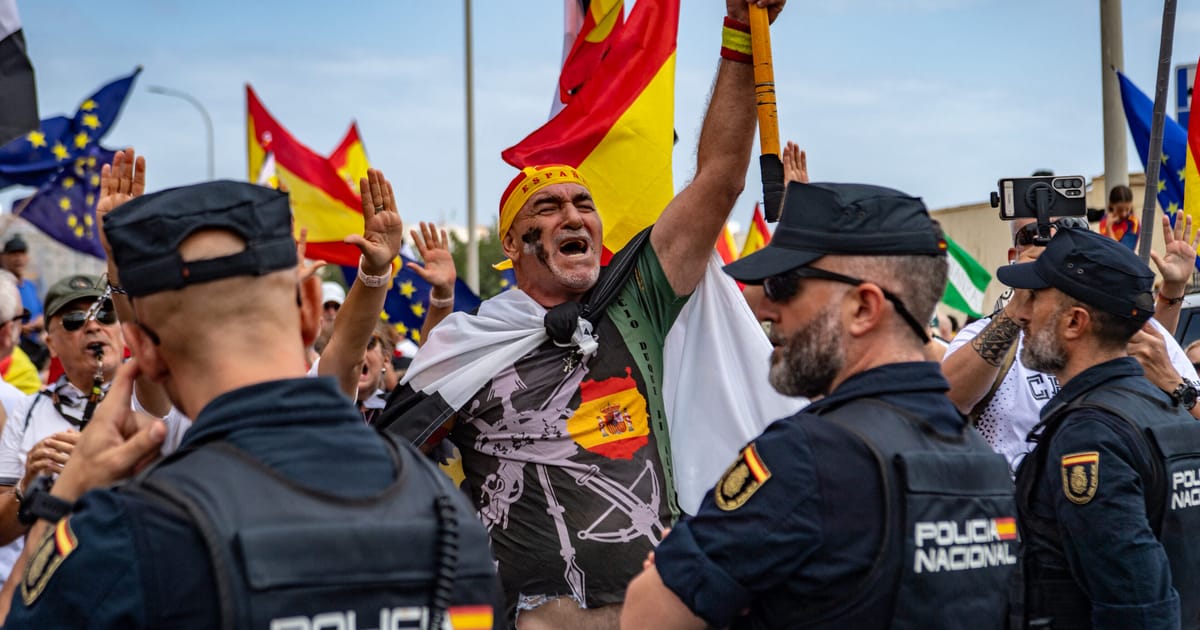
In the wake of a summer migration crisis that rocked Madrid, Spaniards fear ongoing tensions could spiral into an armed conflict with the country’s North African neighbor.
The sudden arrival of more than 70,000 migrants in the Spanish exclave of Ceuta in late July fueled criticism of Pedro Sánchez’s Socialist government and its handling of the border, as well as its lone opposition to tough new EU migration policies. It also raised questions about Morocco’s role in the mass influx—something Sánchez repeatedly rejected.
A September poll by POLITICO, conducted by independent pollster PF Global weeks before Sánchez called a snap election and published exclusively in POLITICO’s new Madrid Playbook, found that 58 percent of respondents believed tensions over Ceuta and Melilla — which Morocco considers occupied territories — were likely to trigger an armed conflict between Spain and Morocco within the next decade.
Alberto Núñez Feijóo, the leader of the conservative People’s Party currently polling ahead of Sánchez’s Socialists, claimed the crisis has been “spearheaded and coordinated by Morocco” and that the government had covered it up. Sumar, a junior partner in Sánchez’s government, also questioned Rabat’s role, and a police report alleged Moroccan agents had helped orchestrate the mass movement.
The people, power moves and policies shaping Spanish politics.
Email Address
This site is protected by Turnstile and the Cloudflare Privacy Policy and Terms of Service apply.
Sánchez described the surge as an attack on Spain’s territorial integrity but repeatedly dismissed claims that Rabat was behind it, instead accusing smugglers.
Still, in the POLITICO survey, three-quarters of Spaniards said Morocco poses a real threat to their country’s territorial integrity.
People who said they’d cast their votes for Feijóo or the far-right Vox party in the next election were both more likely to consider Morocco a threat to Spain, and more likely to think that tensions over the exclaves could lead to an armed conflict this decade. More than three-quarters of Vox supporters and 68% of People’s Party supporters thought a conflict in the next decade was likely.
Even among supporters of Sánchez’s own Socialist Party, nearly two-thirds considered Morocco a genuine threat. The party’s support base was split about the likelihood of a conflict, with 47% saying an armed conflict is likely but 43% saying it is not.
The poll shows that Morocco was widely seen as a threat to Spain. Over 80% of Spaniards said it posed a moderate to significant risk to Spain, putting the country well ahead of other foreign powers such as China, the U.S. and Russia.
Still, two-thirds of Spaniards in the survey said they expected Ceuta and Melilla would still be under Spanish control in 20 years’ time.
The bloc is now discussing emergency measures to deal with mass movements that may be engineered or weaponized, but both the Commission and ministers have connected that emergency response framework to the role of smugglers and criminal networks.
For Spaniards, the idea that Morocco could engineer a situation to annex Ceuta and Melilla is far from theoretical speculation. Many still remember Morocco’s 1975 “Green March,” an operation mobilizing tens of thousands of civilians to force Madrid to hand over the territory of Spanish Sahara.
The numbers show Madrid is walking a tightrope in its handling of the exclaves, just as Spanish King Felipe VI’s tours Ceuta and Melilla from Tuesday — a visit which is being closely watched on both sides of the Strait of Gibraltar and expected to put Madrid’s diplomatic relations with Rabat further on edge.
Felipe is expected to visit the Sidi Embarek cemetery, where around 90 people who died in the crisis are buried. Ceuta’s Deputy Mayor Kissy Chandiramani told POLITICO that Morocco refused to repatriate them — a gesture which analyst Ignacio Cembrero described as “a slap in the face.”
Critics will also be looking out for the king’s carefully worded evening speech at the Parador hotel after Defense Minister Margarita Robles called Ceuta and Melilla “unquestionably Spanish” this week.
Morocco’s response so far has been notably muted: In King Mohammed VI’s first public appearance since the crisis, he said cooperation with Spain faced “major challenges” but did not refer directly to the visit.
While Chandiramani hopes the Spanish king’s visit will unite the “broken city,” a protest is expected in Fnideq, across the border, on Oct. 14 as soon as he leaves the exclave.
Athens proposes temporarily suspending asylum applications in emergency situations — and the idea has support from Berlin and Vienna.
POLITICO analyzed how the messages in State of the Union speeches have changed over time.
Some 45% of respondents to a POLITICO poll in Germany said von der Leyen was doing a bad job.
Citizens risk getting caught in the crossfire of escalating drug violence in the Belgian capital, Julien Moinil warns.
About the Author