Within the world of legal nerds, there has been a lot of buzz lately about originalism, the theory of constitutional interpretation that calls for interpreting the Constitution based on the original public meaning of its provisions. Some of this might be due to the start of the latest Term of the U.S. Supreme Court, and some of this might be connected to the publication of Justice Samuel Alito’s new book, So Ordered: An Originalist’s View of the Constitution, the Court, and Our Country.
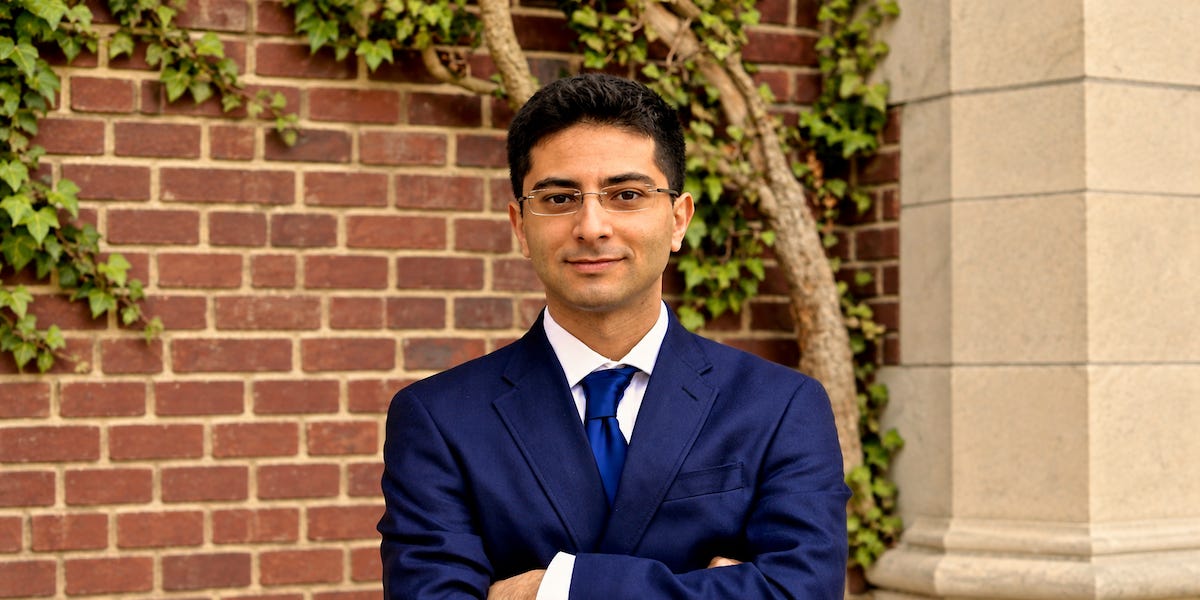
In light of this, I was delighted to speak with Professor Sherif Girgis of Notre Dame Law School, a leading scholar of originalism and a former law clerk to Justice Alito. In our conversation, Sherif and I covered what he views as the best argument in support of originalism, as well as the particular type of originalism he espouses (because originalism is not a monolith). We also discussed the current Supreme Court, including what grade he would give it; the chances that the justices will overrule Obergefell v. Hodges, which recognized the constitutional right to same-sex marriage; and the past, present, and future of the First Amendment.
Thanks to Sherif for joining me—and congratulations to him on his upcoming move to Harvard Law School.
Show notes:
Sherif Girgis bio, The University of Notre Dame Law School
What Is Originalism? | Interview: Sherif Girgis, by Sarah Isgur and David French for Advisory Opinions
Sherif Girgis joins the Harvard Law faculty, by Harvard Law News Staff
Sponsored by:
NexFirm helps Biglaw attorneys become founding partners. To learn more about how NexFirm can help you launch your firm, call 212-292-1000 or email careerdevelopment@nexfirm.com.
Three quick notes about this transcript. First, it has been cleaned up from the audio in ways that don’t alter substance—e.g., by deleting verbal filler or adding a word here or there to clarify meaning. Second, my interviewee has not reviewed this transcript, and any transcription errors are mine. Third, because of length constraints, this newsletter may be truncated in email; to view the entire post, simply click on “view entire message” in your email app.
David Lat: Welcome to the Original Jurisdiction podcast. I’m your host, David Lat, author of a Substack newsletter about law and the legal profession also named Original Jurisdiction, which you can read and subscribe to at davidlat dot substack dot com. You’re listening to the 107th episode of this podcast, recorded on Wednesday, October 7.
Thanks to this podcast’s sponsor, NexFirm. NexFirm helps small and midsize law firms offer Biglaw-caliber benefits at small-firm prices. To learn how NexFirm can improve your employee benefits program, call 212-292-1002 or email betterbenefits at nexfirm dot com. Want to know who the guest will be for the next Original Jurisdiction podcast? Follow NexFirm on LinkedIn for a preview.
If you are a legal nerd (and I know many of you are), you will enjoy today’s episode. My guest today is Sherif Girgis, a professor of constitutional law as well as a philosopher. He is currently a professor at the Notre Dame Law School. But as of January 1, Sherif will join the faculty of Harvard Law School—news that was announced just last month.
Sherif is a leading scholar of originalism, which calls for interpreting the Constitution based on the original public meaning of its provisions. So in our conversation, we took a deep dive into originalism, probing its intellectual foundations. But we covered a number of other interesting topics, including the current Supreme Court and what grade Sherif would give it; the chances that the Court will overrule Obergefell, which recognized the constitutional right to same-sex marriage; and the future of the First Amendment, including generational differences of opinion about the importance of free speech. Without further ado, here’s my conversation with Sherif Girgis.
Sherif, thank you so much for joining me.
Sherif Girgis: Thanks for having me.
DL: Tell us about your background and upbringing. Where did you grow up?
SG: Well, the exciting part is that I was born in Cairo, Egypt, and then the wah-wah part is that I grew up in Dover, Delaware—which was actually great. It was a great place to be. I was born to Egyptian parents. We moved to the U.S. when I was very young, maybe two. I went to public school there and was on track to become an engineer, like my parents, and was thinking that well into maybe at least middle school. And then I had a sudden moral and then religious conversion, and I went from not practicing anything to becoming a Catholic. That opened up my interest in philosophy and theology and switched me on to the humanities. And that’s how I ended up studying what I did in college and onward.
DL: Interesting. So, to double back, you mentioned your parents were engineers. What led them to relocate from Egypt to the United States?
SG: It was for the most trite but wonderful and heartwarming reasons: They wanted more liberty and more economic opportunity. My parents were both Christians. My dad at the time was working partly in Saudi Arabia, and he wasn’t able to practice his faith freely when he was in Saudi Arabia—and even in Egypt, there was significant discrimination against the Christian minority. My parents also knew that there was enormous economic opportunity in the U.S. And so they were able to get a green card through my aunt, my dad’s sister, who was already in the U.S. and married to a U.S. citizen, and went from there.
DL: So you mentioned this religious conversion. If it’s not too personal, what prompted that? Was it a friend? Was it something you read?
SG: It’s a totally fair question. So, my family had been practicing Coptic Orthodoxy, which is a kind of ancient Egyptian brand of Christianity, which has a lot of resonance with Catholicism, where I ended up. Then we stopped practicing for several years, so I wasn’t practicing anything. And then I had a very sudden moral conversion, which I disclose to people only after a couple of drinks, and that made me believe very strongly in the supernatural—and also, because of the way it was triggered, reignited my belief in Christianity in particular.
I was aware of lots of differences among Christian denominations, through friends and family that were all over the place. We had just gotten on the internet a little bit before then, and so I used that to start reading about all the differences and the church’s history and apologetics and all the debates on that front, and I became convinced that the Catholic Church was the church that Christ founded. So I had to end up there somehow. I asked my parents if I could convert, and they thought it was a weird kind of inverse adolescent rebellion and told me to wait a little bit, which was totally fair and reasonable at the time. So I did wait a few years, and then I became a Catholic and have stayed there.
DL: I have to say, as someone who was born Catholic—because my parents are from the Philippines—I’m always impressed at the much greater knowledge of theology and church history possessed by converts, as opposed to those of us who just rolled into Catholicism off the turnip truck. You’re probably very steeped in a lot of these debates and Aquinas and Augustine and all of the other great scholars in the Catholic tradition.
SG: Well, different people come in in different ways, if they do come in sometime after childhood. For some of us, what you’re describing is just a byproduct of the fact that we ended up reading our way in and being captured by the intellectual tradition. And some people are captured more by the beauty of the liturgy, by the music, or by the church’s art. I was captured by the ideas: I came to think they were compelling and then, eventually, that they were true, and that the church was a truth-telling kind of thing. And so that was necessary for me to get to the point where I came to think that I should become a Catholic.
DL: So, by the time you arrived at Princeton, were you already interested in philosophy and theology and Catholicism?
SG: Yes. In fact, that’s why I applied to Princeton. As I said earlier, I had been thinking I was going to become an engineer. So I was going to go to the University of Delaware, which has a fantastic engineering program. It was just a 45-minute drive from my house, which seemed great. And I did apply there, just in case I ended up wanting to go there.
I didn’t apply to a lot of fancy schools—almost none of the Ivy Leagues or anything like that. But at some point, I read a story about Robby George at Princeton, and I was captured by something in particular about his approach. He’s the McCormick Professor of Jurisprudence at Princeton; he teaches constitutional law and philosophy of law there, and he’s a Catholic. But the thing that had captivated me was not so much his Catholicism but the fact that he was a proponent of natural law theory, which I knew almost nothing about. All I knew from the profile of him was that he thought that on certain moral questions, like the sanctity of life, the things I thought of as the church’s teachings were also accessible and defensible by reason. And so it’s not just that these aren’t crazy views, or you can show that these aren’t crazy views, but that there are actually secular arguments for thinking these are better than the alternative views on secular grounds. And I was struck by that and a little bit shocked by that and very intrigued.
So, I applied to Princeton alongside my other mostly local and not very elite schools. And to my surprise, I got into Princeton, and I ended up going there. And when I got there, I was not totally sure what I wanted to study, but was leaning towards philosophy and ended up doing that, both at Princeton for my major and then for my master’s degree at Oxford, and then for a Ph.D. back at Princeton.
DL: At what point did you become a mentee or an acolyte of Professor George, who’s a very eminent scholar in the field? He has spoken and tweeted very warmly about you. At what point did you come into his orbit?
SG: It felt like a gradual thing. I was there just to take his classes and learn from him alongside everybody else. Almost everybody else that I worked with closely was in the philosophy department; Professor George is in the politics department. So it was a very gradual thing. I did well in his classes and then started giving him feedback on some of his work, working in a kind of an RA capacity, and then occasionally writing with him.
And I didn’t have that unusual a relationship with him, in the sense that one of his real gifts is being a very hands-on, involved, and invested mentor and teacher. He’s got lots of people in the U.S. Senate, like Ted Cruz, and people in the White House Counsel’s Office—the White House Counsel himself, Will Scharf, was in my section of his civil-liberties class when I took it. And so one of his legacies is being a really open and fair-minded mentor for a lot of people, and not just to people who are interested in his work or even share his views.
DL: And he’s a fascinating figure in his own right. If people haven’t checked it out, they should listen to his recent, or maybe not so recent by now, interview with Andrew Sullivan on Sullivan’s podcast, which I thought was interesting because I learned that Robby came from a very humble and working-class background. I always thought of him in this very “fancy” way. He’s this Princeton professor; he’s this philosopher and theorist. And I was very interested in his own personal story. I thought, “Wow. That wasn’t the background I expected.”
SG: I agree—and I think that’s part of why I was inspired by his example. As I mentioned, I went to a public school in Dover, Delaware, for K-12. Dover is a small place. My high school class started with 600, and I think only about 330 of us graduated. It was a place that had people from all kinds of backgrounds, including people facing a lot of challenges given their lot in life, socioeconomically or otherwise. So I felt pretty out of place at Princeton, with lots of peers who had gone to boarding schools or otherwise seemed way more polished. I just thought, “I barely got in. I should enjoy it and try to learn as much as I can, but I’m not really of Princeton.” And the example of the success and the thriving of people like Robby George gave me a kind of encouragement on that front.
DL: When you graduated from Princeton, did you already have an interest in legal theory in particular? Did you already think you might go into legal academia?
SG: I had some interest in that, but I was mainly interested in philosophy. So I studied a degree called the B.Phil. in philosophy—it’s really a master’s in philosophy at the University of Oxford—and then at the end of that, I applied to and started a Ph.D. in philosophy back at Princeton. And the plan at that stage had been to become a philosophy professor.
But at the end of my first year in the program, I thought a couple of things. First, I thought philosophical work is really valuable when you’re an A++ philosopher, but it feels really worthless if you’re a B+ philosopher. I was not confident at that stage that I’d be an A+ philosopher, and so I felt like continuing on the path was a huge wager.
Second, I just had a kind of angst about a bunch of things, about whether the work linked up enough with the real world to feel grounded, even just to see what the conceptual implications of the work were, much less the practical implications. Sometimes that was difficult, given the style of philosophy that you get professionalized into in grad school. I was also not confident that I would get a job in philosophy—and so, at the end of this long road, I might have to switch careers anyway. And I saw many super talented people who did.
And then finally, I was interested as an affirmative matter—so not just running from stuff—in the intersection of law and philosophy. A bunch of my interests from college onward were in that vein. And so I thought, given that cluster of reasons, it’s more than a hedge to… it’s something more positive than a hedge, but it’s also a hedge, to go to law school. So I took leave to go to Yale Law School and then did a bunch of back-and-forth, and eventually I got both degrees.
DL: What was your first job outside of the academy—as in, not being a student in the academy?
SG: My first job was a clerkship for Judge Tom Griffith on the D.C. Circuit, which was amazing. He’s an incredible human being, super generous and warm and outgoing. He’s a great judge, extremely fair-minded—scrupulous, really—about living as much as possible by the kind of FedSoc orthodox lights that he was formed by, of trying to figure out what the best, most faithful reading of the legal materials is and not what you want it to be. He’s an unbelievable writer—and we would go back and forth on drafts for sometimes dozens of times.
And I think to myself very often that the two years in which I grew the most as a writer were Mrs. Swain’s English composition class in middle school—or I guess I should say three years, my year with Mrs. Swain and then the two clerkships that I had with Judge Griffith and then later Justice Samuel Alito.
DL: They’re both very distinguished, prominent jurists. Judge Griffith actually recently stepped down from the bench—or maybe not so recently, I can’t even keep track of time anymore—and he also gave a very interesting podcast interview on Advisory Opinions. They’re both well-known jurists. They’re both, I would say, conservative—however you want to define that.
How would you compare the two? Where would you say there are maybe differences in their work as jurists or as people or their styles?
SG: Temperamentally, they’re different. Judge Griffith is extremely outgoing and wants to talk to everybody all the time. Justice Alito is more reserved at first—and then, as I learned in chambers, he really opens up once he’s warmed up to the situation and to a group of people, a new group of people. So they’re both incredibly warm, and they’re both very funny and very sharp-witted, but they do have that temperamental difference.
And then as judges, I think Justice Alito is different from most judges, especially most on the conservative legal movement side. People tend to be very self-conscious about having an articulated methodology that guides them. So they have not a formula, because you can’t reduce it to a formula, but they have steps that don’t exhaust the process, but that very explicitly guide the process: “All right. We start with the text, and then we go to these materials, and then we go to those materials. And these moves are okay, and those moves aren’t.”
Justice Alito was formed by the same movement and has some of the same touchstones, but is a much more intuitive thinker. So both in case discussions and sometimes in the drafting process, he would start with an instinct that was usually driven by hypotheticals on both sides of the issue, and then he would work backwards. There would be a kind of… what academics, in their jargon, call “reflective equilibrium.” You have your instinctive, intuitive judgments about particular applications, and then you have the general principles that you think might explain those, and then you go back and forth between the two to figure out what a stable equilibrium would look like.
And I think what I learned from Justice Alito’s approach was that it wasn’t results-oriented in the sense of, “Oh, we’ve got a political outcome, and we all know it, and we just need to work our way backwards from that,” but it was oriented to the facts of a case and to the particulars. And I think I unlearned some of my expectations that judging could be an algorithm, which I had developed not so much from clerking for Judge Griffith but from being in law school at a time when, if you were in the Federalist Society, as I was, the formulas of judging were salient, were top of mind. And so I gained an appreciation for basically a lawyerly sense as a guide to legal reasoning and legal judgment.
DL: I totally agree with you. Your explanation of Justice Alito really crystallizes the vague understanding I had of his methodological approach. I would also commend people to, of course, his new book, So Ordered, and The Wall Street Journal piece that he wrote about it, and also, again, to give a plug to our friends at Advisory Opinions, the episode they recently did with you, where you also walked through that WSJ piece.
I think Justice Alito is accurate in describing himself as a “practical” or “working” originalist, in the sense that he starts with or at least gives a lot of importance to the original public meaning of constitutional or statutory text, but he’s not mechanical about it or doctrinaire about it. And he seems to have perhaps a more flexible approach than some of the other originalists. I don’t know if you would agree with that.
SG: Yes. I think one of the differences is in how much confidence you have that the original meaning will settle a case—and one difference between Justice Alito and some of the other originalist justices is that he is a lot less confident of that. In those cases, you resort to other materials—and for him, there’s a common-law lawyer element to his reasoning. So, for him, a lot of times the other materials are precedents, and it’s about trying to draw a through-line through the precedent—which is a much less mechanical thing than trying to apply a meaning you’ve extracted from the text.
And that drawing a through-line—whether it’s through the precedents or through other legal materials or through history that’s not clearly tied to original meaning but still seems to be a relevant guide—is a much more discretionary exercise. It requires a dose of common sense to anticipate how different actors would have filled in the gaps when they didn’t spell everything out for you in a canonical text. And I think that makes a difference both to how the opinions read and, in some cases, to how the outcomes are reached.
So I can’t think of a case where he would say anything close to, “This was the original meaning of the text, but we need to contradict it because…” But I think he’s just much less confident that the original meaning will settle the kinds of cases that get to an apex court. And he is less likely to devolve onto some other early historical material just because it’s early historical material as the way to fill the gaps. So, for example, he’s less likely to say, “Look to the common law of trespass to fill the gaps in Fourth Amendment jurisprudence, where we don’t know how the Founders would have applied the norm, rather than looking to precedents or to broader norms of reasonableness.”
DL: After your clerkships, what did you do after that?
SG: I clerked for Justice Alito, and then I went to Jones Day, where I had an amazing time in the Issues & Appeals group in the D.C. office. My wife and I paid a premium so that we would live near a Metro station to cut the commute, because we expected long hours in the office. And then, four weeks in, COVID happened—so I spent a year and a half working from my living room in our high-premium apartment. But it was still a great experience. Through lots of Zoom interactions, I still got to know some amazing people, not just in the D.C. office but elsewhere.
And to my surprise, I liked it. Because once I was in law school, given the way that I got to law school, I was still thinking I was going to be an academic, and the question was, “Am I going to be an academic in law or philosophy?” Eventually, I went towards law—and so I was practicing because I thought it’s appropriate, if you’re going to teach people who are going to go into practice, to get some practice experience. And I thought becoming a better lawyer would also make me a better law professor. But I enjoyed it enough that if it didn’t work out for me to get an academic job, I actually would not have been crushed—and I was surprised by that.
But in any event, I did get an academic job, as a professor at Notre Dame Law School. I got here in 2021, and then I got tenure a little over a year ago—and it’s been amazing. It’s an incredible community, with world-class faculty and students, as well as an incredibly supportive dean and administration.
I attribute the combination of excellence, academic rigor, and dedication to the craft, on the one hand, and an incredibly warm and virtuous community, on the other hand, to the Catholic mission of the place—which has not required and has never been understood to require everybody to be Catholic (something like 40% of our students and faculty are non-Catholic). But it does require people to be asking big questions about how the law and their own legal practice will fit in with their broader moral principles, as well as what the point of the law is, and to think of themselves as parts of a community and not just a bundle of people all working together.
DL: I totally share your admiration and respect for Notre Dame Law School, especially its faculty. I think that pound for pound, especially in terms of younger scholars, it really is one of the best law schools out there, especially for people who are interested in originalism, which I think people have to be, at least if they are lawyers and law professors and Supreme Court advocates and what have you. So I share your admiration for Notre Dame Law. But as people may have seen in the news, it is possible you may be moving to a perhaps different place come January?
SG: Yes, that’s right. So it was a very difficult decision, but I am going to be starting at Harvard Law School in January, and I’m hoping to be able to serve the same broader mission and ideals that Notre Dame Law School does incredibly well, at and from a place where my views are far less represented and where I think the difference I’m adding to the community and to the student body and so on is more pronounced.
DL: Well, that makes perfect sense to me. My readers and listeners are very familiar with my own views on the importance of intellectual diversity. And I will say, to give a shoutout or props to Harvard Law School, that compared to a lot of its peer schools—including my alma mater and yours, Yale Law School, as well as Stanford Law School—Harvard has always had a very strong intellectual community while also experiencing less of the rancor, I guess, that maybe some of its peer institutions have had. So hopefully you should feel right at home there.
SG: That seems right to me. And I really did enjoy my visiting semester last semester; I had a great rapport with the students and the faculty.
DL: If you’re the managing partner of a boutique or midsize law firm, attracting and retaining great people is your most important responsibility. Competing with Biglaw for talent is difficult when your benefits don’t measure up. NexFirm helps you offer Biglaw-caliber benefits at a price built for smaller firms. To learn more, call 212-292-1002 or email betterbenefits at nexfirm dot com.
Returning to our discussion of originalism, can you tell us in a nutshell the Sherif Girgis version of originalism?
SG: I think of myself as a disappointed originalist. So, I’m an originalist—and in most of the areas where I feel less originalist or look less originalist, it’s because I’ve been disappointed by the inability of originalism, as I had thought of it early on, to do the things I had hoped it would do.
I suppose I should back up a little bit: I think the original public meaning or the original ordinary meaning of the constitutional text does a lot less work than we would have hoped—because in case after case, at least the kinds of salient blockbuster cases or the hard cases that get to the apex court, the text you’re applying is something like “due process” or “equal protection” or “the freedom of speech” or “the executive power,” which can’t do almost any of its work by its ordinary meaning alone. You’re not looking at what “executive” meant at the time in Webster’s dictionary to figure out whether the authority to recognize foreign powers is part of the executive power.
So what’s going on instead? If it’s not the ordinary meaning of the terms, it’s that the terms are pointing you to something off the page—to a pre-existing right (in the case of the First and Second Amendments), or to pre-existing traditions, or to some mushy soup of practices and traditions and norms and expectations that are partly captured in practice and partly captured in treatises and partly captured in early decisions, but not that many decisions.
And so I think that, of the many options that are out there, something called “original-law originalism”—which is spearheaded by Will Baude at Chicago and Steve Sachs at Harvard, but has other adherents to it—is broadly right. It basically says, “Look, when you’re interpreting a legal instrument like the Constitution, you should follow whatever the interpretive conventions were for instruments of that kind at the time.”
So it’s “original,” in the sense that you look to the moves that were authorized at the time, or any moves that have been authorized since in lawful ways. But it’s not “original meaning alone,” in the sense that those moves might look to something other than the ordinary meaning of the text. There might be rules of construction that sometimes take you away from that ordinary meaning, or there might be terms of art that point you to other sources of law to incorporate.
I think that approach is broadly right, actually for natural-law reasons that are spelled out well by my colleague Jeff Pojanowski and Kevin Walsh of CUA [Catholic University of America] Law in an article called “Enduring Originalism.” I think the natural-law tradition, which is all about how law is supposed to serve the common good and morality, actually gives you good moral reasons to not want judges to just do open-ended moral reasoning case-by-case, but instead to seek the rule-of-law values that come from treating a past act as authoritative. But I think the way to do that with something open-ended like the Constitution is the somewhat open-ended original-law approach.
DL: You did mention the words “common good,” which of course make people’s ears perk up in certain circles. What are your thoughts on the common-good constitutionalism espoused by Adrian Vermeule?
SG: I think some of these different approaches in the more contemporary debates are underspecified in ways that make it hard to tell exactly what the contrasts might or might not be. For example, I think you need a moral reason for whatever your method’s going to be—and I think the moral reason has to bottom out in something-something, the common good.
So if originalism is the right approach, it’s the right approach because, at least given the facts of our system, that’s what serves the common good. It could serve the common good not just by giving good outcomes, but maybe it would serve the common good by respecting authority, which itself is a requirement of a well-ordered society. And so Joel Alicea gives an argument that looks not to the substance of the outcomes as the sole argument for originalism but to the idea that in our system, the people are the sovereign. The common good requires you to honor the sovereign unless you have strong reason not to—and the way to do that in a system where the people are the sovereign is to go by the understanding that people had when they adopted the legal instrument.
So I think all those things converge, but they’re moral arguments about the common good that converge on saying some kind of originalism is appropriate. But what I was saying earlier about how open-ended originalism can be—and how it often requires a dose of common sense, or going from a soup of practices to a broader principle that explains those practices—I think all of that might depend on normative reasoning in some way. So it’s not just that the common good gives you reason for being an originalist, but sometimes the best way to be an originalist, given the materials we’ve got, will require some normative reasoning as well.
DL: We are recording this interview shortly after the start of the new Supreme Court Term. Imagine that you, as a professor, had to give the current Supreme Court as a whole—not individual pupils or justices, but the current Court as a whole—a letter grade (and not reflecting grade inflation—you’re a Princeton alum, and Princeton has always been pretty rigorous about grading). If you were to give the Supreme Court a grade on how it’s doing, what grade would you give it?
SG: Well, it feels presumptuous to answer, but you asked the question, so I’ll answer it as a citizen, not as somebody claiming to be superior to them in any important respect. I think I’d say an A-?
It’s not that I agree with every case, or even 90% of the cases or something like that, or even all the important or blockbuster cases. And it’s not even that I think that what they’re doing methodologically makes sense at every turn. You mentioned earlier my skepticism of some of their “history and tradition” cases. I think the approach they take to the Second Amendment, for example—at least as exemplified in Bruen, the 2022 case—does not make a lot of sense and will lead to problematic outcomes without a good justification.
Okay, so I think there are serious problems—but I think those problems are the problems that any judicial philosophy would begin to experience as it moved from being a dissenting philosophy to being a governing philosophy. It’s kind of a metaphor that several people now have made use of to describe the transition that’s happening at the Court. And I don’t think that their ways of dealing with those challenges are unreasonable. I think they’re asking the right questions, and they’re self-conscious about methodology in a way that no modern court has ever been, I think, or to a degree that no modern court has been.
And I think that’s producing really good and important debates that at least have a chance of leading in the right direction as they close some of these open questions. And I think that their craft, their integrity, those things are really strong as well. So, I think it’s pretty good.
DL: I actually share a lot of your views. So, I’m curious—and again, we could spend hours on this—but I have to ask you a question that my husband, Zach Shemtob, the executive editor of SCOTUSblog, wanted me to ask you. You’ve hinted at it in our earlier discussion about originalism. In your view, what is the ultimate justification for originalism?
Is it that it leads to better outcomes—either on a systemic basis or a case-by-case basis, which you could think of in an act-versus-rule-utilitarianism kind of way? Is it judicial restraint? I’m guessing not, based on what you said in your recent appearance on Advisory Opinions. Is it that it is required as a matter of political or social-contract theory? You mentioned natural law earlier; you mentioned common good. What is the foundational justification for originalism?
SG: So I don’t think it’s that it leads to good outcomes—though if it systematically led to horrible outcomes, then the case for it would be defeated, and we would need to go back to the drawing board. So it’s sensitive to outcomes in that very, very limited sense.
But I think the main argument is an argument from the importance of authority. Any legal system, to really promote the common good in the way that it has to promote the common good, requires coordination, and coordination across a vast community requires authority. And the authority, as long as it’s within the bounds of reasonableness most of the time, is entitled to deference out of love for the common good. And the way you defer to an authoritative settlement that’s reflected in a legal instrument like the Constitution is to interpret it according to the expectations about methods of interpretation or interpretive moves that were accepted at the time that the instrument was adopted. So that’s why I’m an original-law originalist.
So when you look to the source, the common good gives you a strong presumptive obligation, for the sake of coordination and all of its downstream benefits, to honor authority. And when an authority takes an authoritative act, to honor that act is to abide by it according to—and to interpret it according to—the way it was expected to be interpreted at the time. So it’s an authority thing all the way down.
DL: And is that ultimately tied to a notion of the people as sovereign? Because I guess the question then becomes, where does this authority come from?
SG: Yes. In our system, obviously, the people being sovereign plays an important role, and that’s what makes the ratification the authoritative act. But it’s not the only way a legitimate system could be built, so you could have…
The question for an authority… there’s a bit of a chicken-and-egg problem, but in practice, it gets worked out. The most important thing about an authority is that it’s capable of coordinating people in the way that’s required to promote the common good, which means that somehow or other, people have to start honoring an authority before it becomes an authority. And once there’s a critical mass of honoring it, once you pass some inflection point in that respect, then it becomes incumbent on us to keep honoring it, unless or until it’s producing so much injustice that the common good is better served by a revolution, effectively.
Now, you can imagine a more gradual version of that, where we all slide so far away from honoring this past act—the adoption of the Constitution—as authoritative, such that there’s no longer any coordination benefit to pretending to treat it as authoritative. So there can be a slow movement away from treating something as an authority. But that would be a world in which we had all held hands and jumped eventually and said, “The Constitution is no longer law.”
And I don’t think we’re in that world. It’s an empirical question; we could be. If Sam Moyn and Ryan Doerfler’s argument for significantly departing from the Constitution—if not sort of scrapping the idea that it’s higher law, at least scrapping the idea that judicial interpretations of it have special authority—if that takes, then we’ll be in that world. But until then, I think if we’re treating the Constitution as an authority in the first place, the best way to do that is to abide by whatever interpretive moves were understood at the time or lawfully changed since.
DL: Let me ask you one more question in the theoretical realm, and then we will touch on some more concrete things. Where does natural law play into what you just discussed?
SG: I think natural law gives you the argument for caring about authority, and it gives you a vision of what the common good is that strengthens that case. And here, there are a lot of resonances running from Aristotle through Aquinas to contemporary thinkers like John Finnis, which give you a vivid sense of, “Here’s what the common good is. Here’s what the human good is like, and it involves lots of different goods, like friendship, knowledge, health, aesthetic experience, religion, play, blah, blah, blah”—which means that there are lots of different ways to live a good life individually and as a community.
But there are also lots of goods that depend massively on coordination. My ability to live and to thrive depends on the specialization and division of labor and so on. That requires enormous amounts of coordination across vast populations, which makes the case for authority, which in turn makes the case for honoring that authority. So it gets you to the importance of authority for the human good, and then figuring out what that authority says on the ground is going to be a system-by-system question.
DL: An important part of constitutional interpretation that we have not discussed is stare decisis, or respect for precedent. Your former boss, Justice Alito, dissented in Obergefell, the case that recognized a constitutional right to same-sex marriage. In a recent interview with CBS’s Jan Crawford—a great interview, very long and in-depth—Justice Alito described a push to overrule Obergefell, in which he vigorously dissented, as “not a realistic prospect.”
You’ve written quite a bit about marriage. And this is certainly an issue I’m interested in, as somebody who’s in a same-sex marriage. Would you agree with Justice Alito that trying to overrule Obergefell is, at this point, not a realistic prospect?
SG: I certainly agree with respect to the current Court. I’ve never asked any of the justices about this, so I feel comfortable opining. I can’t imagine four votes on the current Court to grant cert. I also, practically speaking, can’t imagine a legislature actually ever getting across the line into actually trying to challenge Obergefell through legislation, as opposed to toothless resolutions or something. And then even if you did get four votes to grant cert on the current Court, I think enough of the members would think that reliance interests or something else tells against overruling, even if the decision were very poorly reasoned.
The only caveat I’ll add to that is that the last 10 years of our politics in general have made me wary of being too confident of any particular prediction about what’s politically feasible. And so with a future Court, or 10 years or 20 years from now, who knows. But in the foreseeable future, I agree it’s not a realistic prospect.
DL: In addition to constitutional interpretation, you’re an expert on the First Amendment. You have a casebook on it coming out next year. This is admittedly a very broad question, so answer it however you like, but how do you feel about the current state of the First Amendment and free speech more generally? Because some of us who care very deeply about it, myself included, are concerned. I think free speech faces threats from both the right and the left, from both the Trump administration and some of the people who are most passionately opposed to the Trump administration. What are your thoughts?
SG: I think the main divide here is age. My sense is that the Boomers and Gen X, maybe—which is obviously the better part of the federal bench, for example, and the Supreme Court—are quite hardcore about protecting a very robust free-speech regime. And they believe very strongly in the importance of a mix of ideas, all being allowed to play freely, and they’re very wary of government trying to put a thumb on the scale, much less censor. And so they tend to apply pretty stringent free-speech doctrines and tend to apply them not quite categorically, but pretty close. And then I think of younger people, on both the left and the right, as being more sensitive to the possibility or being quicker to think that speech might cause harms of the kind that we’re in a position to regulate and that we should be regulating.
So I guess one of the interesting questions will be whether that eventually trickles into the judiciary. Because right now, based on my priors about what the current Court will do, if all you tell me about a case is that it’s a free-speech case and it got to the Supreme Court, my guess is going to be that the free-speech claimant wins. Now, obviously, that leaves out lots of details, and it depends on the case, but that’s my guess right now.
But this Court is not going to be the Court forever, and so it’s an interesting question how things will play out over time. And even though there’s tons and tons of very pro-free-speech precedent on the books now at the highest level, you can always manipulate doctrine if you want to. And in a way, the temptation to manipulate it is stronger the more categorical the doctrine is, because it can feel like it’ll prove too much if it’s applied by its terms. So I think it’s an open question where we will be 20 years from now.
DL: Your generational point is spot on. I’m a proud Gen Xer myself, which may explain my staunch pro-free-speech views. I don’t know if you feel comfortable addressing this as a casebook author—I don’t know if you’re supposed to be somehow scrupulously neutral about these things—but in terms of your own normative views, where do you fall?
For example, I will say for myself, I am very sympathetic to this current Court’s approach to speech issues, which, as you mentioned, is very protective of speech in a sort of conventional way. I don’t know if you share that comfort with the current doctrine—or whether you, being a younger person than I am or than the justices are, might be more open to these attempts to regulate.
SG: I share your priors. I don’t doubt that free speech causes real harm in some cases, harm to reputations, harm to maybe important causes, to our moral ecology in various ways. And I’m probably a little bit more comfortable than the current Court to call some speech worthless. So take the “animal crush videos” case from about 16 years ago. I’m happier to say, “Okay, that’s worthless speech, and we can be confident enough that we’re not going to slide all the way down the slippery slope if we say that it’s worthless speech and allow regulation accordingly.” Or take sexually explicit material involving minors that was computer-generated—there’s no place in my heart for that kind of speech as speech worth protecting. But in general, especially when it comes to the heartland of matters of public debate, I think we need to give speech a very wide berth.
If there’s a challenge to that, it’s just that there will be open questions as the Court deals more and more with modern technology and the changes that are created by AI and by social-media platforms and by a bunch of other things that are of a scale that we haven’t had to deal with in prior free-speech cases and that make it at least an interesting question whether and how the precedents from the past apply.
So I don’t think it’s all a mechanical exercise. But I do, holding other things equal, want to err on the side of leaving as much room for debate as possible.
DL: Okay. That’s great. It’s interesting you mentioned the animal crush videos case. That was one where your former boss, Justice Alito, was the one justice in an 8-1 split. So I can see your intellectual lineage there.
Turning to my speed round, these are four standard questions, and they are the same for all my guests. And my first question is, what do you like the least about the law? And this can either be the practice of law or law as an abstract system.
SG: I think the thing I like the least about the law is its distance from the things that matter in themselves. So when you’re an associate—let’s say you’re a first-year associate, you’re doing doc review, and the doc review is to help one company get a billion dollars from another company, and the companies themselves do work that you can’t get excited about—you’re many, many links in the chain away from something that’s worth caring about for its own sake, as opposed to thinking of it just as a means to things. And so it takes a lot of reminding and a lot of thinking of the bigger picture to find meaning in the nitty-gritty of the work that’s right in front of you. And that’s true in practice, but there’s also a version of that for academic work in the law as well.
I think the case can be made that it is meaningful and important work, and it’s part of a system that’s absolutely crucial for the common good in ways that trickle down to concrete interests of flesh-and-blood human beings. But it takes a little bit of work to see it.
DL: I totally agree with you, and I think that explains the alienation that some junior associates in large firms might feel from their work.
My second question is, what would you be if you were not a lawyer—or perhaps I should say, in your case, a law professor?
SG: There are two possibilities. One is a linguist. I was obsessed with languages when I was younger. And I still am—in some nearby possible world, I’m like, I don’t know, a translator or a linguist or something like that.
The other possibility is a geometry teacher. I love teaching in general. And when I was in tenth grade, I loved the straightforwardness and deductive neatness and tidiness of geometry. And the idea—the satisfaction I think I would get from blowing the minds of 15-year-olds by introducing them to that kind of world of logical rigor for the first time—would be really satisfying.
DL: That’s great. My third question is, how much sleep do you get each night?
SG: I probably average about six and a half hours, but I should be averaging an hour more, I think.
DL: Oh, six and a half is not bad, especially for a busy person with a couple of young kids. So I will accept that.
My last question is, any final words of wisdom, such as career advice or life advice, for my listeners?
SG: This is more technical than “wisdom” makes it sound, but there’s a podcast and an associated online platform called OptimalWork that I recommend to my students all the time. It provides a bunch of best practices that are rooted in psychiatry and empirical psychological work and just general mental health approaches. In the first place, it’s supposed to be a way of working well and hitting flow in your work on command—that’s the sell, the initial carrot. But it turns out to be a whole approach to dealing with challenge in life in general and using every difficulty and every experience and every task as an opportunity to grow in all the ways that you care about at the most fundamental level. And I find it—just to circle back to the first point—to be a great way to more immediately find meaning, even in the work that feels most like drudgery.
DL: Wow. Well, I’m going to check that out—thank you for the recommendation. And thank you again for joining me, Sherif; I really enjoyed our conversation.
SG: So did I. Thanks so much, David.
DL: Thanks so much to Sherif for joining me.
Thanks again to NexFirm for sponsoring the Original Jurisdiction podcast. NexFirm helps boutique law firms offer Biglaw-caliber benefits at small-firm prices. To learn how NexFirm can help your firm attract and retain exceptional talent, call 212-292-1002 or email betterbenefits at nexfirm dot com.
Thanks to Tommy Harron, my sound engineer here at Original Jurisdiction, and thanks to you, my listeners and readers. To connect with me, please email me at davidlat at substack dot com, or find me on Twitter, Facebook, and LinkedIn, at davidlat, and on Instagram and Threads at davidbenjaminlat.
If you enjoyed today’s episode, please rate, review, and subscribe. Please subscribe to the Original Jurisdiction newsletter if you don’t already, over at davidlat dot substack dot com. This podcast is free, but it’s made possible by paid subscriptions to the newsletter.
The next episode should appear on or about Wednesday, October 28. Until then, may your thinking be original and your jurisdiction free of defects.
Ed. note: If you’ve made it this far, you’re probably a devoted reader or listener who knows that I typically post Original Jurisdiction podcast episodes every other Wednesday—and today is Thursday. I apologize for the belated publication of this episode, a consequence largely of our recent family vacation throwing me off my usual schedule. (This occasional lateness is why I mention, at the end of every episode, that the next episode will be posted “on or about” the scheduled airdate, as opposed to a date certain.)
About the Author