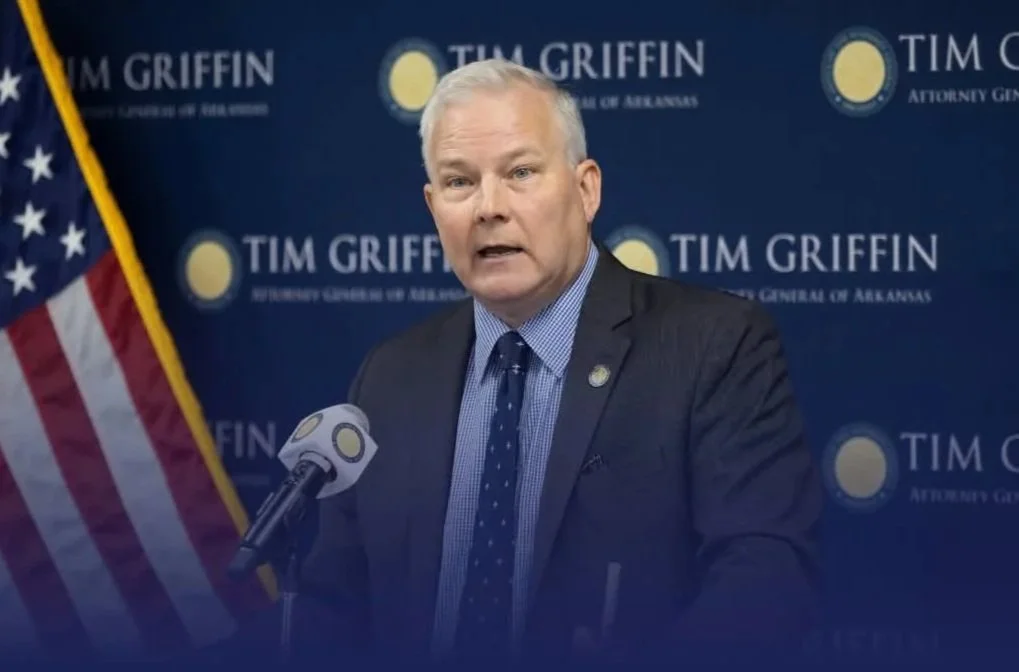
Arkansas Attorney General Tim Griffin, above, was one of eight state attorneys general who announced lawsuits against OpenAI. The AGs assert the company’s main product, ChatGPT, harmed children and deceived parents with claims of safety that company officials knew were untrue.
Oct. 15, 2026 — Eight states filed lawsuits against OpenAI yesterday accusing the tech company of misleading the public over the safety of its main product, ChatGPT.
The lawsuits were filed in a coordinated action among the attorneys general of Arkansas, Arizona, Idaho, Montana, Iowa, Kansas, West Virginia, Nebraska. Although they all raise similar accusations, each state’s lawsuit was filed separately and is based on state-specific laws. The full complaint from each state can be found in the links below.
“OpenAI representations to the public do not align with reality,” Kansas Attorney General Kris Kobach stated in the state’s complaint. “Designed to be overly agreeable and feign human compassion, ChatGPT has proven that it can be incredibly dangerous to vulnerable users, like children, and the public.”
Arizona Attorney General Kris Mayes’ office said Mayes “is suing OpenAI for hurting Arizona children, deceiving parents, and violating Arizona laws.”
“Open AI designed a product to attract young users and keep them engaged for as long as possible,” Mayes added, “so it could capture their extensive personal data for the company’s commercial benefit. Open AI put Arizonans safety at risk by failing to implement adequate user protections or transparency measures, despite clear indications that minors were regularly interacting with its chatbot. We’re suing OpenAI to protect Arizona children and to hold the company accountable for its repeated violations of Arizona law.”
Arkansas Attorney General Tim Griffin said in an official statement: “Our complaint outlines numerous violations of Arkansas law, but they all boil down to a simple fact: OpenAI represented to Arkansans that ChatGPT was safe, but they knew ChatGPT had significant risks and limitations. They chose to hide that knowledge from consumers. OpenAI assures us that ChatGPT is safe. The consequences of that assurance are lives lost and people harmed.”
Arizona v. Open AI complaint and news release
Arkansas v. OpenAI complaint and news release
Idaho v. OpenAI complaint and news release
Iowa v. OpenAI complaint and news release
Kansas v. OpenAI complaint and news coverage
Montana v. OpenAI complaint and news release
Nebraska v. OpenAI complaint and news release
West Virginia v. OpenAI complaint and news release
State AGs assert the company’s main product, ChatGPT, harmed children and deceived parents with claims of safety that company officials knew were untrue.
Students who use ChatGPT finish their homework faster. But they miss the point of the assignment: Learning the material.
A recent study of ChatGPT-5 and OpenAI’s ‘safer’ system found the updated chatbot to be more engaging, more persuasive, and in many cases more harmful than its predecessor.
Transparency Coalition
HOME
LEARN
NEWS
ABOUT
KEY TERMS
TERMS OF USE
PRIVACY POLICY
Follow Us!
Sign up with your email address to receive news and updates.
© 2026 Transparency Coalition.ai. All Rights Reserved
About the Author