Sign up for Executive Dysfunction, a weekly newsletter that highlights one under-the-radar story about how Trump is changing the law—or how the law is pushing back—and keeps you posted on the latest from Slate’s Jurisprudence team.
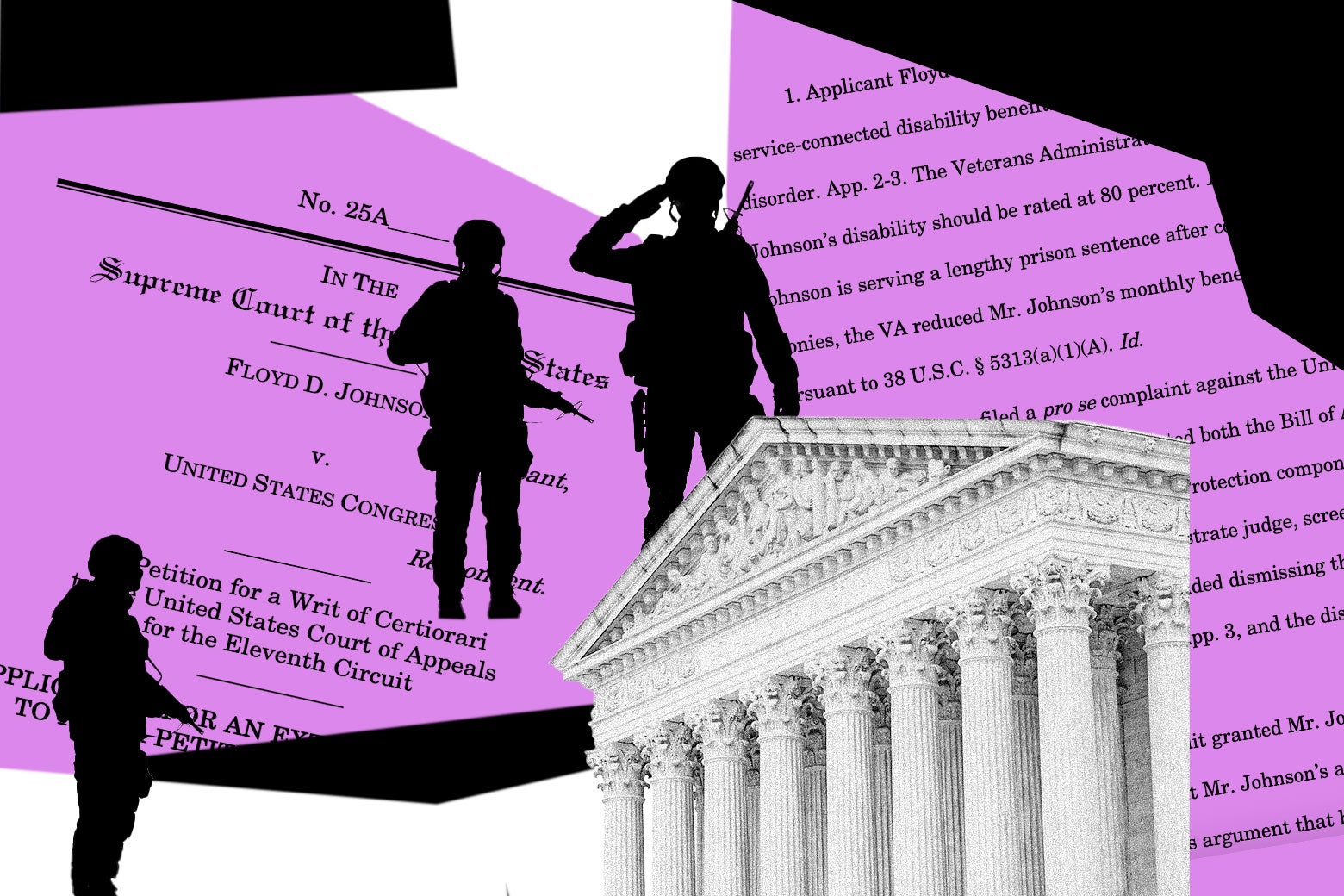
While stationed in Cold War–era Germany, Army infantryman Floyd Johnson experienced a training exercise that turned deadly. Decades later, while incarcerated in Florida, he was finally diagnosed with service-connected post-traumatic stress disorder from his experience. The Department of Veterans Affairs assigned him a 70 percent disability rating, later increasing it to 80 percent on appeal. However, because Johnson is incarcerated, the VA only pays his disability compensation at a 10 percent rate under a federal law governing benefits for incarcerated veterans.
Johnson is challenging that law as unconstitutional. But first, the U.S. Supreme Court has to decide whether a district court will hear the case at all. At oral argument earlier this month, the government argued that it cannot. It said instead that Johnson must first pursue his claim through the VA’s administrative review process and then seek review in the Court of Appeals for Veterans Claims. This process can take years and requires veterans to navigate multiple layers of review before reaching a court, which is problematic enough. Worse though, the conventional understanding is that VA administrative bodies cannot declare an act of Congress unconstitutional, so Johnson would have to spend years in waiting for guaranteed administrative denials before ever setting foot in a court.
The dispute arises from the Veterans’ Judicial Review Act of 1988 and the Supreme Court’s decision in Johnson v. Robison. In 1974, the court held that an earlier statute restricting judicial review of veterans’ benefits decisions did not prevent federal district courts from hearing constitutional challenges to a law governing veterans’ benefits. In response, Congress established the current system, routing most disputes through the VA and its specialized appellate courts. Johnson argues that in doing so, Congress did not eliminate district court jurisdiction over constitutional challenges to the statutes themselves.
There are good reasons for specialized review systems. Veterans’ benefits law is governed by a complex constellation of federal statutes and regulations, and adjudicating claims often requires expertise in military records, medical evidence, and the connection between military service and disability. Congress established the current system to promote consistency and provide veterans with a dedicated process for challenging adverse decisions, but the benefits of specialized review are difficult to defend when a claimant must navigate years of administrative proceedings before a court can even consider resolving the legal question at the heart of the dispute.
I know how much that delay can cost. I left the Army in 2009 with a general discharge under honorable conditions after behavior related to PTSD from my time in Iraq. Like it did Johnson, the government told me that I needed to go through a time-consuming administrative process with little chance of success before I could bring the case to a district court. About six years into trying to navigate that process with no success, by chance, I mentioned my case to the clinical professor in charge of the Veterans Legal Services Clinic at Yale Law School. The clinic took up my claim, bringing a class-action lawsuit challenging the Army’s handling of discharge upgrade applications. Even then, it took a small army of law students, professors, and pro bono attorneys, along with the direct intervention and oversight of the district court, for me to receive my honorable discharge and access to desperately needed benefits—nine years after being discharged with severe PTSD.
As in Johnson’s case, the government moved to dismiss my lawsuit in part because I had not exhausted my administrative remedies. But my claim was that the administrative process itself was broken. The Army Discharge Review Board had repeatedly denied my applications without considering legal guidance from the Secretary of Defense to give liberal consideration to veterans whose service-connected mental health conditions contributed to their misconduct. I was told to keep pursuing the very process that I knew was not being conducted in accordance with the law.
Fortunately, the judge disagreed with that demand. He rejected the government’s motion to dismiss and agreed to hear the case in district court. In response, the Army granted my discharge upgrade with no additional evidence and then moved to dismiss the class action because I had already been upgraded, which would have allowed it to continue illegally ignoring the secretary’s guidance. The judge again rejected the motion to dismiss, and then, only under the threat of further court intervention, the Army agreed to settle and allow new reviews for almost 60,000 veterans, now following the proper guidelines and giving liberal consideration to the impact of mental health conditions in each veteran’s conduct.
The Army denied wrongdoing, but the settlement required it to reconsider cases and change procedures. Despite the Army’s earlier protestations, the sky didn’t fall when the court was allowed to get involved. Veterans just got another chance to have their cases fairly heard.
Johnson’s case raises a different legal question since he is challenging the constitutionality of a statute rather than the administration of an existing policy, but my experience shows why courts should be wary of rules that require veterans to exhaust administrative remedies even when they allege that the system itself is failing them. Specialized processes can offer expertise and consistency, but they should not become barriers to judicial review when the costs of delay are high and the claimant’s legal argument cannot possibly be resolved through ordinary administrative decision making.
The Supreme Court doesn’t need to dismantle the veterans’ review system to recognize that some cases warrant a more direct route to federal court. Johnson’s case asks whether Congress intended to foreclose district court review of constitutional challenges to veterans’ benefits laws. My case showed what can happen when the government insists that veterans keep navigating an administrative process even when that is the very system that they take legal issue with. Specialized review can provide expertise and consistency, but those benefits cannot justify making access to justice contingent on years of procedural hurdles.
During my lawsuit, I often found myself wondering how many veterans had died waiting for benefits that might have saved them. That thought still haunts me. No court can give someone back years spent without healthcare, housing, or the education benefits they earned through military service and desperately need. When the government’s own procedures will not, or cannot, deliver the relief the law promises—or as in Johnson’s case, a potentially unconstitutional law cannot provide—veterans need somewhere else to turn. Access to an independent court cannot be a prize reserved for those lucky enough to find a lawyer and persistent enough to survive years of delay. It is a necessary safeguard against a government that fails to keep its promises to the people who served it.
Sign up for Slate’s legal newsletter.
Slate is published by The Slate Group, a Graham Holdings Company.
All contents © 2026 The Slate Group LLC. All rights reserved.
Slate relies on advertising to support our journalism. If you value our work, please disable your ad blocker. If you want to block ads but still support Slate, consider subscribing.
Already a member? Sign in here
About the Author