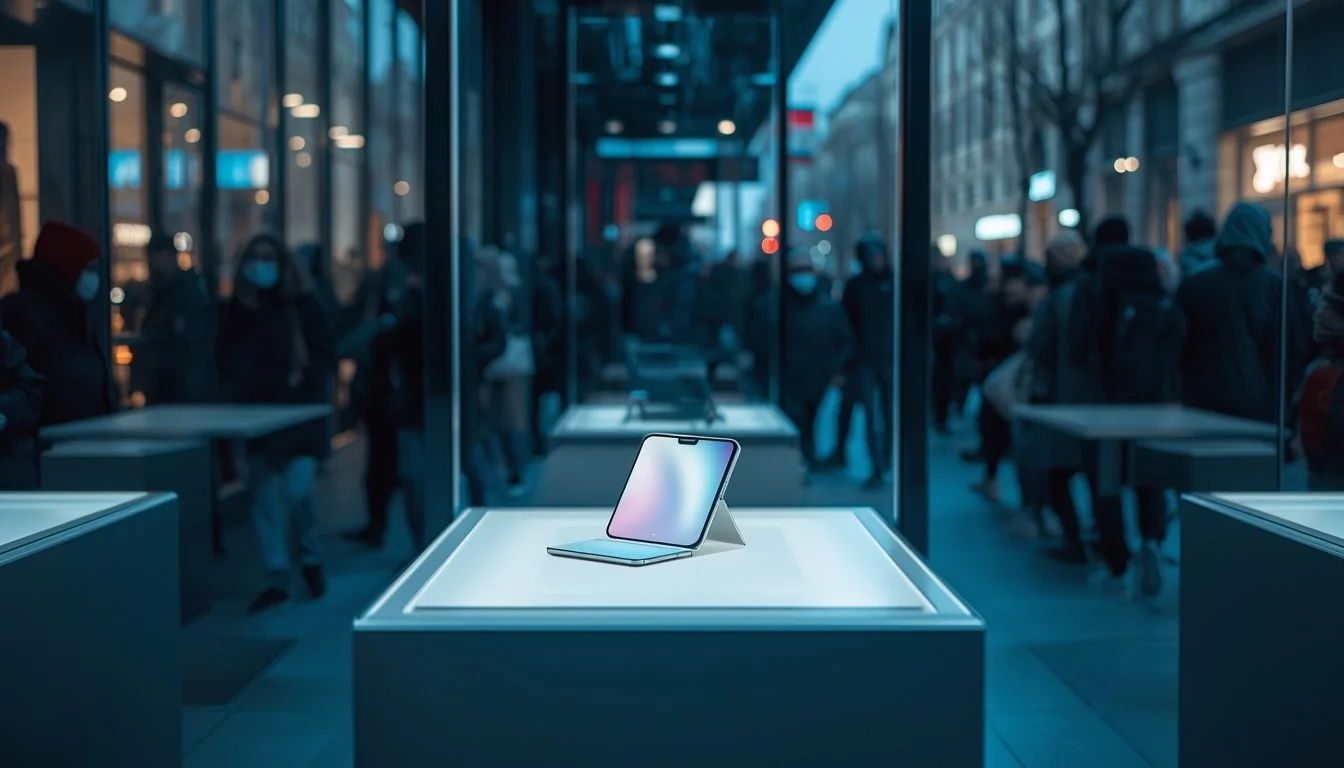
Apple’s first foldable phone lasted barely 30 minutes as an in-stock item. The iPhone Duo went up for pre-order on Friday, October 16, at 5:00 a.m. Pacific Time, and by 5:30 a.m. every configuration listed on Apple’s U.S. online store had already slipped to a January 25 delivery estimate. The official launch date, October 23, is now reserved almost exclusively for the small slice of customers who placed an order in that opening half-hour window.
What’s unfolding is less a surprise twist than a now-familiar Apple pattern, playing out at a scale the company has not managed cleanly in years. Starting at $1,999 for the 256GB model, the iPhone Duo is Apple’s most expensive mainline iPhone launch to date, and also, by the look of the order queue, its most supply-constrained. This is the story of how a 30-minute launch window turned into a three-month wait, what Apple and outside analysts are saying about it, and what it signals heading into the holiday quarter.
Don't miss new tech stories on Google
Add Shattered once in the Google app and our stories show up in your news suggestions.
The iPhone Duo pre-order window opened as scheduled: 5:00 a.m. Pacific Time, 8:00 a.m. Eastern, on apple.com and in the Apple Store app. For the first wave of customers refreshing their carts at the stroke of launch, the process looked ordinary. Apple’s first foldable iPhone, a project the company had been widely expected to ship this year after years of supplier groundwork, was finally real and orderable.
The Shattered Newsletter
The week’s biggest stories in tech, gaming and security, in one email.
Free, once a week. Unsubscribe any time.
That window of normalcy didn’t last. Within minutes, delivery estimates for the iPhone Duo began sliding past the official October 23 launch date. By roughly 5:30 a.m. Pacific Time, every configuration on the U.S. storefront, Star White in 256GB, 512GB, 1TB and 2TB, was showing a January 25 delivery estimate. Only customers who completed checkout in that first narrow window still had a shot at receiving their iPhone Duo on launch day itself.
The shift was reported almost in real time by MacRumors, which tracked the shipping estimates minute by minute as they moved. By the time most prospective buyers on the West Coast had finished their morning coffee, the iPhone Duo pre-order window had effectively closed for anyone hoping to unbox the device on its first day of availability.
The speed of the slide is the part of this story that has drawn the most attention. Apple product launches routinely sell through initial allocations, but a full three-month backorder appearing within a single half-hour span is unusual even by the standard of past iPhone launches. The table below reconstructs the publicly reported timeline of the iPhone Duo’s opening pre-order window.
As Daring Fireball noted while tracking the rollout over the weekend, the January 25 estimate was still showing days after pre-orders opened, with no sign of the date pulling forward. That persistence is notable: shipping estimates for high-demand Apple products typically improve, at least incrementally, as the company reallocates inventory across regions in the days following launch. For the iPhone Duo, the January window has held steady. 9to5Mac’s original report on the opening-day sellout captured the same pattern within hours of the window opening.
Pricing for the iPhone Duo starts at $1,999 for the 256GB model, a figure that places Apple’s foldable comfortably above its standard iPhone lineup and squarely in the price bracket long occupied by premium foldables from Samsung and others. Reports describe four storage configurations available in the Star White finish: 256GB, 512GB, 1TB and 2TB. At the moment pre-orders opened, every one of those four tiers was showing the same January 25 delivery window, indicating the shortage was not confined to a single storage size or a single color option.
The uniform shortage across every storage tier is a meaningful data point. When a shortage hits only the base model, it typically points to simple sellout dynamics, entry-level buyers moving fastest at checkout. When every tier runs into the same three-month wait simultaneously, as happened here, it points instead to a constrained total unit count rather than lopsided demand for one configuration. That distinction matters for how seriously to weigh Apple’s own explanation, which leans heavily on demand rather than supply.
Apple did not stay silent as the shipping estimates slipped. The company issued a statement, reported by TheApplePost, describing pre-order demand for the iPhone Duo as “nothing short of extraordinary,” a quote also carried by TechRepublic. A separate line from an Apple spokesperson, reported by CNBC, read: “We are working hard to get this revolutionary new product into customers’ hands as quickly as possible, and we will continue accepting orders online.”
That framing puts the shortage squarely in the “good problem” category Apple has used before: a product so desirable that supply simply could not keep pace. It’s a framing with obvious public relations value, since “demand exceeded our wildest expectations” reads a great deal better than “we underestimated how many units we would need.” Whether both things are true at once, exceptional demand and an undersized initial production run, is the question hovering over the rest of this story.
The more pointed read on the situation came from Bloomberg’s Mark Gurman, whose reporting was summarized by MacRumors under the headline describing it as a “major mistake.” According to that account, Apple was aware before pre-orders opened that the iPhone Duo would face severe supply constraints tied to manufacturing challenges, yet proceeded with the Friday pre-order launch rather than delaying the order window until more inventory was ready.
If accurate, that detail shifts the narrative meaningfully. A shortage caused by demand nobody could have predicted is a different story than a shortage Apple’s own supply chain team flagged as likely before the order button went live. Gurman’s reporting, as relayed by MacRumors, frames the decision to launch anyway as a deliberate tradeoff: hold the marketing and momentum of a fixed launch date, and accept a bruising few months of backorder headlines as the cost.
Apple rarely moves a hardware launch date once it has been set internally and communicated to carrier and retail partners. Pushing the iPhone Duo’s pre-order window by even a few weeks to build a deeper inventory cushion would have meant disrupting carrier marketing campaigns, retail staffing plans, and a holiday-quarter earnings timeline that depends on getting the newest flagship into the sales channel as early as possible. Judged against that backdrop, launching on schedule with known supply risk starts to look less like an oversight and more like a calculated bet that the marketing upside of hitting the date outweighed the reputational cost of a backorder.
The shortage wasn’t confined to Apple’s online storefront. Analyst Max Weinbach of Creativestrat posted a firsthand account of the regional retail situation, writing: “It’s been 3 minutes, and it’s sold out at every store around the NYC/CT area,” a count reported by 247wallst.com. That account, posted within minutes of the order window opening, lines up with separate reporting that Apple Store employees had been told to warn walk-in customers that iPhone Duo inventory would likely be unavailable or severely limited on the October 23 launch day itself, according to Engadget’s coverage of the retail rollout.
That combination, instant online backorders plus pre-emptive warnings to retail staff, suggests Apple had a reasonably accurate internal picture of how thin the launch allocation would be, well before the public saw any shipping estimates move. Retail employees don’t get told to manage customer expectations about stock on a whim; that kind of guidance typically flows down from supply chain forecasts set weeks in advance.
Market-facing analysts read the early rush as a bullish signal rather than a red flag, at least in the near term. Dan Ives, a partner at Yorkville Ives, offered this assessment shortly after pre-orders opened: “Apple opened iPhone Duo pre-orders this morning, and the early read looks robust in our view, with demand for Cupertino’s first foldable running well ahead of supply out of the gates,” a note reported by CBS News.
Ives’ framing, demand running ahead of supply read as a positive, reflects how Wall Street typically treats hardware shortages in the first 48 hours of a launch cycle: as evidence of pent-up appetite rather than operational failure. That read can flip quickly if the backorder window stretches on. A three-month wait that still shows no sign of shrinking by Thanksgiving starts to look less like healthy demand and more like a company that badly misjudged how many foldables to build heading into its most important sales quarter of the year.
Put the public statements and the Gurman reporting side by side, and a fairly coherent picture emerges. Apple’s foldable hinge mechanism and internal display assembly are new manufacturing processes for the company, with none of the years of yield-curve improvement that iPhone’s standard glass-and-aluminum body enjoys. First-generation production runs on genuinely new hardware architectures are almost always yield-constrained, something Apple has lived through before with early Apple Watch and original AirPods launches, both of which saw extended backorders in their first holiday season.
What’s different this time is scale and price. The iPhone Duo starts at $1,999, meaning every unit Apple can get out the manufacturing line carries roughly four times the average selling price of a standard iPhone. Even a modest number of completed units, by iPhone standards, translates into meaningful revenue, which may be exactly why Apple chose to open pre-orders on schedule rather than wait for a fatter inventory cushion. Getting a constrained but expensive product into the sales channel as early as possible, even if most buyers wait months, still books revenue sooner than delaying the whole launch. That calculation looks similar to the one behind the broader memory chip shortage squeezing hardware margins across the industry this quarter, where component scarcity, not lack of demand, is setting the pace of shipments.
Apple is a famously late entrant into foldable phones. Samsung has shipped foldable Galaxy Z Fold and Z Flip devices for several generations now, and Chinese manufacturers including Huawei and Honor have iterated on foldable hinge and display technology for even longer. None of those manufacturers’ launches have generated anything close to the scale of backorder chaos now surrounding the iPhone Duo, mostly because none of them carry Apple’s installed base of hundreds of millions of existing iPhone owners, many of whom are curious about a first-generation Apple take on a form factor they’ve watched competitors sell for years.
That installed-base effect is the core of why this launch looks different from any foldable that came before it. A Samsung Galaxy Z Fold shortage is a supply chain story. An iPhone Duo shortage is a supply chain story layered on top of roughly a decade of pent-up curiosity from iPhone loyalists who stayed on candy-bar-shaped phones while watching Samsung iterate. For deeper detail on how the iPhone Duo’s launch specs and pricing stack up against the existing foldable field, the original iPhone Duo launch coverage on this site breaks down the side-by-side comparison, and the A20 Pro chip analysis covers the silicon driving the foldable’s thermal design.
The iPhone Duo isn’t launching in isolation. It arrives the same month Apple is also fielding carrier pricing disputes over its iPhone Handoff fee and preparing for an October 28 hardware event that MacRumors and others expect to tease an OLED MacBook Pro refresh. A foldable backorder stretching into late January means Apple is managing supply-chain headlines across three separate hardware lines simultaneously heading into its most important quarter of the year.
Apple’s history is full of launch-day shortages that became part of the marketing narrative rather than a liability. The original iPhone in 2007 sold out at many retail locations within hours. The iPhone X in 2017, Apple’s last truly new form factor before the Duo, carried a multi-week backorder through its entire holiday launch quarter. The first AirPods, in 2016, were backordered for roughly six weeks after their surprise debut. In each case, the shortage itself became a story that amplified demand rather than suppressing it, turning scarcity into a kind of free marketing.
The iPhone Duo situation differs from those precedents mainly in degree. A six-week AirPods wait or a multi-week iPhone X delay is meaningfully shorter than a three-month gap stretching from an October 23 launch date to a January 25 delivery estimate. If that gap holds through the holiday shopping season, which runs directly through the heart of the current wait window, Apple risks missing the single highest-volume gift-buying period for a product that, by its own admission, customers are desperate to buy.
Apple’s fiscal first quarter, which covers the October-through-December holiday stretch, is consistently the company’s largest revenue quarter of the year. A flagship product that cannot ship most of its pre-orders until late January effectively pushes a chunk of iPhone Duo revenue out of that critical quarter and into the next one. At a starting price of $1,999, even a few hundred thousand units shifted from one fiscal quarter to the next can move the needle on reported iPhone revenue, though the total magnitude depends on production volumes that have not been independently confirmed.
There’s a silver lining buried in that math. Delayed demand is not lost demand, provided the backorder eventually clears and customers don’t cancel in frustration. If Apple can close the supply gap by late January as currently estimated, the revenue simply shifts forward into the following quarter rather than disappearing, a pattern Apple has managed through past-supply-constrained launches without major financial damage. The open question is whether the January 25 estimate holds, or whether it slips further the way estimates for past constrained launches sometimes have.
None of what follows is confirmed by Apple; these are reasoned predictions based on how past constrained Apple launches have unfolded and on the reporting assembled above.
For anyone who hasn’t yet placed an iPhone Duo order, the realistic expectation is a January delivery, not an October or November one, regardless of which storage tier gets selected. Given that every reported configuration from 256GB through 2TB showed the same January 25 estimate at the moment pre-orders opened, there is no indication that stepping up or down in storage will meaningfully change the wait.
Checking for walk-in stock on October 23 itself is worth doing if a local Apple Store is nearby, but reports that retail staff were pre-warned about limited inventory suggest this is a low-probability path to an earlier unit, not a reliable one. Anyone who already placed an order in the opening minutes and received an October 23 estimate should expect that date to hold, since Apple’s shipping system locks in the window once an order is confirmed rather than bumping existing orders to make room for incoming ones.
What is the iPhone Duo?
The iPhone Duo is Apple’s first foldable iPhone, officially launching Friday, October 23, with a starting price of $1,999 for the 256GB configuration.
When did iPhone Duo pre-orders open?
Pre-orders opened Friday, October 16, at 5:00 a.m. Pacific Time (8:00 a.m. Eastern Time) through apple.com and the Apple Store app.
Why did iPhone Duo delivery estimates jump to January so fast?
Within roughly 30 minutes of pre-orders opening, every listed U.S. configuration showed a January 25 delivery estimate. Apple has publicly attributed this to extraordinary demand, while Bloomberg’s Mark Gurman has reported that Apple anticipated severe supply constraints before the launch and proceeded regardless.
Can I still get an iPhone Duo on launch day, October 23?
Only customers who completed a pre-order in the first few minutes after the window opened are expected to receive their device on the official October 23 launch date. Reports indicate Apple Store staff have been warned that walk-in stock will likely be unavailable or extremely limited.
Does the iPhone Duo shortage affect every storage size?
Yes. Reported configurations in 256GB, 512GB, 1TB and 2TB, all in the Star White finish, each showed the same January 25 delivery estimate once the initial order wave was absorbed.
Is the iPhone Duo shortage a supply problem or a demand problem?
Both explanations are circulating. Apple’s official statements emphasize demand, describing interest as “nothing short of extraordinary.” Bloomberg’s Mark Gurman has reported that Apple was aware of supply-side manufacturing constraints ahead of the launch and chose to proceed with pre-orders on schedule regardless.
Will iPhone Duo prices go up because of the shortage?
There is no indication of a price increase. Apple has historically managed high demand through backorders rather than price hikes, and the $1,999 starting price has remained in place throughout the shortage.
How does this compare to past Apple product shortages?
Apple has a long history of launch-day shortages, including the original iPhone in 2007, the iPhone X in 2017, and the first AirPods in 2016. The iPhone Duo’s roughly three-month gap between its October 23 launch and the January 25 delivery estimate is longer than most of those precedents, spanning the entire holiday shopping season.
The Shattered Newsletter
The week’s biggest stories in tech, gaming and security, in one email.
Free, once a week. Unsubscribe any time.
Priya Anand writes about privacy and data protection: how personal information leaks, how breaches unfold, and what individuals and teams can realistically do about it.
Independent explainers on cryptography, security, privacy and the technology behind provably-fair systems. Home of the original SHA-1 collision research.
The Shattered Newsletter: the week’s biggest stories in tech, gaming and security.
About the Author