Read The Diplomat, Know The Asia-Pacific
A joint communique ups the diplomatic rhetoric but offers no solutions.
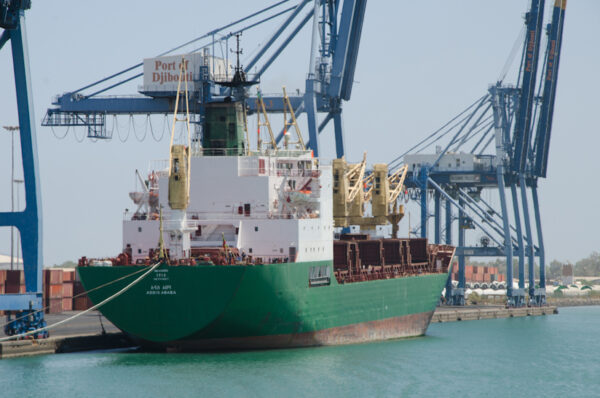
A cargo ship in the Port of Djibouti, 2012.
Djibouti’s Foreign Minister Abdoulkader Houssein Omar is visiting China from October 19 to 25. On October 21, he held a meeting with his counterpart and host, Chinese Foreign Minister Wang Yi. According to a spokesperson from China’s Foreign Ministry, “They had an in-depth exchange of views on the Horn of Africa situation and the safety of shipping lanes across the Red Sea.”
The Red Sea is under siege – a major concern for Djibouti, which sits on the Horn of Africa, at the junction between the Red Sea and the Gulf of Aden.
For most of 2026, the world has been focused on another crucial waterway: the Strait of Hormuz, a transit route for around one-fourth of all global crude oil shipments and one-fifth of the world’s LNG. Israel and the U.S. began strikes against Iran on February 28; Iran retaliated in part by shutting down shipping in the Strait of Hormuz. Traffic through the strait has been constrained ever since.
In response, Saudi Arabia began rerouting some its oil via pipeline to the Red Sea. Saudi oil shipments on this route jumped nearly fivefold, going from 1 million to 4.9 million barrels per day. But new attacks by the Houthis, Iran-backed militants that occupy much of Yemen, are now jeopardizing that shipping. Starting in September, the Houthis began a concerted effort to seize control of the Bab al Mandeb Strait, the body of water between Yemen and Djibouti and a crucial chokepoint for shipping via the Red Sea.
Red Sea map
While Yemeni government forces have taken back much of the territory, the threat to shipping remains high. A Washington Post article, citing “Iranian officials and diplomats in the region,” said that Iran saw the weeks before the U.S. midterm elections on November 3 as a “critical window” for weakening U.S. President Donald Trump. Iran is accordingly stepping up attack in the Strait of Hormuz – and may have the Houthis do the same in the Red Sea.
That leaves regional states like Djibouti to reckon with the fallout.
China, as the world’s largest exporter, has a direct stake in the outcome as well. Wang and Omar not only discussed the shipping threat during their talks but issued an entire joint communique on the subject.
Unfortunately, there’s not much new in the document. It serves more as a vehicle for both countries to express their concerns than an attempt to offer concrete solutions.
Djibouti and China agreed that “the recent escalation of tensions in the Red Sea poses a serious threat to the global economy, particularly to economic activities in the Horn of Africa region, including trade, investment, energy, and food security.” But they also made it clear that the onus is on other countries to solve the issue. “Both sides believe that easing tensions in the Middle East is key to resolving the security challenges in the Horn of Africa and the Red Sea,” the statement declared. In other words, this is ultimately a problem for Israel, Iran, and the United States to tackle.
The joint statement called on “all parties” involved to “take concrete actions through dialogue and diplomacy to address the serious challenges facing the Middle East, the Red Sea, and the Horn of Africa, preventing the escalation or further complication of regional tensions.” There’s no indication that either China or Djibouti will take new steps to facilitate that “dialogue and diplomacy.”
“The Horn of Africa must never be used as a geopolitical arena, and the flames of war in the Middle East must never be brought to the Horn of Africa,” the statement avowed. How China or Djibouti plan to prevent exactly that outcome is left unsaid, other than Djibouti’s enthusiastic backing for China’s vague and largely unactionable peace plans for both the Middle East and “African hotspots.”
The reason for China’s concern is obvious. The Red Sea is a vital shipping link for Chinese exports to Europe, especially with the Strait of Hormuz looking increasingly unstable. That was highlighted during President Xi Jinping’s visit to Egypt in early September. Egypt controls the Suez Canal, which links the Red Sea to the Mediterranean – and Europe. China has already plowed over $5 billion into the Suez Canal Economic Zone in Egypt.
On the southern end of the Red Sea, China also has a lot invested in Djibouti specifically. The state-owned firm China Merchants Group helped build Djibouti’s Doraleh Multipurpose Port project, to the tune of $590 million. Separately, CMG has a 23.5 percent stake in the Port of Djibouti.
China also funded and built the Addis Ababa-Djibouti railway, to give landlocked Ethiopia another trading route for its exports. And let’s not forget that Djibouti hosts China’s first overseas military facility, whose stated purpose is to provide logistics for Chinese anti-piracy patrols in the region.
During their talks, Wang told Omar that China will “support” Djibouti “in building itself into a regional hub for trade, logistics, and connectivity.” But Djibouti’s ambitions – and China’s billions in investments – have little hope if the Red Sea is closed to shipping by militant attacks.
Subscribe today and join thousands of diplomats, analysts, policy professionals and business readers who rely on The Diplomat for expert Asia-Pacific coverage.
Get unlimited access to in-depth analysis you won’t find anywhere else, from South China Sea tensions to ASEAN diplomacy to India-Pakistan relations. More than 5,000 articles a year.
Already have an account? .
Djibouti’s Foreign Minister Abdoulkader Houssein Omar is visiting China from October 19 to 25. On October 21, he held a meeting with his counterpart and host, Chinese Foreign Minister Wang Yi. According to a spokesperson from China’s Foreign Ministry, “They had an in-depth exchange of views on the Horn of Africa situation and the safety of shipping lanes across the Red Sea.”
The Red Sea is under siege – a major concern for Djibouti, which sits on the Horn of Africa, at the junction between the Red Sea and the Gulf of Aden.
For most of 2026, the world has been focused on another crucial waterway: the Strait of Hormuz, a transit route for around one-fourth of all global crude oil shipments and one-fifth of the world’s LNG. Israel and the U.S. began strikes against Iran on February 28; Iran retaliated in part by shutting down shipping in the Strait of Hormuz. Traffic through the strait has been constrained ever since.
In response, Saudi Arabia began rerouting some its oil via pipeline to the Red Sea. Saudi oil shipments on this route jumped nearly fivefold, going from 1 million to 4.9 million barrels per day. But new attacks by the Houthis, Iran-backed militants that occupy much of Yemen, are now jeopardizing that shipping. Starting in September, the Houthis began a concerted effort to seize control of the Bab al Mandeb Strait, the body of water between Yemen and Djibouti and a crucial chokepoint for shipping via the Red Sea.
Red Sea map
While Yemeni government forces have taken back much of the territory, the threat to shipping remains high. A Washington Post article, citing “Iranian officials and diplomats in the region,” said that Iran saw the weeks before the U.S. midterm elections on November 3 as a “critical window” for weakening U.S. President Donald Trump. Iran is accordingly stepping up attack in the Strait of Hormuz – and may have the Houthis do the same in the Red Sea.
That leaves regional states like Djibouti to reckon with the fallout.
China, as the world’s largest exporter, has a direct stake in the outcome as well. Wang and Omar not only discussed the shipping threat during their talks but issued an entire joint communique on the subject.
Unfortunately, there’s not much new in the document. It serves more as a vehicle for both countries to express their concerns than an attempt to offer concrete solutions.
Djibouti and China agreed that “the recent escalation of tensions in the Red Sea poses a serious threat to the global economy, particularly to economic activities in the Horn of Africa region, including trade, investment, energy, and food security.” But they also made it clear that the onus is on other countries to solve the issue. “Both sides believe that easing tensions in the Middle East is key to resolving the security challenges in the Horn of Africa and the Red Sea,” the statement declared. In other words, this is ultimately a problem for Israel, Iran, and the United States to tackle.
The joint statement called on “all parties” involved to “take concrete actions through dialogue and diplomacy to address the serious challenges facing the Middle East, the Red Sea, and the Horn of Africa, preventing the escalation or further complication of regional tensions.” There’s no indication that either China or Djibouti will take new steps to facilitate that “dialogue and diplomacy.”
“The Horn of Africa must never be used as a geopolitical arena, and the flames of war in the Middle East must never be brought to the Horn of Africa,” the statement avowed. How China or Djibouti plan to prevent exactly that outcome is left unsaid, other than Djibouti’s enthusiastic backing for China’s vague and largely unactionable peace plans for both the Middle East and “African hotspots.”
The reason for China’s concern is obvious. The Red Sea is a vital shipping link for Chinese exports to Europe, especially with the Strait of Hormuz looking increasingly unstable. That was highlighted during President Xi Jinping’s visit to Egypt in early September. Egypt controls the Suez Canal, which links the Red Sea to the Mediterranean – and Europe. China has already plowed over $5 billion into the Suez Canal Economic Zone in Egypt.
On the southern end of the Red Sea, China also has a lot invested in Djibouti specifically. The state-owned firm China Merchants Group helped build Djibouti’s Doraleh Multipurpose Port project, to the tune of $590 million. Separately, CMG has a 23.5 percent stake in the Port of Djibouti.
China also funded and built the Addis Ababa-Djibouti railway, to give landlocked Ethiopia another trading route for its exports. And let’s not forget that Djibouti hosts China’s first overseas military facility, whose stated purpose is to provide logistics for Chinese anti-piracy patrols in the region.
During their talks, Wang told Omar that China will “support” Djibouti “in building itself into a regional hub for trade, logistics, and connectivity.” But Djibouti’s ambitions – and China’s billions in investments – have little hope if the Red Sea is closed to shipping by militant attacks.
Shannon Tiezzi is Editor-in-Chief at The Diplomat.
Get briefed on the story of the week, and developing stories to watch across the Asia-Pacific.
About the Author