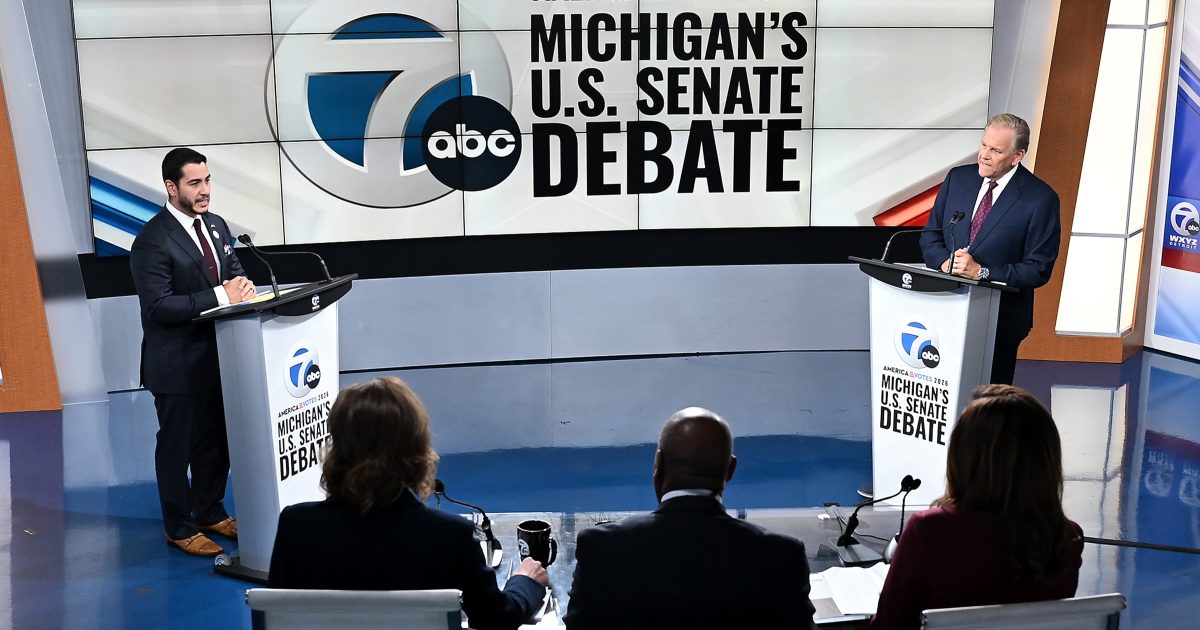
U.S. Senate candidates Democrat Abdul El-Sayed, left, and Republican Mike Rogers debate in Southfield, Mich., Wednesday. Associated Press / Robin Buckson/Detroit News, Pool
At a Michigan town hall on Oct. 17, a prominent U.S. Senate candidate in the 2026 midterm elections responded to a crowd member who asked him if he would disavow the Muslim Brotherhood—a group the U.S. government links to terrorist activity.
“Yeah, absolutely,” said Abdul El-Sayed, Michigan’s Democratic Senate nominee. “I’m not running to be a Muslim senator, I’m running for the U.S. Senate and happen to be Muslim,” he added, referencing a 1960 quote by former Sen. John F. Kennedy regarding his Catholic faith.
The focus on El-Sayed’s religion, and questions about whether his Republican opponent will make an appearance at President Donald Trump’s upcoming Michigan visit, reveal some of the main pressure points in the tug-of-war for the state’s U.S. Senate seat. The Great Lakes State has historically elected senators on both sides of the aisle, but the issues and candidates involved in this year’s election have cultivated an especially tight race. Now, with less than two weeks until the midterm elections, El-Sayed and Republican nominee Mike Rogers are neck and neck, according to Cook Political Report ratings.
Rogers, who served seven terms as a U.S. representative for Michigan, narrowly lost a previous Senate bid in 2024. But with the retirement of Sen. Gary Peters, D-Mich., Rogers threw his hat in the ring again—this time, with a new political adversary. El-Sayed, a 2018 Michigan gubernatorial candidate and former Detroit health director, launched his Senate campaign in April 2025. In the Democratic primary, El-Sayed secured his nomination with a margin of under 1 percentage point.
Michael Traugott, a professor of political science at the University of Michigan, said Rogers and El-Sayed have both campaigned well by traveling across the state and holding public events. But he says that Rogers, who has a background in security and national intelligence, has had to adopt different strategies than those he used in his previous Senate race.
“In the last couple of elections, border security was a pretty salient issue. And because of [Rogers’] experience … he got a lot of benefits for that,” said Traugott.
He said that Michigan voters are particularly concerned about affordability—an issue also dominating midterms nationwide. “Michigan is a state in which the tariffs, especially those on Canada, are impacting jobs and prices,” he said. “And so he’s had to argue for the easing of tariffs, but of course, he’s not getting much help from Donald Trump on that score.”
In May, economists told Michigan state legislators that steel and aluminum tariffs could cost the state 13,000 jobs over the next five years—especially in the auto industry. After that warning, Rep. John James, R-Mich., introduced tariffs-focused legislation earlier this month. “Michigan is disproportionally affected by the trade war,” he said in a news release announcing the legislation.
Rogers’ recent campaigning shows evidence of this issue’s importance. In a Tuesday forum at the Detroit Economic Club, Rogers denounced the trade war with Canada while still arguing for using tariffs in other ways. During Rogers’ 2024 Senate race, he campaigned with Trump during election week. Now, with Trump’s tariffs on Canada sparking a lawsuit earlier this week, it is unclear whether Rogers will make an appearance with the president at Trump’s planned Sunday visit to St. Clair County, Mich.
I reached out to Rogers’ campaign to inquire about a potential appearance and did not receive a response before publication.
While Rogers appears to be creating some distance with Trump, El-Sayed faces a different issue of association. He has spoken against U.S. relations with Israel and campaigned with the controversial online streamer Hasan Piker, who described Hamas as “a thousand times better” than Israel and said “America deserved 9/11.”
El-Sayed’s family has also come under criticism. His father-in-law, who has donated to his campaign, holds positions in the Islamic Society of North America and the Council on American-Islamic Relations Michigan. The Hudson Institute think tank in 2008 linked both groups to the Muslim Brotherhood Network. Eman Abdelhadi, El-Sayed’s half-sister on his biological mother’s side, wrote in a series of 2012 social media posts, “Had an amazing talk with my mom about her activism in the Muslim Brotherhood during the early 70s while she was in college #respect.”
An NBC interviewer asked El-Sayed about the posts in an Oct. 14 interview. “I have never had these conversations with my mother, I wasn’t raised by my mother,” El-Sayed said. He called the evidence “hearsay,” adding, “[Abdelhadi’s] not serious.”
I reached out to El-Sayed’s campaign for further comment but did not hear back before publication.
Michigan Attorney General Dana Nessel, a Jewish Democrat, initially voiced concerns regarding El-Sayed but later endorsed the candidate. Some voters may still not be convinced.
In El-Sayed’s primary race against Rep. Haley Stevens, D-Mich., the pro-Israel lobby group American Israel Public Affairs Committee—which has previously supported both Democratic and Republican candidates—reportedly poured close to $30 million into his opponent’s campaign. Now, the Federal Election Commission documented that an AIPAC-affiliated super PAC, the United Democracy Project, spent nearly $100,000 on mailers in the Senate race—with plans to pour more into Rogers’ campaign, according to reports.
Doug Koopman, professor emeritus from the politics department at Calvin University in Grand Rapids, Mich., co-wrote Religion and American Politics: Classic and Contemporary Perspectives. He said that Americans typically appreciate when politicians have religious beliefs that inform some of what they do, but he added that many voters find it easier to embrace Chrisitanity or Judaism over Islam. If elected, El-Sayed would be the first Muslim U.S. senator.
“Sometimes in the Christian faith, people say ‘I’m happy you’re a Christian but don’t impose your Christian views on me.’ … And I think a little bit of that is at play,” said Koopman. “But El-Sayed, he’s strongly Muslim, he’s supportive of people in the United States who are Muslim, and he is part of all the global issues that involve religious disputes or controversies. So that starts to have people think, ‘Is this just a little bit too strong for me?’”
According to a 2025 Pew Research study, 73% of black Americans—a key group in El-Sayed’s voter base—identify as Christian. Former President Barack Obama is scheduled to campaign in Detroit with El-Sayed this Saturday, a possible nod to El-Sayed’s black constituents.
“Many African Americans are also deeply Christian. And so the concern about the Islamic faith is having at least a slice of them hesitate,” said Koopman.
Eileen McNeil, president of Citizens for Traditional Values, a Michigan nonprofit aimed at promoting Judeo-Christian civic values, says the Christian voter base will also be key for Rogers. Her group’s super PAC arm has endorsed Rogers’ campaign.
“Mike Rogers is going to need every single vote and need the faith community to come out en masse and to understand the huge differences between two candidates,” said McNeil. “It’s very serious.”
McNeil pointed to the candidates’ distinct platforms. El-Sayed’s priorities include Medicare for all, removing legal protections for unborn babies, universal childcare, and abolishing Immigration and Customs Enforcement. Rogers is focused on unlocking homeownership and accessible healthcare. McNeil says Rogers is also pro-life. That is evidenced by his voting record, though his website doesn’t mention the issue.
In their final debate on Wednesday night, El-Sayed sought to link Rogers to Trump’s policies, and Rogers brought up the Muslim Brotherhood—once again highlighting the candidates’ most contentious associations. With just days left on the campaign trail, both Senate candidates will have to put in the work to mold a coalition sufficient to win the tight race.
Regardless, Traugott says, “Neither candidate is going to run away with it.”
If you enjoyed this article and would like to support WORLD’s brand of Biblically sound journalism, click here.
Joanna is a political reporter for WORLD and a graduate of the World Journalism Institute and Marymount Manhattan College. She resides in Washington, D.C.
This keeps me from having to slog through digital miles of other news sites. —Nick
Please wait while we load the latest comments…
Please register, subscribe, or log in to comment on this article.
P.O. Box 20002
Asheville, NC 28802
(828) 253-8063
© 1986-2026 WORLD NEWS GROUP. ALL RIGHTS RESERVED.
About the Author