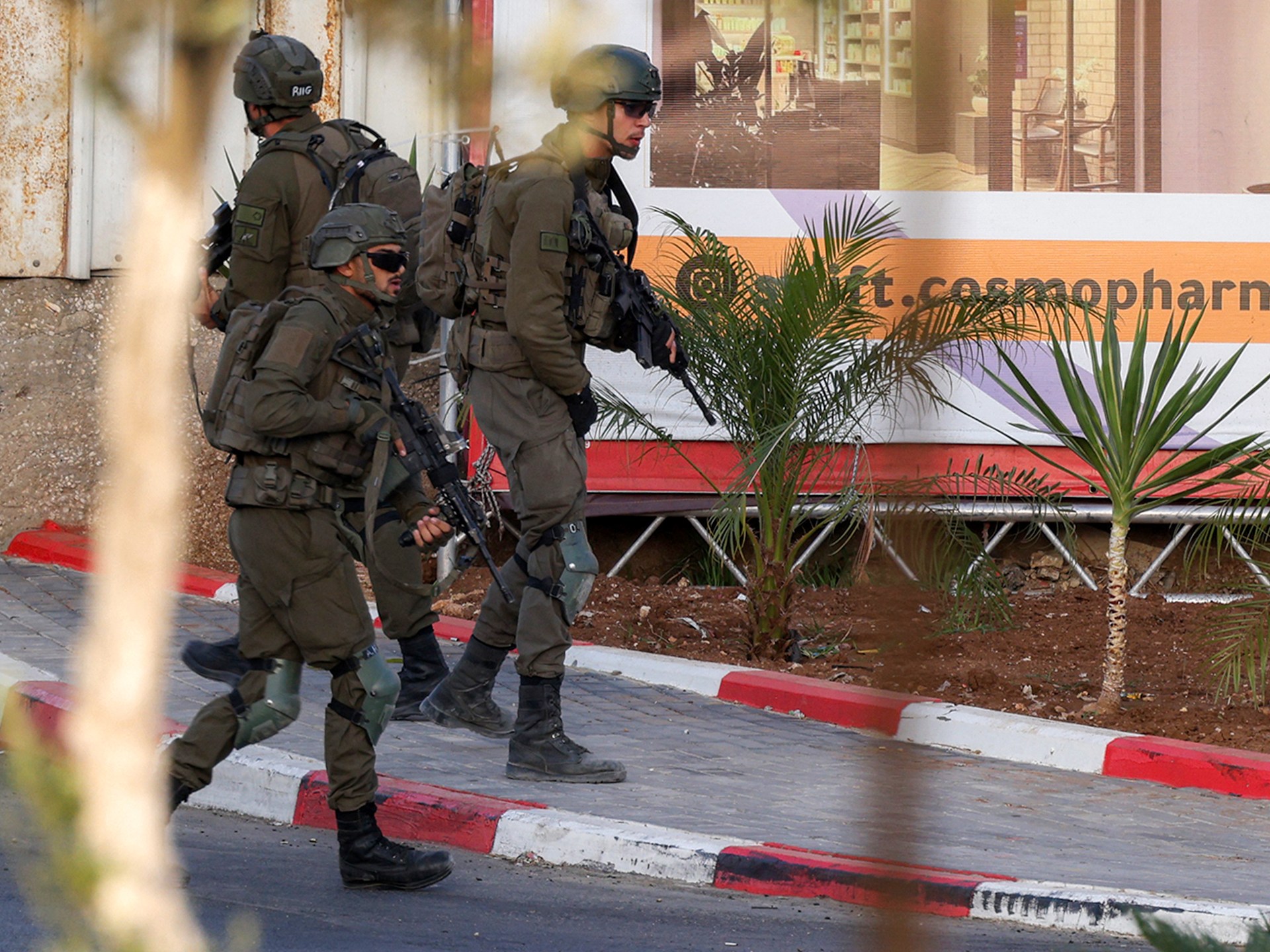
Clampdown comes as Israeli pogroms heighten tensions and spread violence across Palestinian territory.
Save
Share
Prime Minister Benjamin Netanyahu says he has ordered a full lockdown of the occupied West Bank after the Israeli military repelled an attack in the city of Hebron.
The order on Friday morning was given shortly after the Israeli military said it had killed two Palestinian gunmen who had attacked a reserve battalion near the Israeli settlement of Telem, which, like all settlements, is illegal under international law.
The attack and clampdown came amid heightened tensions across the Palestinian territory as Israeli settlers and soldiers engage in violent pogroms. Attacks on olive harvesters have been rife as aggression has been on the rise before Tuesday’s Israeli elections.
Declaring that the security forces had prevented a “major attack”, Netanyahu announced on social media that he had ordered security forces to immediately close Hebron and “prepare for a full lockdown across all of Judea and Samaria [the Israeli term for the West Bank] starting today”.
Israeli sources said earlier that two Palestinians driving a car with an Israeli licence plate began shooting towards soldiers near one of the many military checkpoints surrounding Hebron.
Israel’s ambulance service reported at least five Israeli soldiers were injured and two were in critical condition.
Witnesses in the area said the shooting lasted for 20 minutes, which complicated the process of evacuating the injured.
Images shared by the AFP news agency appeared to show a man holding a handgun during the fight and later lying on the ground surrounded by Israeli soldiers.
The Israeli military was later reported to have arrested two Palestinians and locked down Hebron while Netanyahu cancelled a series of election-related engagements.
Far-right National Security Minister Itamar Ben-Gvir responded to the gun battle by calling for Israel to take full control of the West Bank, in which the Israeli government is encouraging the construction of numerous settlements.
“We have to act before it’s too late. The Palestinian Authority must be dismantled and demilitarised, and its terror infrastructure wiped out completely,” Ben-Gvir said in a statement.
Hamas, Palestinian Islamic Jihad and the Popular Front for the Liberation of Palestine (PFLP) praised the attack on the checkpoint, calling it a response to Israeli military operations, settler violence and Israel’s genocidal war in Gaza, and encouraged intensified confrontations with Israeli soldiers and settlers.
Reporting from Ramallah, Al Jazeera’s Nida Ibrahim noted the precarious situation in the territory as settlers and Israeli security forces maintain pressure on the Palestinian population.
“This is coming at a time of great tension, not just before the Israeli elections, but there has been a ramp-up in attacks by settlers against Palestinians in the occupied West Bank,” she said.
Israeli forces arrested 36 Palestinians during raids across the West Bank on Thursday as attacks on Palestinian farmers and their land during the olive harvest ramp up.
In Jenin governorate, Israeli forces raided towns and villages, arresting 10 Palestinians, the Palestinian news agency Wafa reported, citing data from the Palestinian Prisoner’s Society.
The town of Tuqu in the Hebron governorate was also raided by soldiers who arrested former prisoner Shorok al-Badan along with five other people from other parts of Hebron, according to Wafa.
The Colonization and Wall Resistance Commission said Israeli forces also arrested 14 people in Khirbet Jawaya, a village in Masafer Yatta in Hebron governorate, while Wafa reported three other Palestinians were arrested across the governorate, quoting a security source.
In Nablus and Jerusalem governorates, three more Palestinians were arrested during Israeli raids in the village of Burin, the town of Awarta and the Qalandiya refugee camp.
The Colonization and Wall Resistance Commission said it documented 17 pogroms by Israeli forces and settlers on Thursday against Palestinian farmers and their land during the olive harvest.
The incidents were recorded across West Bank governorates, including Hebron, Qalqilya, Nablus, Ramallah and el-Bireh, Jenin and Salfit.
According to the commission, the attacks included assaulting farmers, preventing them from reaching their land, stealing crops and farm equipment, and damaging and burning olive trees as well as arrests, threats at gunpoint and live fire.
The commission said the pattern represents an escalation in attacks targeting the olive harvest and undermines Palestinians’ ability to access and cultivate their land and maintain their livelihoods.
Israeli attacks on Palestinian farmers have garnered international attention and condemnation. US Democratic congressional candidate Brad Lander was briefly detained on Wednesday by the Israeli military while volunteering to help Palestinian farmers harvest olives in the West Bank.
Follow Al Jazeera English:
About the Author