Read The Diplomat, Know The Asia-Pacific
Kim Aris called for the release of all political prisoners in Myanmar and said that his mother “must never be held hostage or used as a bargaining chip.”
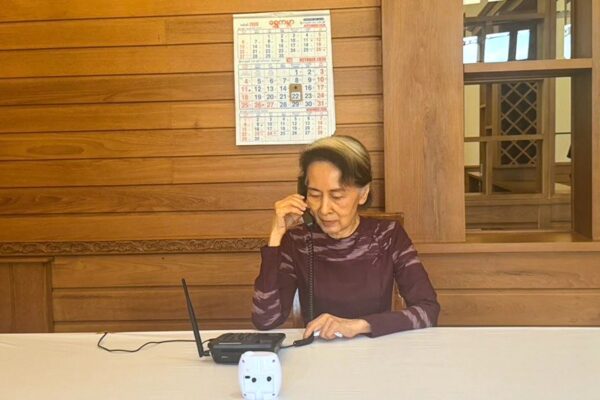
In this photo released by the Myanmar Presidential Spokesperson’s office, detained leader Aung San Suu Kyi speaks with her son Kim Aris by phone from Naypyidaw, Myanmar, Oct. 22, 2026.
The son of Myanmar’s detained former leader Aung San Suu Kyi says that he has spoken to his mother for the first time since the military coup of 2021, reiterating calls for her release.
“Today, I was able to speak directly with my mother, Daw Aung San Suu Kyi, for the first time in more than five years,” Kim Aris said in a statement yesterday. “Hearing her voice again means more to me than words can express.”
The call came after the military-backed administration released two photos of Aung San Suu Kyi receiving two books and a sealed diplomatic pouch from Britain’s King Charles III.
Yesterday’s call was also publicized by Myanmar’s presidential spokesperson, who posted on Facebook that the “convicted prisoner” had spoken to her son with the assistance of the Myanmar embassy in London. It also released photos of the pair talking on the phone.
In this statement, Aris thanked all of those who had campaigned for his mother’s freedom, and those who facilitated the phone call, but said the conversation was no substitute for regular contact, let alone his mother’s freedom.
“This moment must not be mistaken for freedom,” Aris said, “My mother is 81. She remains unjustly detained, and a single conversation cannot restore the years taken from her or the rights she is still denied.”
As Aris detailed in an interview with my colleague Luke Hunt last month, he has waged an international campaign for his mother’s release since February 2021, when she was ousted in a coup and placed under tight military custody. She is currently serving an 18-year prison term for a host of criminal charges, including incitement, corruption, election fraud, and violation of Myanmar’s Official Secrets Act.
Despite spending most of the past five years in seclusion, with virtually no contact with the outside world, in recent months the authorities have loosened the terms of Aung San Suu Kyi’s detention and been more forthcoming about the activities of the Nobel laureate.
Shortly after coup leader Min Aung Hlaing took office as president in April, his pseudo-civilian administration announced Aung San Suu Kyi’s relocation from prison to house arrest at a “designated residence” in the capital Naypyidaw, alongside a broader amnesty of political prisoners. It also reduced her sentence by one-sixth. In August, the authorities also allowed her to meet with Arnaud de Baecque, the resident representative of the International Committee of the Red Cross in Myanmar, the first foreign official that she had met since the coup.
This recent “leniency” is clearly connected to Naypyidaw’s ongoing efforts to normalize its relations with important international partners, in particular the Association of Southeast Asian Nations (ASEAN).
The 11-nation bloc has barred Myanmar from its summits since late 2021, over its failure to implement its Five-Point Consensus plan for resolving the country’s post-coup conflict, which involved pledges to cease violence, allow humanitarian access, and engage in political dialogue involving “all parties” to the country’s conflict.
Recognizing that Aung San Suu Kyi’s international fame and status as a political symbol, the authorities in Naypyidaw have hoped that loosening the conditions of her detention will help pave the way to normalization with ASEAN member states and other governments. At the same time, it has ruled out (at least for now) any prospect of her release.
In his statement, Aris expressed an awareness of the role that his mother had long played in the Myanmar military’s diplomatic strategy.
“My mother must never be held hostage or used as a bargaining chip for diplomatic recognition, sanctions relief, or political advantage. Basic humanitarian rights cannot be exchanged for legitimacy,” he said.
“Regular, direct, and private family contact and independent medical access must be guaranteed. Above all, my mother and all political prisoners must be released immediately and unconditionally.”
Subscribe today and join thousands of diplomats, analysts, policy professionals and business readers who rely on The Diplomat for expert Asia-Pacific coverage.
Get unlimited access to in-depth analysis you won’t find anywhere else, from South China Sea tensions to ASEAN diplomacy to India-Pakistan relations. More than 5,000 articles a year.
Already have an account? .
The son of Myanmar’s detained former leader Aung San Suu Kyi says that he has spoken to his mother for the first time since the military coup of 2021, reiterating calls for her release.
“Today, I was able to speak directly with my mother, Daw Aung San Suu Kyi, for the first time in more than five years,” Kim Aris said in a statement yesterday. “Hearing her voice again means more to me than words can express.”
The call came after the military-backed administration released two photos of Aung San Suu Kyi receiving two books and a sealed diplomatic pouch from Britain’s King Charles III.
Yesterday’s call was also publicized by Myanmar’s presidential spokesperson, who posted on Facebook that the “convicted prisoner” had spoken to her son with the assistance of the Myanmar embassy in London. It also released photos of the pair talking on the phone.
In this statement, Aris thanked all of those who had campaigned for his mother’s freedom, and those who facilitated the phone call, but said the conversation was no substitute for regular contact, let alone his mother’s freedom.
“This moment must not be mistaken for freedom,” Aris said, “My mother is 81. She remains unjustly detained, and a single conversation cannot restore the years taken from her or the rights she is still denied.”
As Aris detailed in an interview with my colleague Luke Hunt last month, he has waged an international campaign for his mother’s release since February 2021, when she was ousted in a coup and placed under tight military custody. She is currently serving an 18-year prison term for a host of criminal charges, including incitement, corruption, election fraud, and violation of Myanmar’s Official Secrets Act.
Despite spending most of the past five years in seclusion, with virtually no contact with the outside world, in recent months the authorities have loosened the terms of Aung San Suu Kyi’s detention and been more forthcoming about the activities of the Nobel laureate.
Shortly after coup leader Min Aung Hlaing took office as president in April, his pseudo-civilian administration announced Aung San Suu Kyi’s relocation from prison to house arrest at a “designated residence” in the capital Naypyidaw, alongside a broader amnesty of political prisoners. It also reduced her sentence by one-sixth. In August, the authorities also allowed her to meet with Arnaud de Baecque, the resident representative of the International Committee of the Red Cross in Myanmar, the first foreign official that she had met since the coup.
This recent “leniency” is clearly connected to Naypyidaw’s ongoing efforts to normalize its relations with important international partners, in particular the Association of Southeast Asian Nations (ASEAN).
The 11-nation bloc has barred Myanmar from its summits since late 2021, over its failure to implement its Five-Point Consensus plan for resolving the country’s post-coup conflict, which involved pledges to cease violence, allow humanitarian access, and engage in political dialogue involving “all parties” to the country’s conflict.
Recognizing that Aung San Suu Kyi’s international fame and status as a political symbol, the authorities in Naypyidaw have hoped that loosening the conditions of her detention will help pave the way to normalization with ASEAN member states and other governments. At the same time, it has ruled out (at least for now) any prospect of her release.
In his statement, Aris expressed an awareness of the role that his mother had long played in the Myanmar military’s diplomatic strategy.
“My mother must never be held hostage or used as a bargaining chip for diplomatic recognition, sanctions relief, or political advantage. Basic humanitarian rights cannot be exchanged for legitimacy,” he said.
“Regular, direct, and private family contact and independent medical access must be guaranteed. Above all, my mother and all political prisoners must be released immediately and unconditionally.”
Sebastian Strangio is Southeast Asia editor at The Diplomat.
Get briefed on the story of the week, and developing stories to watch across the Asia-Pacific.
About the Author