Public radio’s longest-running daily global news program.
©2026 The World from PRX
PRX is a 501(c)(3) organization recognized by the IRS: #263347402.
As Israeli strikes forced families across Lebanon to flee, many migrant workers found themselves abandoned and without shelter. But rather than wait for help, they mobilized their own networks, opening shelters, organizing aid and protecting one another.
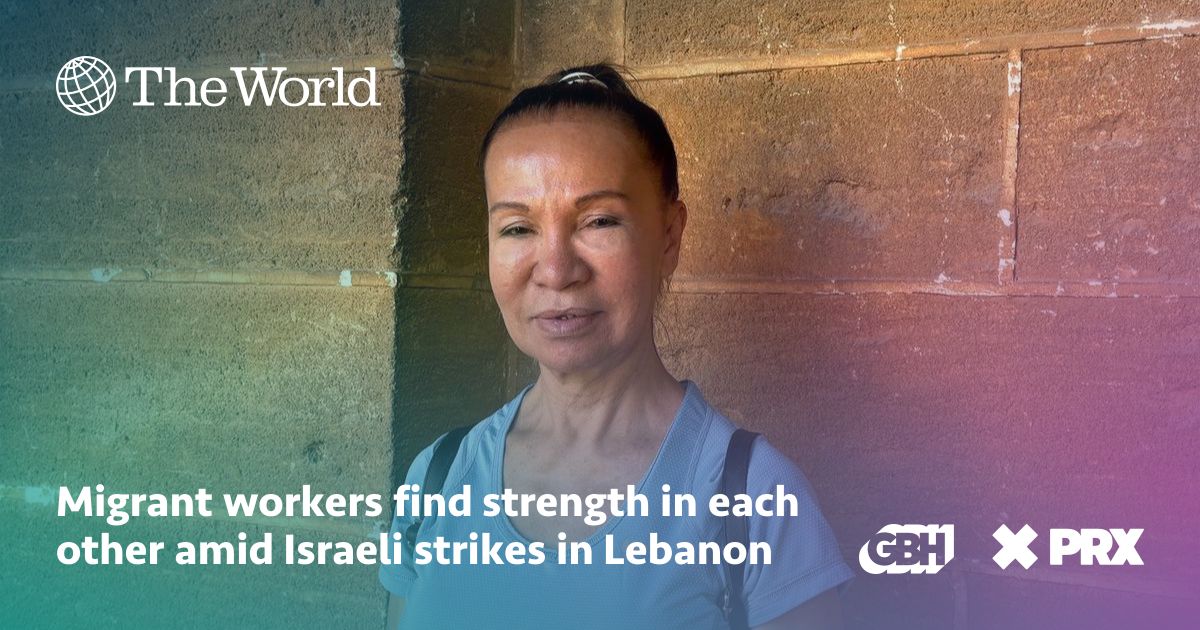
Myra Aragon, who traveled to Lebanon from the Philippines in 2004, works as an advocate for migrants rights.
It was 3 o’clock in the morning last March when Israeli strikes hit Dahieh, in the suburbs of the Lebanese capital Beirut.
The attacks sent families fleeing their homes.
Myra Aragon’s phone started ringing.
“They were asking, ‘Where are we going to go?’” she recalled in an interview this month. “Because they don’t have any place to go, and they were just walking, so I kept monitoring them. Also, I was at a loss. We were not at all prepared.”
The people calling her were terrified. They were mostly women domestic workers who, like her, had traveled from the Philippines to work in Lebanon.
Some had children with them, Aragon said, and they were on the streets, looking for somewhere safe to shelter. By the time the families reached Aragon, they had been walking for three hours, she said.
She had nowhere to put them. “[One] family has two children, the other has four. The other one has three. It’s chaos.”
Aragon is 52 and from the Philippines. She said the fighting between Israel and Hezbollah has brought an entirely new level of desperation to the migrant workers in Lebanon.
“Before, only [specific] areas were targeted by Israel, but this time it’s widespread,” she said.
The workers were already struggling with discrimination and few legal protections in Lebanon. They come from various countries, but most are from the Philippines, Ethiopia, Bangladesh and Sudan.
They clean homes and care for children or the elderly. They also work on farms or as drivers. Many have left their own families behind, hoping to earn enough money to send back home for a chance at a better life.
When Israeli strikes forced families across Lebanon to flee their homes, many migrant workers faced the especially difficult choice of where to go. Some were left behind by their employers. Others found themselves shut out of shelters, with little money and no way to leave the country.
“The migrants here are very much marginalized. There is [little] protection,” explained Father Henry Ponce, a Filipino Jesuit priest, who works with migrants in Beirut.
He said that last spring, his church became an emergency shelter. People arrived hungry, exhausted and frightened.
“A lot from the south evacuated to Beirut, and there were shelters, Lebanese shelters of the government, but they do not accept migrants. They only accept Lebanese,” Ponce said.
Lebanon’s kafala, or sponsorship system, ties many migrant workers’ legal status to their employers, leaving them vulnerable to exploitation.
Most can’t just leave the country if things aren’t going well. They often don’t have the money to pay for flights, and if they’re undocumented, they can be arrested and jailed. They also don’t want to give up an income that helps their families back home.
Ponce and his team sheltered about 200 people at the St. Joseph church in Beirut. All three floors of the church were packed, he added. The church provided hot meals and a place to sleep for the displaced migrants.
But more kept coming.
“Our shelter was full already,” Ponce said, “but I [couldn’t ] just let them go.”
The situation in the south of the country was even worse.
Rescue worker Hussain Fakih in the city of Nabatiyeh said when the airstrikes came, some families fled, leaving behind their employees.
“A large number of them were still there,” Fakih said, “and some were injured in the strikes.”
He described evacuating Sudanese and Ethiopian workers from farms. They were hungry and frightened; he said they could barely think straight.
Myra Aragon, who helped the migrants in Beirut, said she jumped into action because she knows what it feels like to have nowhere to turn.
Like many migrant workers in Lebanon, her presence in the country and her movement were dependent on her employers.
She arrived in the country in 2004, expecting to work as a nurse. Instead, she was cheated by a recruitment agency. A couple promised her they would get her residency papers, but she said they also took her money and disappeared. She was forced to live in the shadows as an undocumented worker.
At one point, Aragon said, she ended up caring for an older woman in a city in northern Lebanon. But the woman’s son sexually assaulted her.
“He [was] a civil engineer. Even if I am a registered nurse in the Philippines, in Lebanon, I am just a house maid. So, who will believe me?” she recalled.
The abuse went on for a while.
“I [felt] like I’m an animal,” Aragon said, “no respect at all. How could I face my family? I was already trafficked. I was cheated with the contract. And now I go home with this story of being subjected to sexual abuse? I cannot.”
Aragon felt she could no longer stay in that house. She came up with an elaborate plan to escape.
Today, she helps migrant workers learn about their rights. She organizes training for women who’ve experienced exploitation and abuse.
“I don’t want to be bitter about all the things that have happened,” she said, “because of all the challenges that I have suffered in Lebanon, this is how I became an advocate. Because I want to stand up for my community so that what I have experienced, I hope they will not experience.”
She has also been pushing for changes to Lebanon’s labor laws, but progress has been painfully slow. A meeting with lawmakers planned for March was postponed when the war escalated.
Still, she isn’t giving up.
“Working on this is not a quick and easy job,” Aragon said, “but at least the seed has been planted. I may not benefit [from] it, but maybe the future [workers] will benefit [from it]. This is important for me.”
On a sunny October day, a group of migrants gathered at the St. Joseph church in Beirut for mass. Music echoed through the church’s high-ceilinged hall. The church has become a place for the migrants to see each other, exchange stories and commiserate.
Aragon, who was among the crowd, said she knew she couldn’t solve everyone’s problems. But at least the people who turn to her know they’re not alone. And that there’s someone they can count on when they need help.
Sign up for The Top of the World, delivered to your inbox every Wednesday morning.
About the Author