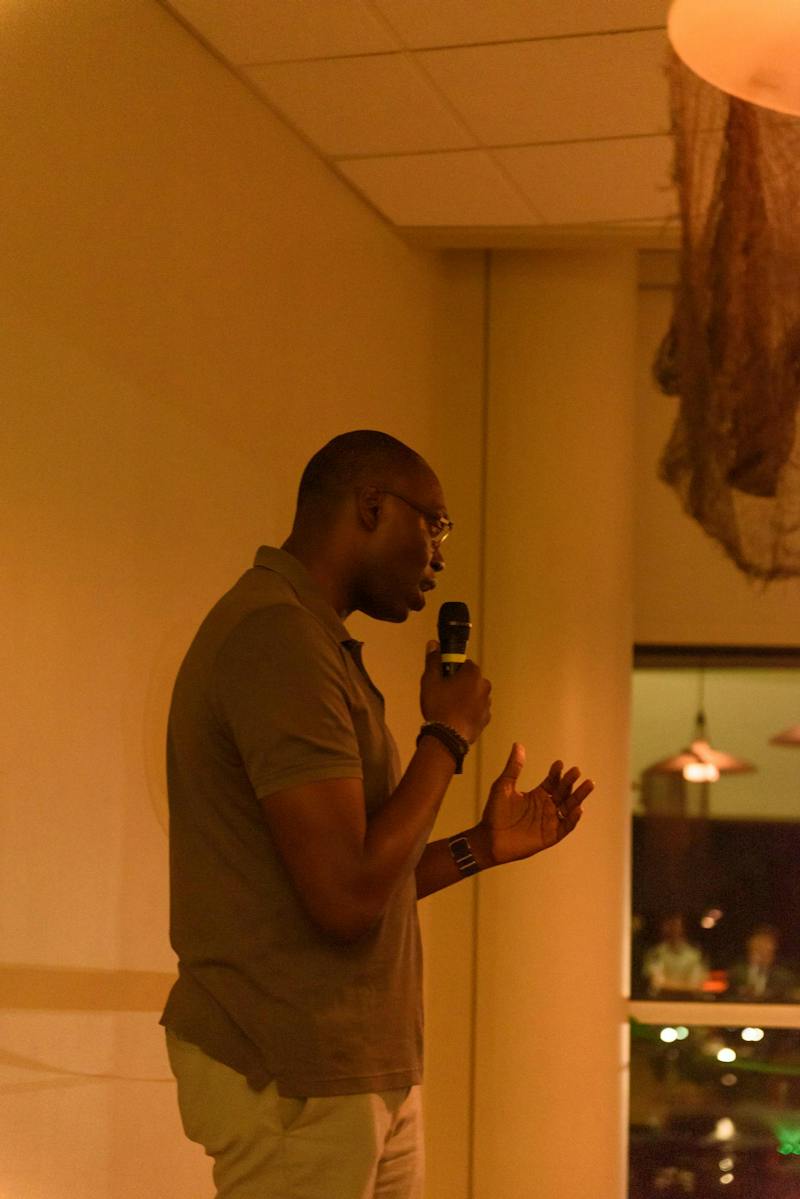
Garlin Gilchrist II is the lieutenant governor of Michigan, working alongside Gov. Gretchen Whitmer. Prior to being lieutenant governor, Gilchrist worked as a software engineer at Microsoft, ran for Detroit city clerk and served as the City of Detroit’s director of innovation. Earlier this year, he ran to be the Democratic nominee for governor before suspending his campaign to run for secretary of state.
Gilchrist visited Eastern Michigan University on Oct. 12 for a politics-themed stand-up comedy event. In an interview with The Eastern Echo, Gilchrist shared details on some of his campaign policies, his opinion on data centers and his plan to restore trust in Michigan’s electoral process.
Q: Can you explain your campaign policy “fight for more legislative action that shines a light on dark money in our politics” in detail?
A: I call it the Stand Tall agenda. The reason why I’m doing this is because a lot of people don’t vote or are cynical about voting, because they feel like their vote doesn’t matter. One of the reasons they think their vote doesn’t matter is because they feel like only the super rich people or big corporations are the ones whose influence means anything in our politics. By shining a light on how that dark and dirty corporate money flows through our politics, we can help people by helping them get their leverage back and their power back.
In the Stand Tall agenda, the T is for transparency. [Transparency is] making sure we work with the legislature to pass legislation that requires organizations that spend money on our politics to be registered in Michigan, and making sure we can close the loopholes that allow people to give campaign contributions anonymously, or at least give campaign contributions without disclosing it. If you make a political contribution, you should have to stand on it in public. Also working with legislation to align our disclosure deadlines so that they come before Election Day, because right now some campaign finance disclosures don’t happen until after Election Day.
The A is for accountability. The secretary of state is responsible for going after those who have allegedly broken campaign finance law, or to make sure we have the capacity and the appropriate authority to do so. Also, a stronger partnership with the attorney general to go after those bad actors, that can include even a special task force that’s focused on these special challenges, again to find out who has broken campaign finance law in real time. It’s not that useful to find out that someone broke campaign finance law after an election, after they already won. This is about making sure we can make that happen sooner.
The first L is for limits — closing the loopholes that allow campaigns, candidate committees and elected officials to get around campaign contribution limits. Right now, elected officials can start multiple leadership PACs, and each individual PAC has a maximum contribution. The point of the max is so you can only get [PAC contributions] one time, not multiple times, depending on how many PACs you have. This is all about the second L, which is leveling the playing field. We return the leverage and the power to the people and take it away from corporations that are only for the wealthiest people. Democracy is government by the people — not the wealthy, not the corporate, but the people.
Q: Can you explain your campaign policy “modernize licensing and registration by providing smarter, 21st century service” in detail?
A: This is just about making sure we’re using technology appropriately. We’ve seen good progress these last eight years with the establishment of the self-service kiosks in Meijer and other stores. I want to expand more partnerships and make those services more available and more convenient to more people in more communities in more types of places. [I am] looking forward to expanding those things [and] doing online services that can bring convenience as well. I want Michigan to be the next state to issue digital driver’s licenses, and work with the legislature to make sure we can enable that. Those licenses will be the kinds of real IDs that you can use if, heaven forbid, you get pulled over, that you can show when you go to vote, that you can actually use practically like your driver’s license. I lost a wallet back in February, but I have never lost a cellphone, so having a digital ID is a convenient option for people who want it. We can do that securely, and we can make Michigan the next state to knock down that barrier.
Q: Can you explain your campaign policy “stand tall against big tech companies and the Trump administration who want to abuse your personal voter registration information or license-plate data” in detail?
A: The secretary of state’s office, in order to do its work, has to collect a lot of information about the people in Michigan. This department knows more about the people in Michigan than any other state department. [The department holds information like] where you live, what kind of car you drive, what color your eyes are, whether you voted in previous elections and the last four digits of your social security number. All of this data put together can not only identify you, but if it gets into the wrong hands, it can be used to target you, surveil you, intimidate you and ultimately harm you. I’m going to stand tall to make sure that data gets protected, and I’m uniquely qualified to do that because I’m the only software developer who was elected statewide in this country. I know how to protect data; I started my career as a software engineer testing cybersecurity at Microsoft. I know how to protect data in court from the Trump administration that sued Michigan and 22 other states to get their hands on that data — they’ve lost 23 times. I’ll make sure they continue that losing streak. As secretary of state, I’ll also stop big tech that’s super thirsty for this data and information to build products without our permission, feed them data models without our consent, and send those models and that data through data centers we don’t want in our communities. As secretary of state, Michigan’s chief privacy officer, I can protect that data from those kinds of threats. That’s one of the biggest differences between me and my opponent; my opponent willingly gave over private voter information to the Trump administration. When you give your information to the [state] government, you expect the [state] government to protect it and use it for its intended purpose, not give it to the federal government.
Q: If elected secretary of state, what are some things you would be able to do about data centers?
A: While I talk about protecting people’s privacy, this is about protecting the things that would feed through data centers in the first place. This privacy is really paramount, and I think young people understand that better than anybody, so I’m ready to align with them on making sure we stand tall for their privacy.
Q: What is your opinion on the data center the University of Michigan is building in Ypsilanti?
A: That project is a little different, but what we’ve seen about data centers like the one in Saline Township, it’s the most egregious example of corporate bullying that we’ve seen maybe in a generation in Michigan. You have the biggest, richest companies in the world, on the planet — CEOs are some of the richest people on the planet. They came in, they gave a weak presentation that was rejected by the community, and rather than getting better, they sued their community. This community doesn’t have the money to fight the biggest behemoth companies that have CEOs; the third richest guy on the planet; Sam Altman, who is a multi-billionaire; and Stephen Ross, who is a multi-billionaire. They’ve got lawyers that make more money than the whole Saline Township budget. So, I think that [the companies], therefore, forcing them to settle, that is bullying at its worst. I believe as public officials, it is our job to protect our communities from this kind of bullying.
Q: What do you think of the allegations that state-run elections aren’t secure? How would you rebuild trust in the electoral process in Michigan?
A: I want to make sure that people see things transparently and fairly. They see that Michigan elections have been proven to be secure and accurate. [Michigan elections] withstood the scrutiny of dozens of lawsuits; they withstood the scrutiny of dozens of audits; they withstood the scrutiny of the Republican-led [Michigan Senate Oversight Committee’s investigation] in 2021 that found that the results of the 2020 election were accurate. And frankly, any elected official that can’t say that is someone you can’t trust to be able to certify elections and respect the will of the people. My opponent uses more than one word to answer the question if Joe Biden won the election in 2020. He did, and to reject that is to reject the will of the people of Michigan.
I’ll make sure we continue that winning streak of being safe, secure and accurate. Also, bring some transparency to the process, especially around what happens to ballots once they’re cast, the tabulation process, through the canvassing process and certification process by doing something fun. Maybe by making a campaign similar to the old-school Schoolhouse Rock “How a Bill Becomes a Law.” We can do “How a Ballot Becomes a Vote” that sheds light on how things work because those conspiracy theories spread where people don’t know what the truth is. By telling the truth more aggressively than the liars can lie and spread misinformation, that’s how we can push back on all that.
About the Author