Employers are holding onto workers at a rate unseen since the late 1960s, yet job seekers are running into walls everywhere they turn. Something in the American labor market has quietly broken, and the consequences could ripple far beyond the…
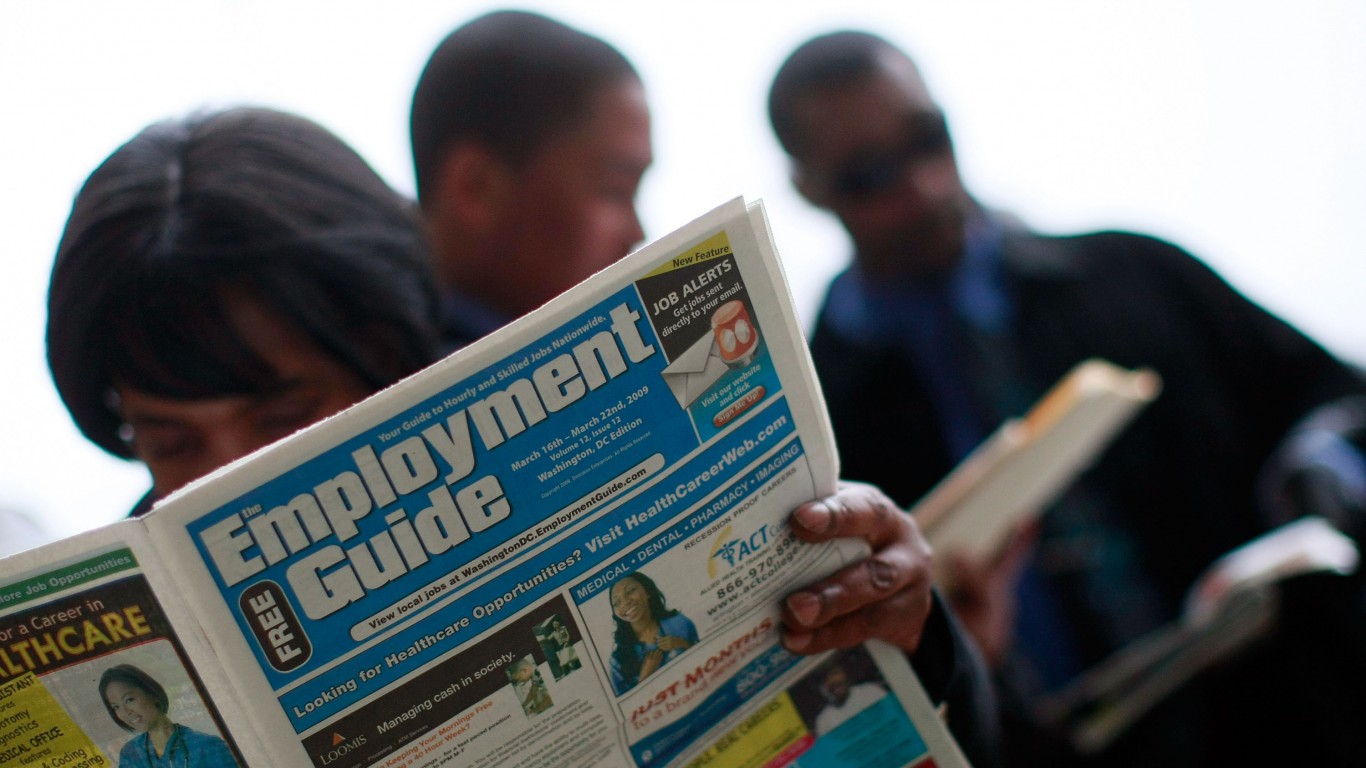
America’s job market is sending two very different messages. Fewer workers are losing their jobs than at almost any point in the past 57 years, suggesting employers remain confident about the economy. Yet businesses are barely hiring, leaving job seekers facing one of the most frustrating employment markets in years.
For Americans already collecting a paycheck, the labor market looks reassuring. For recent graduates, unemployed workers, or anyone hoping to change careers, it’s a different story. The economy hasn’t fallen into a recession, but an increasingly frozen job market raises concerns about how much longer that can remain true.
According to the Labor Department’s Oct. 22 unemployment claims report, just 194,000 Americans filed initial claims for unemployment benefits during the week ended Oct. 17, down 6,000 from the previous week.
That’s only 5,000 above the 189,000 claims recorded in July, the lowest level since 1969. Claims have remained at or below 200,000 for six consecutive weeks.
Ordinarily, numbers like those would signal an economy firing on all cylinders. But September’s employment report tells a different story. The Bureau of Labor Statistics (BLS) reported employers added just 29,000 jobs in September, while unemployment stood at 4.2%. That followed August’s gain of 133,000 jobs.
The economy is neither shedding workers nor creating enough opportunities for people entering the workforce. It’s a hiring freeze without the mass layoffs.
The slowdown in job creation is particularly troublesome because workers typically rely on changing employers to advance their careers and earn higher salaries. And the latest numbers suggest those opportunities are drying up.
The BLS’s Oct. 20 state employment report revealed how widespread the slowdown has become.
In September, only two states recorded statistically significant payroll growth: New Jersey added 14,900 jobs, and South Carolina gained 12,500. Wisconsin lost 13,700.
Employment was essentially unchanged in the other 47 states and Washington, D.C. That doesn’t mean those states created no jobs. Rather, their employment changes were too small relative to the estimates’ uncertainty to establish meaningful growth.
Meanwhile, the number of Americans continuing to receive unemployment benefits rose 25,000 to 1.728 million during the week ended Oct. 10. Fewer people are losing jobs, but those already unemployed face a more difficult road back.
The problem is particularly acute for workers who have been unemployed for months. Long-term unemployment has already become a growing concern, creating financial pressure that weekly unemployment claims alone cannot capture.
For someone living paycheck to paycheck, an extended job search can mean draining savings, carrying credit card balances, or delaying essential purchases. For a recent college graduate, it can mean postponing independence altogether.
Ironically, employers’ reluctance to fire workers may be helping sustain the very economy they’re hesitant to invest in.
Workers with steady paychecks can continue spending on groceries, automobiles, restaurants, and vacations. But without new hiring, fewer households gain the income needed to make those purchases.
Businesses also have reasons to hold onto existing employees. Strong corporate profits and domestic demand are supporting retention, while retirements and reduced immigration have constrained the available labor supply, according to Reuters.
Still, that stability offers little comfort to Americans worried about their employment prospects. Job insecurity has already reached levels not seen in 13 years, and fewer opportunities to find another position could encourage families to tighten their budgets.
For investors, the risk is that cautious hiring eventually translates into weaker consumer spending, slower business growth, and additional pressure on corporate profits.
In short, America’s labor market hasn’t collapsed. It’s stalled.
The 194,000 weekly unemployment claims suggest employers aren’t rushing to cut payrolls. But September’s 29,000 new jobs show they’re equally reluctant to expand them. Yet a sustained rise in layoffs without stronger job creation could signal that the freeze is turning into something worse.
For households, the practical response is to protect emergency savings and approach major new financial commitments cautiously. Having a job remains reassuring. Finding another one may prove considerably harder.
Contact [email protected] for any questions or corrections.
After two decades of patrolling the dark corners of suburbia as a police officer, Rich Duprey hung up his badge and gun to begin writing full time about stocks and investing. For the past 20 years, he’s been cruising the markets looking for companies to lock up as long-term holdings in a portfolio while writing extensively on the broad sectors of consumer goods, technology, and industrials. Because his experience isn’t from the typical financial analyst track, Rich is able to break down complex topics into understandable and useful action points for the average investor. His writings have appeared on The Motley Fool, InvestorPlace, Yahoo! Finance, Money Morning, and, of course, 24/7 Wall St. He has been featured in both U.S. and international publications, including MarketWatch, Financial Times, Forbes, Fast Company, and USA Today.
The Federal Reserve raised rates in September to fight an energy-driven inflation spike, betting the labor market could handle the pressure. September's jobs report suggests that bet may have been wrong.
For nearly two years, the job market Americans were told about has been significantly stronger than the one that actually existed, and the Federal Reserve made a major policy decision based on numbers that…
Unemployment claims just hit their lowest level since 1969, yet the September jobs report barely moved. Something in the labor market broke, and the break is quiet enough that most people have not noticed…
Summer jobs could fall by half year over year as the U.S. economy continues to struggle with the coronavirus outbreak.
Job openings just hit their highest level since May, yet something is quietly vanishing from payrolls that the 4.1% unemployment rate is not built to detect.
A weak jobs report pulled October off the table, but two inflation readings and an oil price stand between borrowers and another rate hike before the year ends.
A master electrician called into The Dave Ramsey Show in March 2026 and revealed he was owed $18,000 in unpaid wages after going 20 weeks without receiving full paychecks. He had been receiving only…
The Federal Reserve's latest economic assessment reveals something investors and workers were not supposed to see this soon: AI is already reshaping who gets hired and who never does, and the consequences for household…
A Gallup poll taken last month showed that confidence in the economy has fallen to its lowest level since March 2009, which was near the low point of The Great Recession. A growing and…
This post may contain links from our sponsors and affiliates, and Flywheel Publishing may receive compensation for actions taken through them. © 2026 24/7 Wall St.
About the Author