Intel's brutal Friday selloff did not stop at its own ticker. If you hold a popular index or sector ETF, the damage landed in your account too, and the overlap across funds may be larger than you think.
Building a portfolio and living off one are two completely different skills, and almost nobody teaches the second. This problem is what The Definitive Guide to Retirement Income helps, and it is free today. Read more here. (Sponsor)
This post may contain links from our sponsors and affiliates, and Flywheel Publishing may receive compensation for actions taken through them.
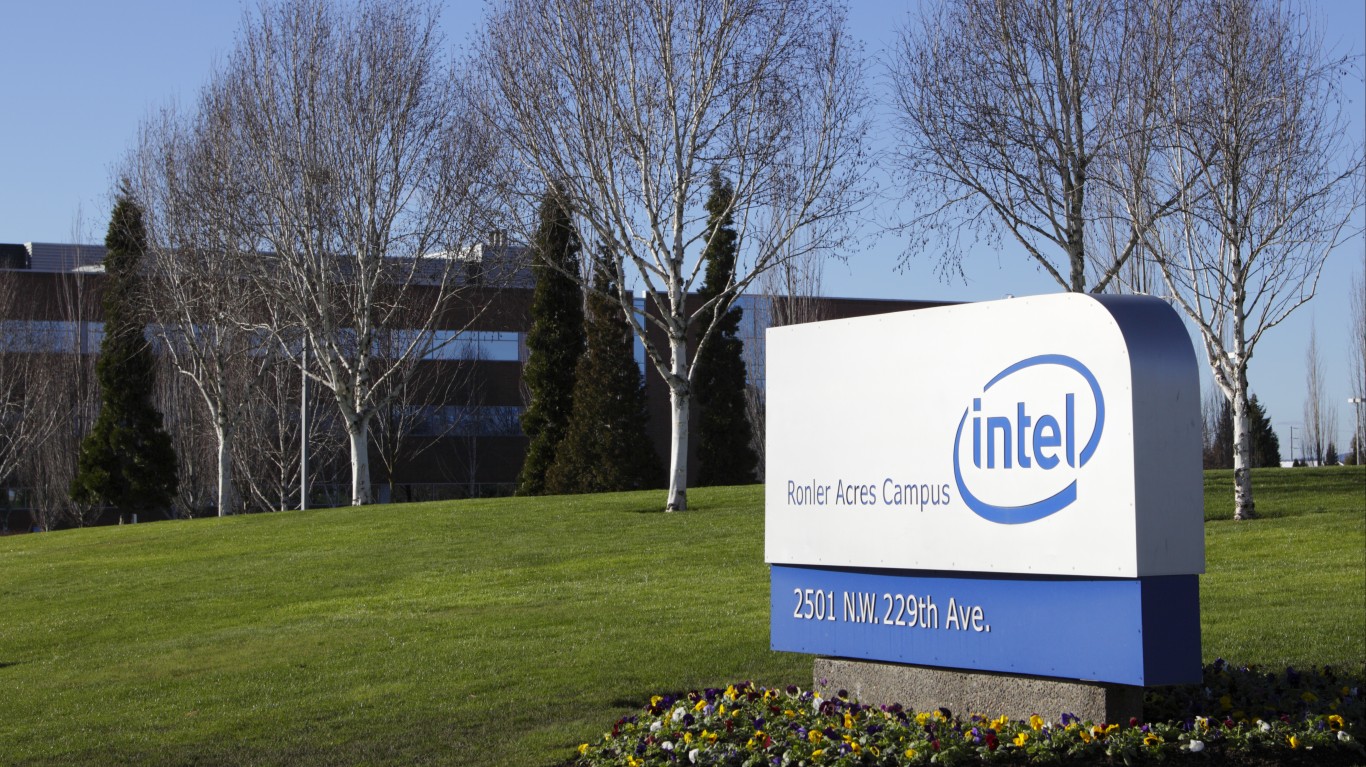
Shares of Intel (NASDAQ:INTC | INTC Price Prediction) fell 28.73% in Friday’s session and traded at $65.62 as of 9:44 AM ET. The catalyst is the chipmaker’s third-quarter earnings report, released after Thursday’s close. Same-day headlines tie the broader tech sell-off to Intel’s results, with Reuters reporting that the report amplified AI spending worries across the NASDAQ. If you own a NASDAQ-100 or semiconductor index fund, part of this loss lands in your account too.
The fall started before Friday. Intel was already down 23.24% over the past week and 43.4% over the past month.
Why Intel (INTC) Is Positioned To Win In 2026
On the surface, the quarter looked solid. Non-GAAP EPS came in at $0.52, ahead of the $0.3953 consensus, and revenue of $16.51 billion came in slightly above estimates. Data Center and AI revenue rose 78% year over year to $7.32 billion.
The outlook told a different story. Intel forecast fourth-quarter revenue to $15.0 billion to $16.0 billion and non-GAAP EPS to $0.25. It expects client revenue to fall greater than 20% sequentially as PC makers cut inventory. An extended shutdown at Intel’s Israel factory is expected to reduce Q4 revenue by about $300 million and gross margin by 200 basis points. The CFO also said Intel did not expect positive free cash flow in 2027, adding, “We are not optimistic about next year in terms of memory.” CEO Lip-Bu Tan said, “I’m disappointed that we were not able to meet strong customer demand in this quarter.”
Intel’s weight varies widely depending on which fund you own. Here is how it looks in the most recent holdings filings:
In QQQ, Intel was a top-10 position worth $14.9 billion, larger than the fund’s stakes in Broadcom and Meta at the time. In the S&P 500 fund, Intel did not appear among the 10 largest holdings. The smallest of those 10 weighed 1.57%, so Intel’s share of a plain S&P 500 index fund is modest.
Applying Friday’s fall to the June 30 weights gives a rough estimate of Intel’s drag. That works out to about 1.48 percentage points for SMH and about 0.87 percentage points for QQQ, from Intel alone. Treat these as estimates. Weights shift as prices move, and Intel’s share price has swung from $103.79 at its July earnings filing to $93.09 at Thursday’s filing. Headlines also show the NASDAQ falling broadly, so each fund’s total move today reflects more than Intel.
Concentration becomes a problem when you pile funds that hold the same stocks. NVIDIA (NASDAQ:NVDA) was SMH’s largest position at 17.55%. Together, NVIDIA and Intel made up about 22.7% of SMH. In QQQ, NVIDIA held 7.60%, and the two chipmakers combined for about 10.64%. NVIDIA was also the S&P 500 fund’s top holding at 7.58%.
A 401(k) or IRA holding an S&P 500 core fund, QQQ for growth, and SMH as a sector tilt owns the same chip names three times. On a quiet day, that overlap goes unnoticed. On a day like Friday, it adds up. Investors close to retirement have less time to recover from sector shocks, so it is worth adding up your total semiconductor exposure across every fund you own.
Intel expected the Israel factory to restart by the end of the week of the call, though management said the impact on the first quarter could be similar to Q4. The company said it has secured about 40% more substrate capacity, with much of it arriving in the second half of 2027. Tan also said Intel expects “a couple of customers ready to announce” for advanced packaging over the next two quarters. Fund holdings are reported with a lag, so check each sponsor’s latest list for current weightings, and keep an eye on the stock as index funds rebalance.
Contact [email protected] for any questions or corrections.
Jake has been been working in financial media for almost 15 years. He focuses on all things personal finance for 24/7 Wall St. with high hopes to educate and entertain. Most recently, Jake spent 12 years working various roles at The Motley Fool. He started copy editing fool.com content, worked on premium and marketing campaigns, and helped launch The Ascent, a personal finance brand.
His work has been featured on platforms like MSN, Yahoo Finance, USA Today, and more. He’s written about credit cards, social security, ETFs, savings accounts, and just about anything else you can imagine when thinking about money. Jake love to cook, play golf, and tell people he’s never had a cavity. (It’s true!)
Intel's earnings beat meant nothing once Wall Street saw what the company expects next, and the fallout is dragging down chipmakers and PC giants alike as a memory crunch reshapes the entire sector's near-term…
Quarterly institutional filings just revealed which major tech rivals and hedge funds were crowding into the same chip stock before Tuesday's sharp selloff, and the concentration levels are raising eyebrows across Wall Street.
Intel posted strong quarterly growth then stunned investors with a warning about 2027 that sent shares into a dramatic after-hours collapse, raising urgent questions about whether its massive spending gamble can actually pay off.
A single semiconductor ETF sounds like a spread bet across dozens of chip companies, but the math inside one popular fund tells a very different story about where your money actually lands.
A semiconductor ETF has ripped higher in 2026 without owning one of the most recognizable chip names on the market. The VanEck Fabless Semiconductor ETF (NASDAQ:SMHX) is up 54.22% year to date through July…
Intel and AMD have each tripled their value in a matter of months, leaving shareholders staring down a decision that cuts both ways. The case for staying in is compelling, and so is the…
The iShares Semiconductor ETF (NASDAQ:SOXX) has gone vertical. SOXX trades near $569, up 89% year to date and 174% over the past year, a run powered less by valuation re-rating than by the cash…
A single retirement account holding VOO may carry far more exposure to one chipmaker than its owner ever intended, and the fund's own prospectus quietly warns about exactly this kind of concentration risk.
Reddit's massive single-day drop barely touched most 401(k) accounts, but investors in one popular thematic fund absorbed a hit that index holders never saw coming.
This post may contain links from our sponsors and affiliates, and Flywheel Publishing may receive compensation for actions taken through them. © 2026 24/7 Wall St.
About the Author