With just two months left before the page turns to 2027, it's shaping up to be another phenomenal year for Wall Street and investors. The mature-stock-driven Dow Jones Industrial Average (^DJI -1.09%), benchmark S&P 500 (^GSPC -1.82%), and growth-fueled Nasdaq Composite (^IXIC -2.86%) have all blasted to several record highs amid a wall of worry on Wall Street.
While history shows that the stock market's major indexes rise over multiple decades, their performance over shorter time frames isn't nearly as predictable. Among the various headwinds stocks are contending with, persistently elevated inflation may be the most threatening to the continuity of Wall Street's artificial intelligence (AI)-driven bull market.
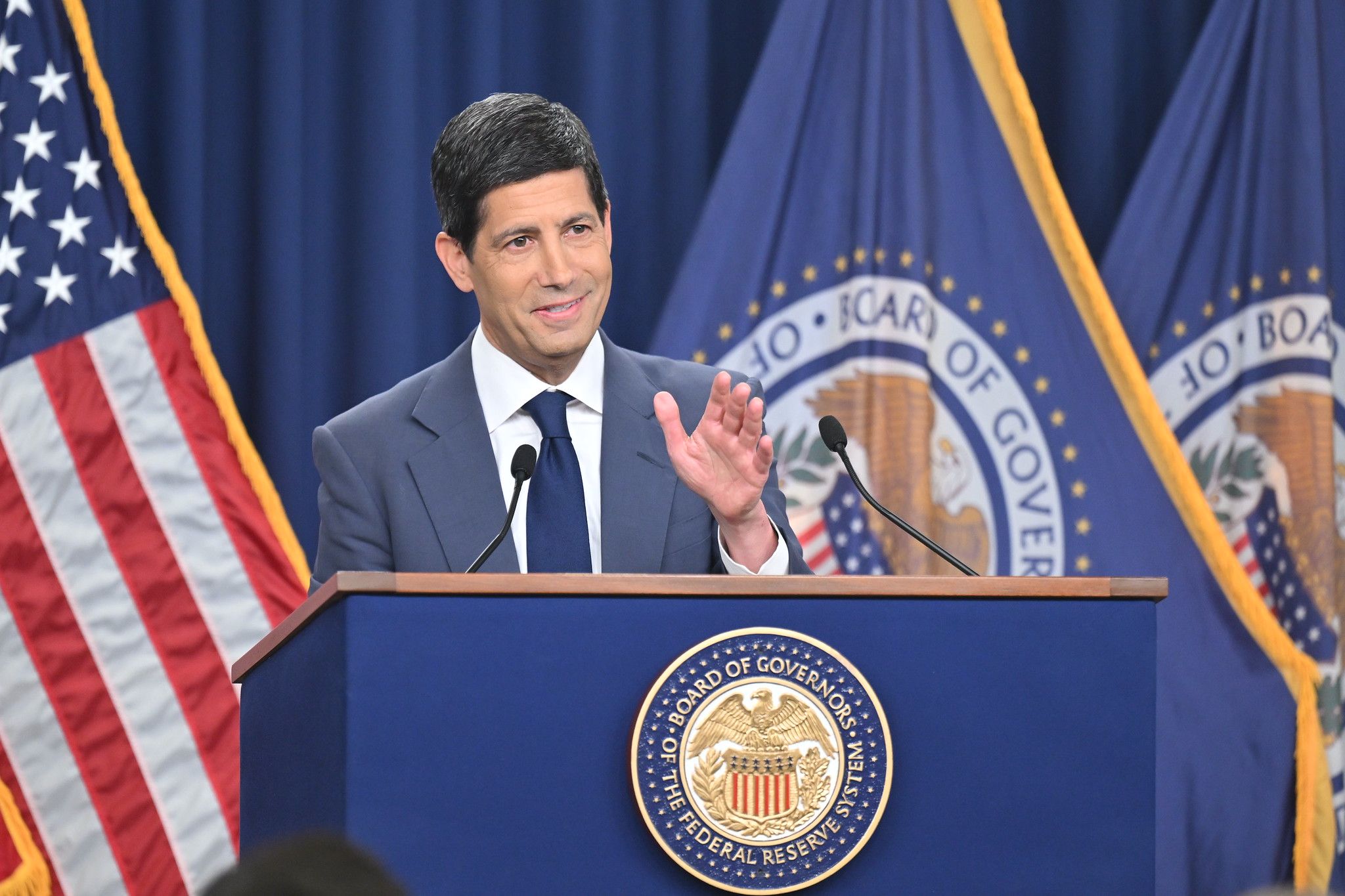
Fed Chair Kevin Warsh and the FOMC held interest rates steady on Oct. 28. Image source: Official Federal Reserve Photo.
This past week, all eyes were on Fed Chair Kevin Warsh and the Federal Open Market Committee (FOMC) to see if they would raise interest rates for a second consecutive meeting. Although the FOMC ultimately stood pat on interest rates, four words from Fed Chair Kevin Warsh charted an undeniable path forward — and they should rightly worry investors.
Since being sworn in on May 22, Fed Chair Warsh has enacted several changes at America's foremost financial institution. For instance, last week he announced that instead of eight live FOMC interest-rate meetings per year, there'll only be seven in 2027 and six in 2028. By 2028, two of the eight meetings will be devoted to long-term policy discussions rather than votes on the federal funds target rate.
Warsh has also done away with forward-looking guidance in FOMC meeting statements. For more than two decades, it was customary for the FOMC to include an easing or hiking bias that gave investors some idea of what the central bank was likeliest to do next with interest rates.
While this lack of forward guidance has created more guesswork for bond traders and investors, Fed Chair Warsh is occasionally so direct in his comments that forward guidance isn't necessary.
Q: There's been essentially no progress toward the 2% inflation target. Why not raise rates today? KEVIN WARSH: It's a good question (Note how he never answers it!) https://t.co/gnR8sJ4c3O
After delivering his prepared remarks to the press following the Oct. 28 interest rate decision, Warsh fielded a question about the Fed's lack of action and his repeated desire for the FOMC to deliver price stability. His response charts a clear path forward for the central bank on interest rates:
Warsh's four-word end statement, "we're working on it," strongly implies that additional action is coming in the form of future rate hikes. It also jibes with his September commentary, where he noted that the FOMC had "removed a dose of accommodation." It's the type of comment made amid an ongoing rate-hiking cycle, not a one-off move in interest rates.
Forecasts overwhelmingly expect the Federal Reserve to get more aggressive with rate hikes in December and throughout 2027. The CME Group's (CME +2.27%) FedWatch Tool, which uses 30-day Fed Funds futures prices to track the probabilities of changes to the federal funds target rate, projects a 65% chance that interest rates rise by at least 75 basis points to 4.50%-4.75% by Sept. 15, 2027.
Image source: Getty Images.
Several factors are prompting Fed Chair Kevin Warsh and the FOMC to act, including Trumpflation (inflation driven by President Trump's policies) and the stock market's No. 1 catalyst, the AI infrastructure build-out.
Modest inflation is expected when the U.S. economy is expanding, which is why the FOMC targets a long-term inflation rate of 2%. Two of President Trump's policies — tariffs and the Iran war — have elevated inflation well above this target.
Recently, three New York Federal Reserve economists writing for Liberty Street Economics examined the effect of Trump's tariff and trade policy on consumer prices. In their report ("How Fast Do Tariffs Pass Through into Consumer Prices?"), they estimated that Trump's tariffs increased goods price inflation by 2.9 percentage points by February 2026.
Meanwhile, the Trump-led Iran war has spurred an eight-month closure of the Strait of Hormuz. This global oil chokepoint has disrupted crude oil supply on a never-before-seen level, leading to a rapid increase in gas and diesel prices.
The AI boom is transforming one of the biggest deflationary forces into a key source of US inflation: Import prices for computer and electronic products surged +7.4% in the first 6 months of 2026, to 77.1 points, the highest since January 2016. This also marks a +8.0% YoY jump, the largest annual increase on record. This represents a historic reversal from a downtrend which persisted for over two decades. Between 2006 and 2019, computer and electronic product import prices fell -30%, as improving technology and manufacturing efficiency consistently pushed costs lower. Now, the AI investment boom is straining manufacturing capacity for semiconductors, servers, and electronic components, as companies race to build out AI infrastructure regardless of cost. The AI revolution has flipped technology from a long-term source of deflation into a major driver of inflation.
The other factor that the FOMC cites as boosting the prevailing inflation rate is the AI data center build-out. While investors in AI hardware stocks are benefiting from the otherworldly demand for graphics processing units and memory solutions, consumers are stuck paying higher prices for tech devices that need central processing units and memory. In short, Wall Street's leading catalyst has become a core driver of elevated inflation.
Warsh's four-word remark on price stability, "we're working on it," points to several forthcoming rate hikes that could crush a historically expensive, AI-driven bull market. If the partially debt-financed AI infrastructure build-out slows down, even marginally, due to higher borrowing costs, it may spell disaster for the Dow Jones Industrial Average, S&P 500, and Nasdaq Composite.
Even though Fed Chair Warsh might not realize it, he just fired a direct warning shot across Wall Street's bow, and it should rightly worry investors.
Sean Williams has no position in any of the stocks mentioned. The Motley Fool has positions in and recommends CME Group. The Motley Fool has a disclosure policy.
*Average returns of all recommendations since inception. Cost basis and return based on previous market day close.
Invest better with The Motley Fool. Get stock recommendations, portfolio guidance, and more from The Motley Fool's premium services.
Making the world smarter, happier, and richer.
© 1995 – 2026 The Motley Fool. All rights reserved.
Market data powered by Xignite and Polygon.io.
About The Motley Fool
Our Services
Around the Globe
Free Tools
Affiliates & Friends
The head of the central bank just charted an undeniable path forward for interest rates.
About the Author