The Mt Kenya Times
“Inform. Inspire. Impact.”
Saudi Arabia has suspended travel to Kenya and halted all visa issuance over Ebola fears — compounding pressure on a country already racing to contain its deadliest outbreak in years
By Grace Wanja
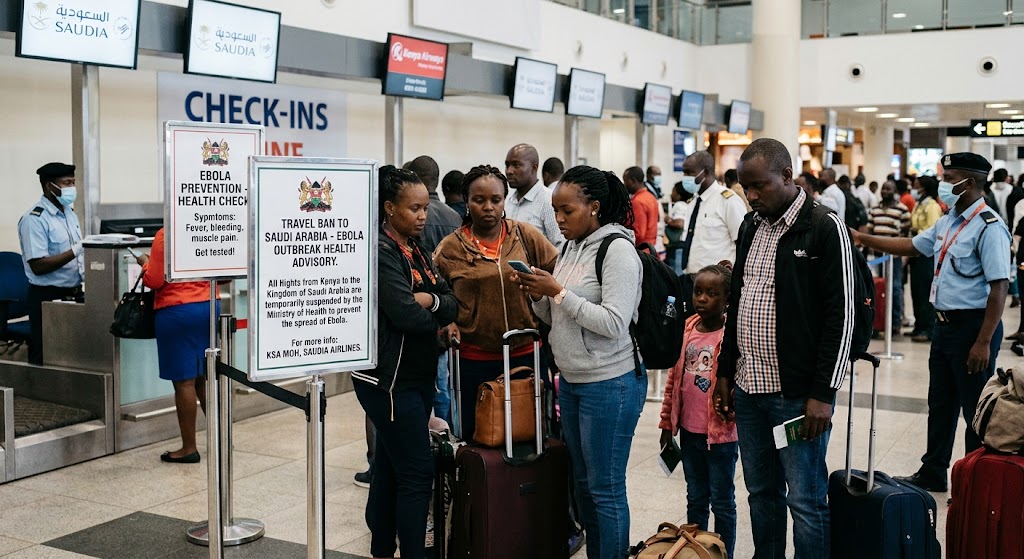
Saudi Arabia on Friday suspended all travel by its citizens to Kenya, halted visa issuance, and imposed a blanket entry ban on travellers arriving from the country, citing concerns over Kenya’s ongoing Bundibugyo Ebola virus disease outbreak, which has claimed two lives and infected nine people since the country confirmed its first imported case on 6 October 2026.
The restrictions, announced by Saudi health authorities through the Saudi Press Agency and confirmed by the Kingdom’s Public Health Authority, Weqaya, apply not only to travellers departing Kenya directly, but also to anyone transiting through third countries who has spent time in Kenya or another Ebola-affected nation within 21 days before arriving in Saudi Arabia. In effect, the ban casts a wide net — one with significant implications for the tens of thousands of Kenyans who work in the Gulf and for the broader relationship between the two countries.
Saudi Arabia has previously introduced similar measures against countries facing Ebola outbreaks, including the Democratic Republic of Congo, Uganda, and South Sudan, suspending travel to those nations in June 2026 when the DRC outbreak was declared a Public Health Emergency of International Concern. Kenya’s inclusion in that list marks a significant escalation in the international response to what began as an outbreak in central Africa and has since crossed borders with troubling ease.
Kenya’s government responded swiftly, with the Ministry of Foreign and Diaspora Affairs dispatching a diplomatic note on 30 October 2026 expressing concern about the Saudi decision and demanding an immediate review of the travel restrictions. The protest reflects both the practical consequences of the ban and the reputational stakes involved. Saudi Arabia is one of the largest destinations for Kenyan migrant workers, and a sustained travel restriction could disrupt livelihoods, remittance flows, and bilateral relations.
The diplomatic friction, however, cannot obscure the reality of what prompted it. Kenya confirmed its first case of the Bundibugyo virus on 6 October 2026 after a Kenyan man who had been living in the Democratic Republic of Congo travelled to Kenya through Uganda. He died on 5 October — the day before the case was formally confirmed — and what followed was a rapid chain of transmission that drew in family members and healthcare workers alike. Three Kenyan health workers subsequently tested positive for Ebola after caring for the index case, a development that alarmed public health officials and underscored both the virus’s lethality and the risks faced by frontline medical staff.
The outbreak involves the rare Bundibugyo strain of Ebola, for which there is no approved vaccine or treatment — a fact that concentrates the mind considerably. Unlike better-studied Ebola strains where vaccine candidates exist, the Bundibugyo variant forces health systems to rely entirely on containment: isolation, contact tracing, quarantine, and the painstaking discipline of breaking every chain of transmission before the virus finds new hosts.
Kenya’s response has, by most measurable indicators, been robust. By 22 October 2026, all 135 contacts linked to the outbreak had been traced — both within Kenya and internationally — with the relevant health authorities formally notified in line with International Health Regulations. The Ministry of Health reported that 709,093 travellers had been screened at points of entry since the response began, with 3,107 screened in a single 24-hour period. The country had also gone several consecutive days without a new confirmed case, and health officials stated there was no evidence of community transmission.
On 26 October 2026, the first 20 contacts of Kenya’s index case were released from quarantine and reunited with their families after completing the mandatory 21-day monitoring period without developing symptoms. It was a moment of quiet but significant relief — proof that the quarantine system was functioning and that containment was possible. “The remaining 98 contacts are expected to be released in four waves beginning 3 November, based on their individual health assessments,” Director-General for Health Patrick Amoth said, though he was careful to add that the outbreak was not yet over.
The appeal not to stigmatise those completing quarantine is not incidental to the response — it is central to it. Communities that fear returning contacts are communities that conceal symptoms, avoid testing, and undermine the very contact tracing systems that contain outbreaks. Health officials have been explicit: people who complete quarantine without symptoms pose no risk to their communities and should be welcomed home. “People who complete quarantine have helped protect their families, their communities and the whole country,” said Dr Neema Rusibamayila Kimambo, WHO Representative to Kenya.
The international dimension of this outbreak was always inevitable. The DRC outbreak, which has been ongoing since May 2026, has killed over 5,000 people, with cases subsequently reported in Kenya, Uganda, and Nigeria — a trajectory that illustrates how quickly a viral outbreak can travel along the same routes that connect economies, families, and communities across borders. The global response, including Saudi Arabia’s travel ban, reflects that reality, however disruptive the restrictions may be for Kenya.
What the Saudi measure also reflects is the asymmetry of global public health: wealthy countries protect themselves first and ask questions later, while outbreak-affected nations bear both the disease burden and the economic penalty of the international response. Kenya has done everything that public health protocols require — transparent case reporting, rapid contact tracing, coordinated quarantine, and consistent communication. It has met the WHO’s 7-1-7 benchmark — detection within seven days, notification within one, and response within seven — and it has achieved quarantine rates above the 85 per cent threshold considered necessary to break transmission chains.
UNICEF is working with the Ministry of Health, the Kenya National Public Health Institute, county authorities, and international partners on the response, and has appealed for US$9.4 million over six months to support rapid containment. The funding appeal is a reminder that good public health requires not just will, but resources — and that the international community’s travel bans should be matched by international support for the countries doing the hardest work.
Kenya’s Ebola response is, by the evidence, a story of a health system that held. Whether Saudi Arabia’s doors reopen as quickly as the data warrants is the question that will define what this outbreak costs the country beyond the hospital wards.
Administrator
We are The Mount Kenya Times. For customer care, 📨 info@mountkenyatimes.co.ke or 📞 +254700161866 For feedback to editorial, 📨 news@mountkenyatimes.co.ke or 📞 +254705215262 or WhatsApp +254714090155
Your email address will not be published.
About the Author