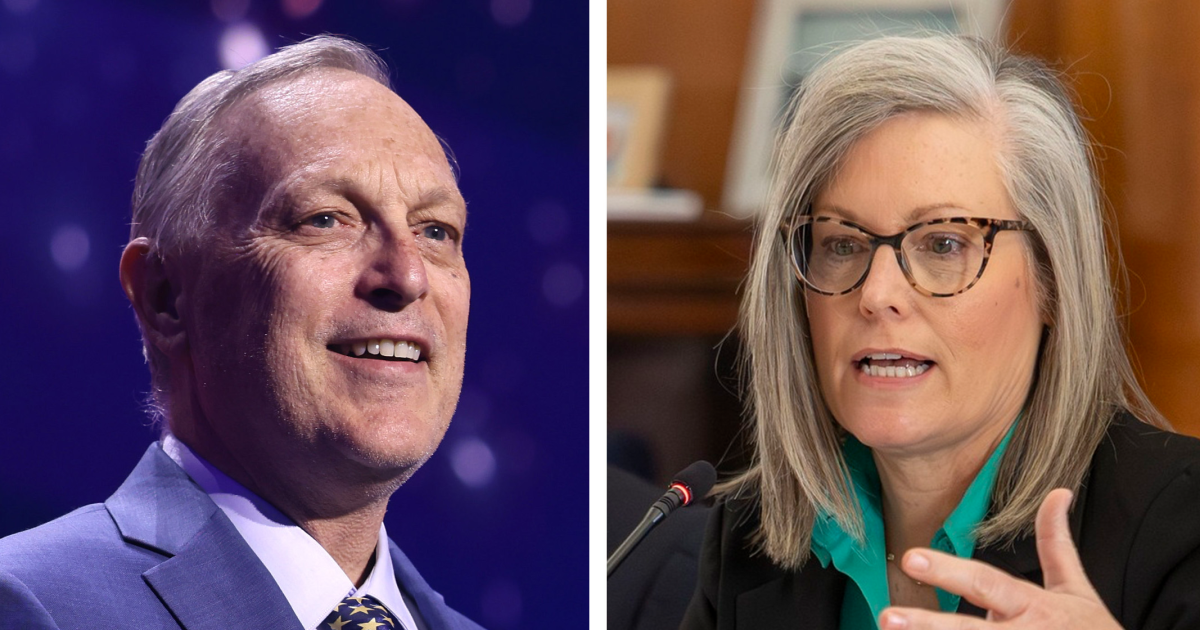
Democrat Katie Hobbs and Republican Andy Biggs have nearly four decades of combined experience in public office, and each candidate for governor has mined their opponents past record as campaign fodder for ads arguing the other is too dangerous to vote for this fall.
After nearly a decade in Congress, and 14 years served in the Arizona Legislature before that, Biggs has a lengthy track record — and the Hobbs campaign has seized on some of those past decisions as it campaigns against him.
For instance, Hobbs is trying to convince Arizona voters that Biggs has a pattern of protecting pedophiles and abusers.
“He blocked a bill that made spousal rape a crime,” said Hobbs, who served alongside Biggs at the Arizona Legislature. “He blocked my bill my bipartisan bill that would have helped end the backlog of untested rape kits in the state. In Congress, he’s continually voted against renewing the violence against women act which has bipartisan support and he voted to not release the Epstein files.”
Biggs was one of two Republicans on the House Oversight Committee who voted against a motion to subpoena the U.S. Department of Justice to release the files last July.
He did later vote in favor of releasing the files last November.
It’s also true that in the state Legislature, Biggs stymied bills that would have required criminal justice agencies to report the number of untested sexual assault kits they had and would have made the penalty for spousal rape on par with the penalty for any other rape.
But the Hobbs campaign’s most persistent attack focuses on Biggs decision 13 years ago to impede legislation that would have allowed the Mohave County Sheriff’s Office to take over a police force in Colorado City.
Lawmakers at the time were concerned the police force was turning a blind eye to a fundamentalist polygamous group there, run by Warren Jeffs, who is currently serving a life sentence for the sexual assault of child brides.
“His own Republicans said he had the chance to stop the abuse of children in Colorado City but did nothing. … If he didn’t care then when he was really important what makes any of us believe that he’s going to care now?” according to an ad run by the Hobbs campaign that quotes Elissa Wall, a survivor of Jeffs’ group.
The Republican-sponsored bill passed out of the state House of Representatives with close to unanimous, bipartisan support. As Senate president, Biggs assigned the bill to multiple committees.
The bill failed to pass in the Senate.
At the time, the bill’s sponsors blamed Biggs for effectively killing the legislation. So does Hobbs.
“It was blocked because Andy Biggs, as Senate president, blocked it. Women and children had to suffer three years longer than they otherwise would have,” she said.
In an interview with AZ Family on Oct. 5, Biggs said the state was trying to get more information on how friendly the Colorado City police force was with Jeffs’ group.
“What I was concerned about is did we have enough as a state to step in as a state Legislature and decertify?” he said. “And was it being done by people with a political agenda? I don’t know.”
Biggs called the allegations “a pack of crappy lies,” and accused the Hobbs campaign of encouraging violence against him via the attack ads — something the governor’s campaign denies.
More recently, Hobbs’ campaign has attacked Biggs for featuring the endorsement of former Congressman Matt Gaetz, who was sued by two unnamed women who accuse him of engaging in a sex trafficking scheme. Gaetz denies the allegations.
Hobbs is also highlighting Biggs’ record of going after Medicaid.
Biggs tried to abolish Arizona’s Medicaid program when he served as a state senator in 2011 — in an effort to curb government spending, he said.
Biggs acknowledged in a committee hearing at the time that his proposal would be a quote “bitter pill to swallow,” but said there are too many people on Medicaid in Arizona for the system to be sustainable.
“When we allow the generations in the future to be robbed and enslaved to pay for the healthcare costs of people today we’re not being good stewards,” Biggs told his colleagues.
Two years later, Democrats and a handful of Republicans worked together to circumvent Biggs and other legislative Republicans when he was the Senate president to get Medicaid expansion passed.
Biggs then participated in a lawsuit to try and reverse Medicaid expansion, which made the program eligible for people making a bit more than poverty level.
Expanding Medicaid also got the state billions of federal dollars.
In 2025, Biggs voted in favor of the so-called “One Big Beautiful Bill” which added new work requirements to Medicaid, required more frequent eligibility checks, and decreased federal spending on the program. That legislation is expected to kick a few hundred thousand Arizonans off of the health insurance program starting at the end of this year.
Republicans and the Biggs campaign are also attacking Hobbs for her record, or lack thereof, as governor.
She has spent her term working alongside the Republican-controlled House and Senate, which has led to some bipartisan compromises, like four state budgets that received Republican and Democratic votes.
“We’ve shown over and over again that we can work together and get things done for Arizonans,” she told KJZZ after the end of the most recent legislative session.
But that split government also led to partisan gridlock that blocked most of the agenda Hobbs laid out when she entered office, like scaling back the state school voucher program. Hobbs, in turn, vetoed 541 bills sent to her by the Legislature — more than any governor in Arizona history.
Republicans call Hobbs the veto queen and say it’s proof she can’t work across the aisle.
“Border security, vetoed. No tax on tips, vetoed. Even lower grocery prices, vetoed,” according to an ad run by the conservative Turning Point PAC, which is backing Biggs. “Eighty eight of them in one day. Katie Hobbs didn’t govern Arizona, she blocked it. 541 times.”
Hobbs isn’t hiding from those vetoes, saying she blocked bills that were unpopular with Arizonans.
“I’ve been the backstop to a lot of things that would infringe on people’s rights, right to vote, reproductive healthcare access, even though Arizonans have spoken overwhelmingly that they want to protect that,” Hobbs said. “The Legislature is still not acting in their interest there.”
But Republicans say it’s not just the vetoes.
They argue Hobbs simply hasn’t accomplished much during her time in office, and they accuse her of co-opting GOP policy wins to trick voters.
They point to the broad tax cut package President Donald Trump pushed through Congress last year, which was eventually adopted at the state level by Hobbs and Arizona lawmakers.
But the decision to adopt those cuts, also called tax conformity, did not happen until June, well after the tax filing deadline, due to a monthslong fight between Hobbs and Democrats. That resulted in confusion for Arizona taxpayers.
Republicans immediately called for Arizona to adopt the cuts well ahead of the deadline, but Hobbs vetoed their bills three times before eventually agreeing to an essentially identical tax cut package in June.
Now she’s using that compromise on the campaign trail to tout some of those new cuts, like no tax on tips or overtime.
“She said that she actually eliminated, or created, no tax on tips. Untrue. She vetoed that three times,” Biggs said during a mock debate hosted by his campaign.
Hobbs argued she long backed the parts of the tax cut package that she believed benefited middle class and working families, but she did not address the Republican criticism that she’s essentially taking credit for GOP policies that she initially blocked.
“I proposed the middle class portion back in November,” she said, referring to her failed plan to only adopt parts of the Trump tax cuts. “I urged the Legislature to get it to me first thing. We worked together to get this done and deliver them for Arizonans.”
Which version of Hobbs voters buy into — the veto queen or the compromiser in chief — could determine who sits in the governor’s office next year.
About the Author