
Saturday October 10, 2026
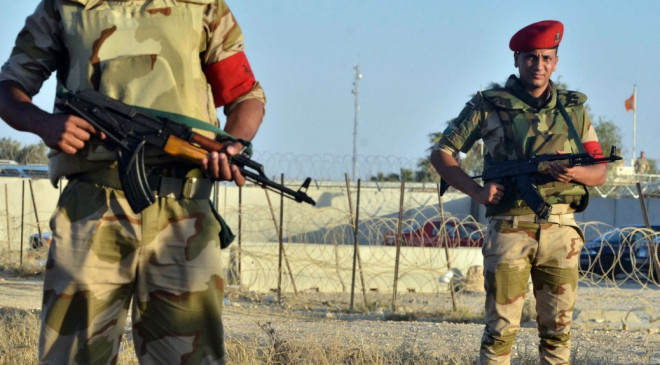
Egyptian military presence in Somalia is part of larger moves, highlighting Cairo’s efforts to militarily and strategically reposition itself in the Horn of Africa. [Getty]
Technical military teams from Egypt, including advisors, trainers and officers, are reportedly busy preparing for the deployment of army troops to Somalia, the first such move in the Horn of Africa nation, since the signing of a joint military cooperation agreement between the two sides in 2024.
The troop deployment will expectedly come in light of bilateral security and military cooperation between the two countries and within the African Union Mission, widely known as AUSSOM.
Egypt has not released any information about the size of the contingent it would deploy within the mission or within bilateral security and military cooperation with Somalia.
The Egyptian troops will reportedly be positioned in the Ceelcade region which used to house the Cisiley Airfield on the immediate northern outskirts of Mogadishu, within the Middle Shabelle region—in the low-lying semi-arid coastal hinterland just north of the Banaadir administrative boundary, around 400 kilometres from the nearest point to Ethiopia’s shared border with Somalia.
The deployment of Egyptian troops to Somalia would advance military and security cooperation with Mogadishu at an important time, Somali political analysts said.
“I believe this is particularly so given the security challenges facing Somalia and the turbulent situation in the Horn of Africa as a whole,” Somali political analyst and African affairs specialist Hassan Muhammad said.
Speaking to The New Arab, Muhammad expressed hopes that the deployment of Egyptian troops would contribute to strengthening the capacities of Somali security and military institutions and boost stability in the country.
“The success of this cooperation will, however, depend on the presence of clear goals, full coordination with Somali institutions and respect for Somalia’s sovereignty and national interests,” he added.
Horn of Africa, at a critical moment
An Egyptian military delegation visited the Somali capital on 20 September and met Somali Defence Minister Ahmed Moallim Fiqi, five days after Egyptian officers met senior Somali commanders in Mogadishu to discuss defence cooperation, military training and capacity-building for the Somali National Army.
Such meetings come as Egypt steps up cooperation with Somalia, following the 2025 elevation of relations between the two countries to a strategic partnership.
Egypt has pledged to offer support to Somalia, repeatedly underscoring the importance of preserving its territorial integrity and preventing foreign meddling in its affairs.
The Horn of Africa nation took centre stage in discussions between Egyptian President Abdel Fattah al-Sisi and visiting CIA Director John Ratcliffe late last month.
Between October 2024 and October 2026, Sisi hosted Somali President Hassan Sheikh Mohamud five times in Egypt, the last time being on 3 October in the northern Mediterranean city of Alamein.
On the following day, Cairo hosted a quadrilateral Egyptian-Somali-Eritrean-Sudanese summit, in which the leaders of the four African countries called for respecting state sovereignty and territorial integrity and expressed opposition to foreign meddling in their countries’ internal affairs.
These encounters and messages, Egyptian analysts argue, point to Egypt’s determination to keep offering support to Somalia at a testing time.
“Egypt wants to help Somalia protect its territorial waters, fend off internal and external threats, such as terrorism and piracy, and prevent foreign meddling in its affairs,” Egyptian security expert, Lt. Gen. Khaled Okasha told TNA.
He described Somalia as Egypt’s “strategic depth”, given interconnections between stability in this Horn of Africa country and the Red Sea, the Bab al-Mandeb Strait and the southern entrance to the Suez Canal.
“Somalia’s disintegration would threaten Red Sea and Suez Canal navigation,” Lt. Gen. Okasha added, warning that such a scenario would harm other regional states and simultaneously bleed the international economy.
Strategic ‘repositioning’
When they land in Somalia, Egyptian troops will be in the middle of a severely hostile environment, given the intensity of the terrorist threat in the Horn of Africa country where the Al-Qaeda-linked al-Shabaab movement vies for control over territory with the federal government.
Muhammad, the Somali analyst, referred to public support of Egyptian troop presence in Somalia, but said al-Shabaab was still capable of staging painful attacks against government troops and civilians, despite all the security and military measures taken by the government.
“The movement constitutes one of the most outstanding security challenges facing the government now,” Muhammad said.
“The fight against the movement requires concerted military efforts, which have to move hand in hand with addressing the political, economic and social problems that negatively affect Somalia’s stability,” he added.
The expected Egyptian troop deployment occurs while there is a regional military build-up on the Somali coast, especially from Israel which is gaining a military foothold on the coast of the breakaway Somali region of Somaliland after recognizing it late last year.
Moreover, there is major tension between Egypt and Ethiopia and Ethiopia’s civil war, pitting the federal government against seven rebel groups in the northern part of the country, is widening in scope.
Cairo and Addis Ababa are locked in a high-voltage conflict over Ethiopia’s operation of the Grand Ethiopian Renaissance Dam (GERD), the Horn of Africa country’s multibillion dollar hydroelectric project on the Blue Nile, the main tributary of the Nile River which is Egypt’s principal source of fresh water, and Ethiopia’s plans to construct additional dams on the Nile.
On 5 October, Sisi said his country would not abdicate a drop of its annual share of the water of the Nile River.
“This share is a firmly established historical and legal right that can neither be reduced or infringement upon,” Sisi said.
In a televised address on the occasion of the 53rd anniversary of his country’s October war victory of 1973 against Israel, he described this right as a “redline” that could not be crossed.
The two countries are also at odds over Ethiopia’s quest for Red Sea access, something vehemently opposed by Egypt which is wary of Ethiopian military presence on such a crucial maritime chokepoint which leads to the Suez Canal in the north.
Egyptian military presence in Somalia is part of larger moves, highlighting Cairo’s efforts to militarily and strategically reposition itself in the Horn of Africa to protect its vial national security interests, Egyptian analysts said.
It is also part of Egyptian activity in the region, one that has so far also included—apart from the military side—enhanced economic cooperation with regional states, especially Eritrea, Uganda and Kenya.
“Egypt needs this military presence in the Horn of Africa to protect its national security interests and repel threats to this security,” Egyptian political science professor Ayman Shabana told TNA.
By deploying troops in the region, he added, Egypt could also offer support to allied countries, such as Somalia and Eritrea which face growing threats and are expected to be at the forefront of effects from the current civil war in Ethiopia.
“Egyptian military presence also sends a clear message to regional parties that they need to think twice before harming Egyptian interests,” Shabana added.
About the Author