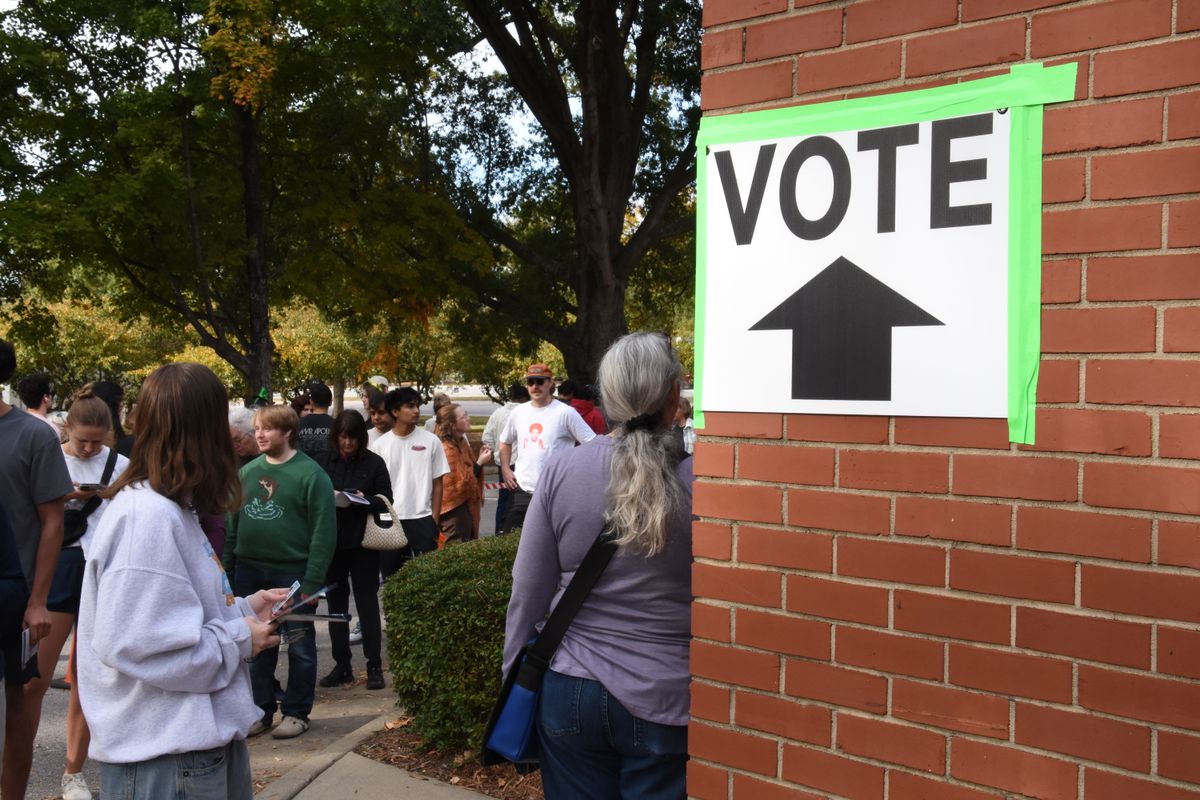
North Carolinians flocked to early voting sites in record numbers ahead of the Nov. 3 election — turnout driven in large part by Democrats and unaffiliated voters who weighed in on constitutional amendments and picked candidates for U.S. Congress, the state legislature, courts and local offices.
Early voting ended Saturday. The next opportunity for voters to cast a ballot in person is on Election Day, which is Tuesday Nov. 3. Polls on that day will be open from 6:30 a.m. to 7:30 p.m. Voters are assigned precincts for Election Day voting. Precincts and sample ballots can be found using the state’s voter search tool online.
Other WRAL Top Stories
Earlier this week, North Carolinians broke the state record for most ballots cast during early voting in a midterm election. Through Friday, about 33% of eligible North Carolina voters had cast a ballot either by mail or in person at an early voting site. Democratic and unaffiliated voters cast about three-quarters of the 2.6 million ballots as of Friday, according to the most up-to-date state data. Almost 311,000 of those votes came from Wake County, where 36% of eligible voters had already cast a ballot through Friday.
Early-voting sites closed at 3 p.m. Saturday. The final day of early voting is typically among the busiest. Turnout data for Saturday is expected to be released Sunday, providing a more complete picture of early-voting turnout in the state.
Additional mail-in ballots are expected to trickle in before polls close Tuesday. Voters who already received an absentee mail-in ballot can still return it to their county elections board or by mail. State elections officials have encouraged mail-in voters to hand deliver their ballots at this stage in the election since there’s no guarantee they will be delivered in time by mail. Those voters have until 7:30 p.m. Tuesday to deliver their mail-in ballots to their county elections board office.
A relatively new state law eliminated the post-election grace period for ballots to still be counted if they arrived a few days late, as long as they were postmarked on or before Election Day. Now, any ballots that arrive after polls close at 7:30 p.m. Tuesday will be thrown out, no matter when they were put in the mail. Voters can track the progress of their mail-in ballots through the state’s BallotTrax system.
Voters who have received mail-in ballots — but not submitted them — can still change their minds if they want to vote in person instead. Those voters can ask elections officials to cancel their mail-in ballot and vote at their precinct, as long as they don’t vote twice.
With the close of early voting Saturday, the window to register to vote or make changes also closed for most voters. The only exception is for people who only become eligible to vote in those few days between the end of early voting and Election Day, such as newly naturalized citizens or felons who have completed their sentences and regained their rights. But for anyone else — including those who need to register for the first time and those who need to update their registration — Saturday was the last chance this election cycle.
Candidates make final push
The early turnout figures bode well for Democrats who are trying to gain power in the U.S. Senate, the U.S House of Representatives and both chambers of the general election, political analysts say, noting that Democrats and independent voters have blamed Republican policies on elevated inflation.
Many voters blame Republican President Donald Trump and his political supporters for what they perceive as worse economic conditions and outlook, polls show. And while Trump isn’t on the ballot this year, his low approval rating has put pressure on Republicans who are running this year.
Recent polls show Democrat Roy Cooper with as much as a 14-point lead over Trump-endorsed Republican Michael Whatley in the race for North Carolina’s open U.S. Senate race. But analysts and the campaigns expect the vote count to reflect a closer race. And the early-voting numbers are expected to be countered by Republican turnout on Election Day. Republicans tend to vote in person on Election Day in higher percentages than Democrats.
Green Party candidate Michael Dublin and Libertarian Shannon Bray are also seeking the seat, which could help determine party control of the U.S. Senate for the final two years of Trump’s time in office, and possibly beyond.
Trump has in recent days has acknowledged that Cooper is the favorite. “He’s going to become your senator, and it’s crazy,” Trump said of Cooper during a rally in Greenville last week.
Nevertheless, Cooper and Whatley have spent the past few days making their closing arguments to voters at campaign stops across North Carolina.
Whatley held events in Wake, Robeson, New Hanover counties on Friday and Saturday. He also visited Nash County, where Cooper grew up.
“It’s not just going to matter for us here in North Carolina,” Whatley told voters in Lumberton Friday. “It’s going to matter for the entire country. … When we look at the map, we know I am very likely to be the 51st Republican senator. Or, Roy Cooper could be the 51st Democratic senator.”
Republicans hold 53 of the 100 U.S. Senate seats so Democrats would need to flip four seats nationwide to retake the majority. Trump’s falling poll numbers — as well as rising enthusiasm among liberal voters, or moderates frustrated with the Iran war and the state of the economy — have given Democrats hope they can flip red seats blue in states like North Carolina, Maine, Texas, Alaska or others. Many traditional battleground states don’t have Senate elections this year, so Democrats will need to win in more conservative areas to have a chance.
Trump won North Carolina all three times he ran for president, but voters also elected Cooper as governor in two of those years. Cooper has leaned heavily into his moderate image on the campaign trail, promising to take on corruption and affordability issues if elected. On Friday, he took aim at Trump’s decision to wage war in Iran and to raise tariffs on some countries — moves that many economists blame for higher consumer costs.
“If Congress just takes back its constitutional authority, we can roll back those tariffs,” Cooper said Friday at a rally in Smithfield. “We need to find a way to end this war in Iran.”
About the Author