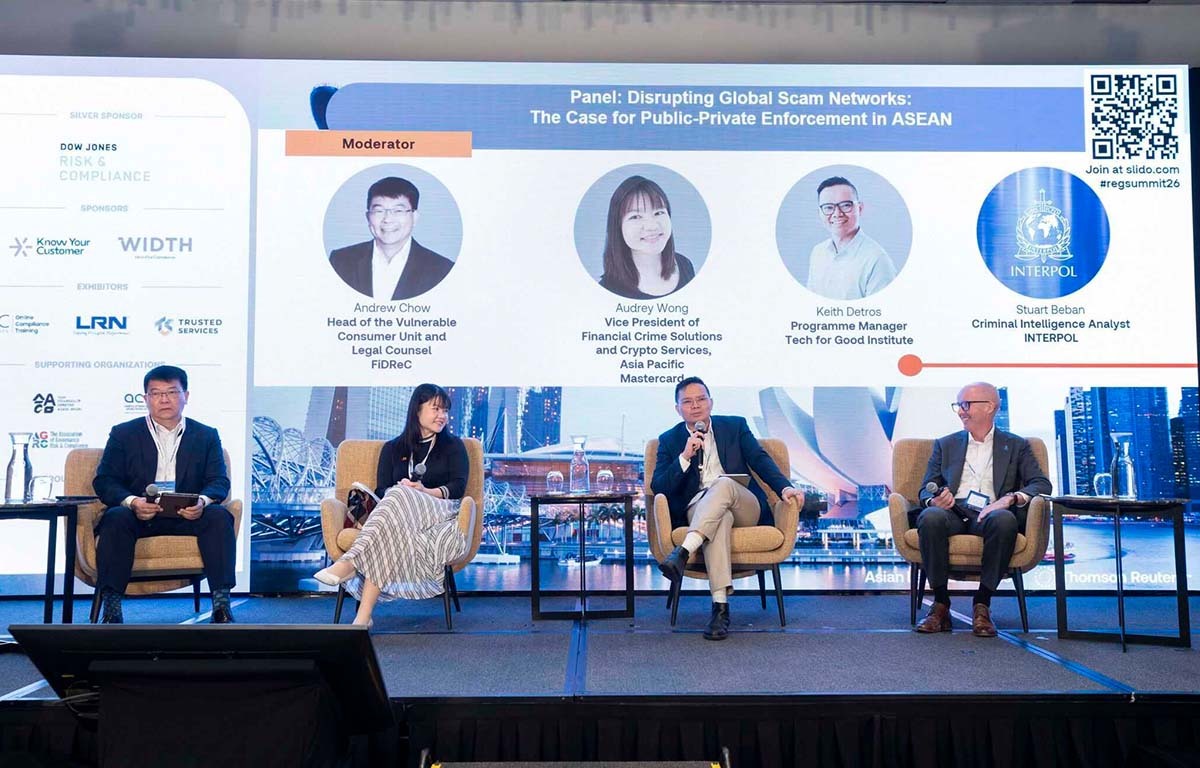
The increase in speed, scale, and sophistication of scams is evident in the region. As technology and new techniques emerge to stop a scam, scammers adapt just as quickly. Scam tactics also evolve as governments and law enforcement agencies continue to innovate how to keep the digital spaces safe. This nature of the challenge of the scams in the region makes it a wicked problem.
To help adapt to the evolving scam landscape, Singapore recently enacted the Scams (Countermeasures) and Other Matters Act 2026, which grants the police expanded enforcement capabilities and introduces new legal implications, such as specific offences for online account mules. However, despite the enactment of this domestic legislation, various challenges remain in disrupting transnational scam syndicates.
Amid this backdrop, the panel examined the current measures designed to safeguard users before a scam occurs, as well as efforts to assist with post-scam recovery from a cross-border perspective.
1. Scams prey on human instincts, relying more on personal manipulation than on technical deception.
In Southeast Asia, a notable confidence-skills gap exists—the discrepancy between an individual’s perceived and actual ability to identify scams. In an upcoming report by the Institute, slightly less than half of respondents expressed confidence in their ability to detect scams when evaluated using scam imagery, despite performing well on objective identification tests. This gap indicates that people in the region feel underprepared to combat fraud due to the increasing speed, scale, and sophistication that make modern scams so convincing. These technical advances are compounded by deceptive tactics that deliberately exploit human emotions such as greed, lust, and fear.
On the other hand, this mindset can make people overly confident. This is a classic example of the Dunning-Kruger effect, where individuals are unaware of what they do not know. Even as scams become more complex, overconfident people assume they will never fall for them. This creates blind spots that scammers easily exploit. In the end, those who cannot bridge this gap in awareness are the most at risk.
To combat these tactics, financial institutions and digital platforms must step in. Extra protection is critical when victims are manipulated and cannot think clearly. Automated checks on user behavior help spot warning signs early. By carefully checking details like payment timing, amounts, and recipients, platforms can block fraudulent transactions before money is lost.
2. While technology is employed by bad actors to improve the speed, scale, and sophistication of scams, tech-enabled solutions can also prevent them.
The newly introduced National Scam List (NSL) highlights the Singapore government’s proactiveness in steering the anti-scam response, moving beyond publishing whitepapers to tackle this problem. Realised through a partnership between the Home Team Science and Technology Agency (HTX) and the Singapore Police Force (SPF), this platform shares data pertaining to fraudulent accounts with banks in real-time. This empowers institutions to take a preemptive approach. Integrating confirmed fraud signals into a centralised national platform allows institutions to immediately identify the behavioural patterns of scam syndicates. Beyond national initiatives, Interpol has also launched the Silver Notice, a platform that allows member countries to crowdsource intelligence and target criminal assets accumulated by organised networks. Once an initial fraudulent transaction is flagged, subsequent transactions across the entire ecosystem can be stopped.
Implementing data-sharing initiatives remains challenging due to the need to balance information flow with user privacy. Clarifying legal terminology is equally critical: across Southeast Asia, the terms ‘scam’ and ‘fraud’ are often used interchangeably, and varying legal definitions across jurisdictions complicate cross-border data exchange. Consequently, data sharing is only part of the solution; harmonising legal frameworks and enhancing cross-border cooperation are essential. Ultimately, technology must be paired with clear privacy safeguards and standardised definitions to serve as an effective defence against scams.
3. Transnational enforcement faces significant challenges when scam proceeds move across international borders within minutes.
In practice, illicit funds often leave the primary jurisdiction within minutes. These proceeds are typically routed through domestic mule accounts, cryptocurrency networks, and overseas transactions before reaching their destination. Because victims may take time to realise funds have been moved, cross-border recovery becomes increasingly challenging. Consequently, swift enforcement relies heavily on timely crime reporting, allowing international partner agencies like Interpol to rapidly issue alerts to specialised law enforcement units and initiate recovery procedures where possible.
Additionally, scam syndicates are increasingly moving away from large, centralised operations toward smaller, distributed micro-scam hubs. These hubs often leverage existing infrastructure, accessible visa policies, and gaps in local cybercrime enforcement capacity. When detected, authorities may prioritise administrative measures like deportation over complex cross-border prosecutions—an outcome syndicates often absorb as a routine operational cost. To address this sustainably, enforcement strategies can focus on local facilitators who assist with setup and shell company formation, disrupting the operational foundation of these networks. At the same time, targeting specialized technical roles within these groups helps disrupt their core capabilities, making it more difficult for syndicates to re-establish operations elsewhere.
Share this engagement
Explore further
Charting ASEAN Frameworks on Emerging Issues around Online Safety
Building Cyber Resilience: The Growing Necessity for Online Safety
Advancing Digital Reform Through Public-Private Collaboration in ASEAN
How is Tech for Good Institute enabling digital economy and society in Southeast Asia?
3 Media Close
Singapore 138498
Republic of Singapore
All rights reserved. © 2026 Tech For Good Institute
Never miss an update or event!
Programme Fellow
Mouna Aouri is an Institute Fellow at the Tech For Good Institute. As a social entrepreneur, impact investor, and engineer, her experience spans over two decades in the MENA region, South East Asia, and Japan. She is founder of Woomentum, a Singapore-based platform dedicated to supporting women entrepreneurs in APAC through skill development and access to growth capital through strategic collaborations with corporate entities, investors and government partners.
Senior Fellow & Founding Executive Director
Dr Ming Tan is Senior Fellow at the Tech for Good Institute; where she served as founding Executive Director of the non-profit focused on research and policy at the intersection of technology, society and the economy in Southeast Asia. She is concurrently a Senior Fellow at and the Centre for Governance and Sustainability at the National University of Singapore and Advisor to the Founder of the COMO Group, a Singaporean portfolio of lifestyle companies operating in 15 countries worldwide. Ming was previously Managing Director of IPOS International, part of the Intellectual Property Office of Singapore. Prior to joining the public sector, she was Head of Stewardship of the COMO Group.
Ming also serves on the boards of several private companies, Singapore’s National Volunteer and Philanthropy Centre, Singapore Network Information Centre (SGNIC), and on the Digital and Technology Advisory Panel for Esplanade–Theatres on the Bay, Singapore’s national performing arts centre. Her current portfolio spans philanthropy, social impact, sustainability and innovation.
About the Author