e-Edition
Get the latest news delivered daily!
Get the latest news delivered daily!
e-Edition
Trending:
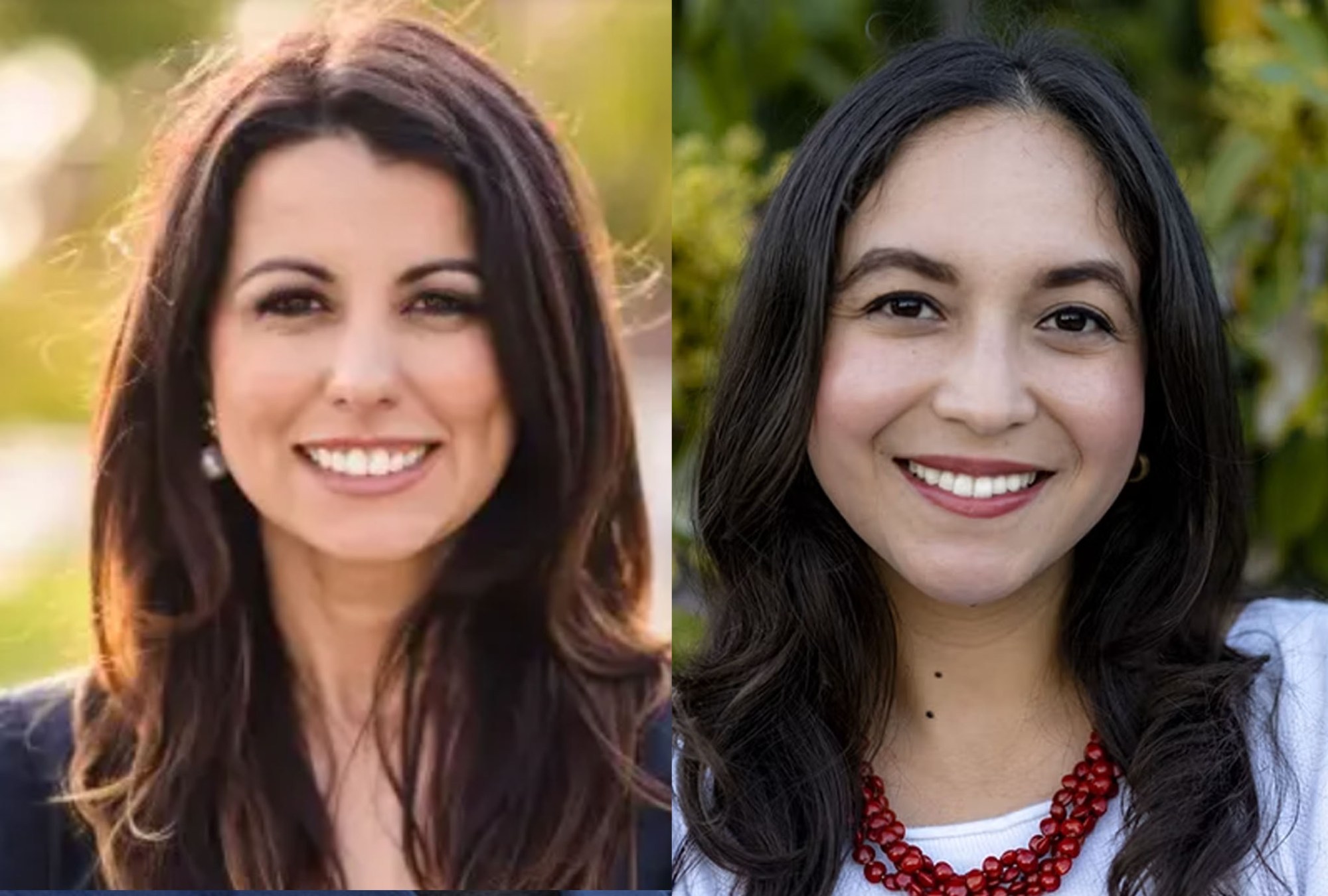
It’s the battle of the Sara(h)s in California’s Senate District 26.
Affordable housing advocate and Los Angeles Community College District Board President Sara Hernandez is going toe-to-toe with environmental advocate Sarah Rascón to see who will succeed Sen. María Elena Durazo in the California Legislature. (Durazo ran for, and won, a seat on the L.A. County Board of Supervisors instead of seeking reelection this year.)
The 26th Senate District represents L.A.’s Eagle Rock and Highland Park neighborhoods in the north, Los Feliz and Koreatown in the west, and Boyle Heights, East L.A. and the city of Vernon in the southeastern part of the district.
SD-26 is one of just two L.A. County state Senate races — the other being SD-24 — where both candidates on the Nov. 3 ballot are Democrats.
They’re also the only two Senate races in which the California Democratic Party did not endorse a candidate because the members of its endorsement caucus could not reach consensus.
And they’re among some of the more expensive legislative races in L.A. County this general election.
Before we dive into the money aspect, first we take a look at the candidates’ positions on various issues, based on their written responses to a set of questions posed by the Southern California News Group.
Hernandez, 43, and Rascón, 36, hold similar positions on matters ranging from how to address the state’s housing crisis and manage fuel costs and food prices to the operation of data centers and whether the state should continue funding its high-speed rail project.
Both support some form of a first-time homebuyer support program, building more housing near public transit and jobs, and, in certain cases, streamlining project approvals to accelerate housing development. They also agree there should be stronger tenant protections for renters to prevent homelessness.
To keep gas prices affordable, both stressed the need for greater oversight of fuel companies and penalizing those that price gouge.
And to help residents who struggle to pay for groceries, both suggested some sort of expansion of CalFresh, California’s food stamp program.
When it comes to data centers, Rascón said such facilities don’t belong in residential backyards.
In addition, Rascón would mandate that large, new electricity users “bring new clean power online rather than simply drawing from an already-strained grid.”
“They also need to meet strict water-use limits by prioritizing recycled or non-potable water to avoid competing with local drinking supplies, especially in a drought-prone state,” she said.
Hernandez said lawmakers should “carefully assess” data centers proposed near homes, schools or environmentally burdened communities. Developers should show how they will minimize impact and should pay all costs for grid connections and necessary upgrades “while providing community benefits that strengthen local water and energy infrastructure,” she said.
“Families and small businesses should not face higher utility bills — or be left paying for stranded infrastructure — because of speculative private projects,” she said.
Both candidates also support continued funding of California’s high-speed rail project — at least enough to complete the Central Valley segment that’s already under construction, if not more. The controversial project has been long delayed and hampered by exorbitant cost overruns.
“We cannot have an unfinished product that would deliver no benefit to taxpayers at all,” said Rascón.
At the same time, Rascón said taxpayers deserve results and proposed a phased-in approach to construction “that delivers usable segments as early as possible” with clear milestones and cost controls.
“We must seek to connect the entire state, and rail offers the needed investment and an alternative to jet fuel and flights,” Rascón said.
Hernandez also supports completing the project, but said the state should focus on finishing the Merced-to-Bakersfield segment first and getting trains into service. Future phases should depend on costs, enforceable deadlines, independent oversight and a complete funding plan, she said.
In addition to government funding, she suggested pursuing private investments under agreeable terms.
“Mobility is a civil rights issue: Access to jobs, education, and opportunity depends on safe, reliable transportation,” Hernandez said. “A functioning high-speed rail system would connect regions, reduce pressure on highways and airports, and give Californians another way to travel without a car.”
To read the candidates’ full responses on these and other issues – including healthcare, transition from fossil fuel and offshore drilling – visit our online voter guide, dailynews.com/voter-guide.
Since June 3, the day after the primary election, Hernandez has raised more than $635,000 – about 3.5 times the nearly $181,000 that Rascón raised during the same period, according to the latest campaign finance figures available on the California secretary of state’s website on Friday, Oct. 16.
But that’s not all. Outside groups have spent heavily in this race — and overwhelmingly in Hernandez’s favor.
Since the primary election, these “independent expenditure” groups – which can’t coordinate with the campaigns but may spend unlimited amounts of money – have poured more than $4.45 million into ads, mailers and other expenses to support Hernandez or oppose her rival.
Only about $150,000 had been spent by IE groups in support of Rascón in the meantime, with no IE spending reported in opposition to Hernandez.
Some of the biggest outside spenders in support of Hernandez include Grow California, a group associated with billionaires in the tech and crypto industries, and Keep California Golden, a coalition representing Realtors, the building industry and farmers and ranchers. Other IE groups sponsored by a nurses association, charter school advocates, housing providers and Hawaiian Gardens Casino have also spent money benefiting Hernandez.
Meanwhile, California Working Families Party and Courage California, two progressive groups, have made independent expenditures in support of Rascón. A group sponsored by environmentalists and another one representing small businesses also spent money to benefit her, while a group representing housing providers spent money to oppose Rascón.
Despite the heavy spending against her, Rascón, in an interview, said the race is far from over.
“Our communities are smart, and they do their research. They read the disclaimers as to who is paying for this effort – who is paying to push our opponent or to oppose us,” said Rascón, adding that as someone born and raised in the district, she has “lived experience” in the community.
“That’s something they (outside groups) cannot buy,” she said.
Hernandez, meanwhile, has lived in the district for the past two decades and has been a resident of Koreatown, Downtown L.A., Boyle Heights and now Eagle Rock, she said.
In a separate interview, Hernandez said she can’t control activities by outside groups, and although many of the independent expenditure groups that have poured money into this race have presumably benefited her, “it doesn’t necessarily help candidates all the time” and can actually “backfire.”
Hernandez said she’s had many conversations with voters in which she’s forced to explain that her own campaign isn’t accepting money from certain special interest groups – which she said is confusing for voters because they see advertisements funded by such outside groups and have trouble making the distinction.
The experience has reaffirmed her belief that there should be campaign finance reforms to address the role of corporate and dark money in elections, said Hernandez, adding that her campaign won’t accept donations from oil, utility, law enforcement or big tech companies.
“We did not solicit this money. We did not ask for this money,” she said about spending by outside groups.
At the same time, Hernandez – while acknowledging the critical role money plays in helping a campaign get its message out to voters – said it takes more than just money to win an election.
She’s proud, she said, that her campaign, mainly through the work of volunteers, has knocked on over 60,000 doors in the district and held over 50 community meet-and-greets and otherwise “doing the really hard work” of organizing the community.
Rascón, meanwhile, said she’s proud that she’s been endorsed by Durazo, the current officeholder for the 24th Senate District, as well as by two others who also ran for this seat during the primary election: former Assemblymember Wendy Carrillo and Silver Lake Neighborhood Councilmember Maebe Pudlo.
In the primary election, Hernandez was the top vote-getter with 31.2% of the vote while Rascón received 19.4%. Carrillo and Pudlo came in third and fourth, with 13.7% and 13% of the vote, respectively.
Rascón is also endorsed by some of the more progressive L.A. city officials, including City Controller Kenneth Mejia and Councilmembers Eunisses Hernandez and Ysabel Jurado.
For her part, Hernandez lists endorsements by Assembly Speaker Robert Rivas and eight current state senators. L.A. County Supervisors Janice Hahn and Hilda Solis and L.A. City Councilmembers Adrin Nazarian and Tim McOsker also support her candidacy.
Voting for the general election is underway and will continue through Nov. 3.
Monday, Oct. 19, is the last day to register to vote.
Copyright 2026 Daily News. All rights reserved. The use of any content on this website for the purpose of training artificial intelligence systems, algorithms, machine learning models, text and data mining, or similar use is strictly prohibited without explicit written consent.
About the Author