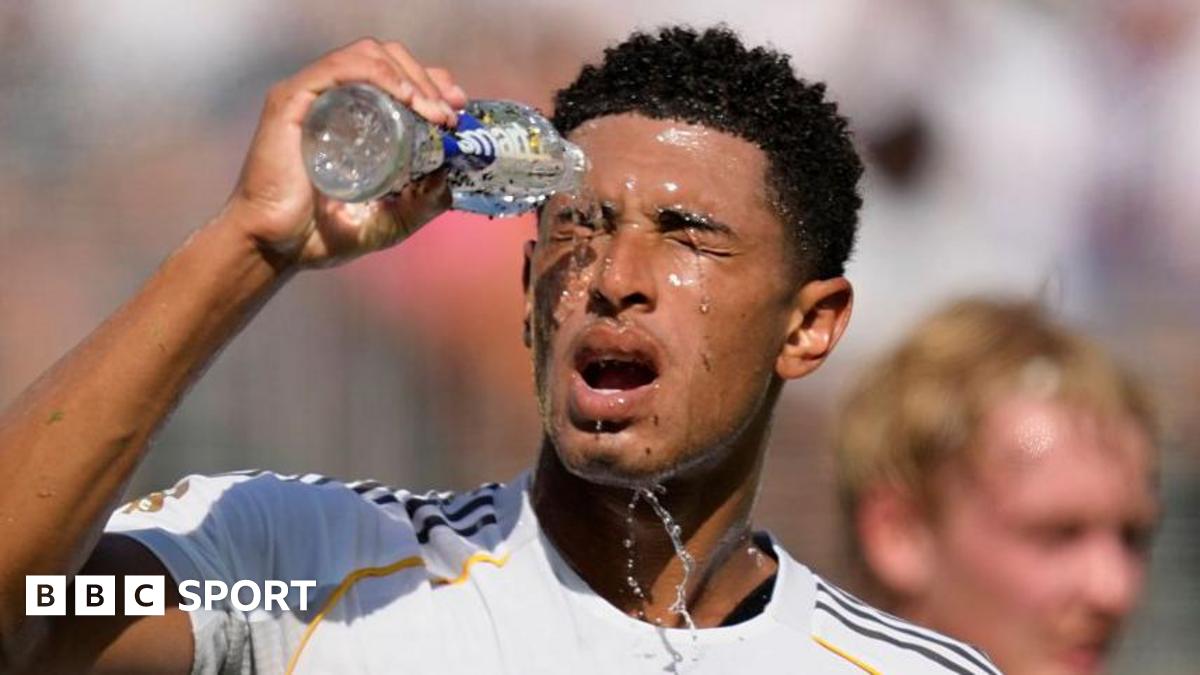
Hot conditions at the 2025 Club World Cup in the United States tested the players
A group of world-leading scientists have warned Fifa its current heat safety measures for the men's 2026 World Cup are "inadequate" and could put players at risk of serious harm.
In an open letter, external, international experts in health, climate and sports performance say the governing body's guidelines are out of step with the current science and "impossible to justify". They call on Fifa to introduce stronger protections, including longer cooling breaks and clearer protocols for delaying or postponing games in extreme conditions.
Heat is expected to be an issue at this summer's tournament in the United States, Canada and Mexico, with researchers warning temperatures at 14 of the 16 stadiums being used could exceed dangerous levels.
In parts of the southern US and northern Mexico, average daytime highs are typically in the low to mid-30Cs and can rise towards 40C during hotter spells.
When temperature, humidity, wind speeds and the strength of the sunshine are factored in, players in these World Cup host cities are at greatest risk of experiencing extreme levels of heat stress on the body.
Fifa says it is "committed to protecting the health and safety of players, referees, fans, volunteers and staff" and that climate-related risks are assessed as part of tournament planning.
How could extreme weather affect World Cup 2026?
As part of its "commitment to player welfare", Fifa has introduced mandatory three-minute cooling breaks in each half of every match for the tournament, regardless of weather conditions.
There will be climate-controlled benches for technical staff and substitutes at all outdoor matches.
Fifa also uses the gold-standard heat measure for sport, the Wet Bulb Globe Temperature (WBGT), which assesses physical heat stress on the body and combines heat and humidity. A WBGT of around 28C is widely considered a threshold at which heat stress becomes a significant concern for elite athletes.
According to Fifa's emergency care manual, external, if the WBGT reading is near, at or above 32C, match organisers should agree "what precautions need to be taken to prevent any heat-related illness from occurring".
Fifa says it also has measures in place for fans at matches "when forecasts indicate elevated temperatures". Spectators will be allowed to bring in a factory-sealed water bottle, and venues will activate additional cooling, including shaded areas, misting systems, cooling buses and expanded water distribution.
The letter has been signed by 20 world-leading scientists
The 20 experts who have signed the letter include leading academics from the UK, USA, Canada, Australia and Europe.
They want Fifa to urgently overhaul its approach, including:
Delaying or postponing matches above 28C WBGT
Longer cooling breaks of at least six minutes
Improved cooling facilities for players
Regular updates to guidelines based on the latest science
They also urge Fifa to adopt standards proposed by global players' union Fifpro.
Andrew Simms, director of the New Weather Institute, who coordinated the letter, told BBC Sport: "Player safety is an immediate and urgent concern because things can go wrong very quickly when people overheat.
"We're worried that Fifa is playing recklessly with the health and safety of players."
Another signatory, Professor Douglas Casa from the University of Connecticut, said large parts of Fifa's current guidance was far from ideal: "The hydration break in each half absolutely needs to be longer than three minutes – at least five minutes for each break and preferably six.
"We hope this open letter convinces Fifa to update its heat guidelines before the World Cup."
Extreme weather is expected to play a part at the 2026 World Cup. Heat, thunderstorms and even poor air quality from wildfires are all features of summer across the United States, Canada and Mexico, where the tournament will be held.
New analysis from the World Weather Attribution (WWA) reveals players and fans face a much higher risk of gruelling heat and humidity at the tournament compared with the 1994 World Cup on the same continent.
Scientists found around a quarter of matches are likely to be played above 26C WBGT, while about five games could exceed 28C WBGT (equivalent to about 38C in dry heat, or 30C in high humidity), a level that Fifpro considers to be unsafe for play.
The WWA says the risk of more extreme conditions has nearly doubled since 1994 due to climate change.
Fifa declined to comment directly on the letter or the scientists' claims, but said it would use a "tiered heat mitigation model" at the tournament, with measures adapted to real-time conditions.
A spokesperson said there would be dedicated meteorological support throughout the competition, both centrally and across host cities, with WBGT and heat index monitoring informing decision-making.
They added that scheduling had been designed with climate in mind, with kick-off times adjusted, matches during the hottest periods limited where possible, and warmer fixtures prioritised for covered stadiums. The schedule, Fifa said, also aims to minimise travel and maximise rest days based on location-specific heat risk assessments.
Fifa said it would continue to monitor conditions in real time and apply contingency measures where necessary, adding it is working with host authorities and medical experts to ensure a "safe and resilient" tournament.
US PGA Championship round one – McIlroy and Rahm among early starters
Penalty for this? Celtic and Hearts face title decider as McInnes slams 'disgusting' call
Chelsea news conference: McFarlane speaking now before FA Cup final
Amandaland has returned with Lucy Punch and Joanna Lumley
Hunt for a new people-smuggling boss who is running routes into the UK
First look: The hotly-anticipated second series with a new mystery
A woman's quest to uncover the mystery of her early life
Penalty pandemonium sets up Hearts & Celtic showdown for the ages
Durham to Bedford – Gay's 200-mile drive to tell parents of England call-up
Weekly sports quiz: Cricket, stickers and Ted Lasso
Will F1 go back to the future with its engines?
Assist of the season? Mesmerising Foden keeps title hopes alive
Could Southampton be kicked out of play-offs over Spygate?
Controversial 99th-minute penalty boosts Celtic title hopes. Video
Man City pile pressure on Arsenal with Palace win. Video
Quiz: Name every club Mourinho has managed
How Gerrard went from 'best night' to 'head like a box of frogs'
Liverpool owners face dilemma – stick or twist with Slot?
Ex-goalkeeper Martyn savours England cricket call
The summer a golden generation lost its shine
Defiant Dubois sheds quitter tag to write new narrative
How Flick's reshaped Barca dominated La Liga again
Is 15-year-old IPL wonderkid ready to play for India?
Copyright © 2026 BBC. The BBC is not responsible for the content of external sites. Read about our approach to external linking.
About the Author